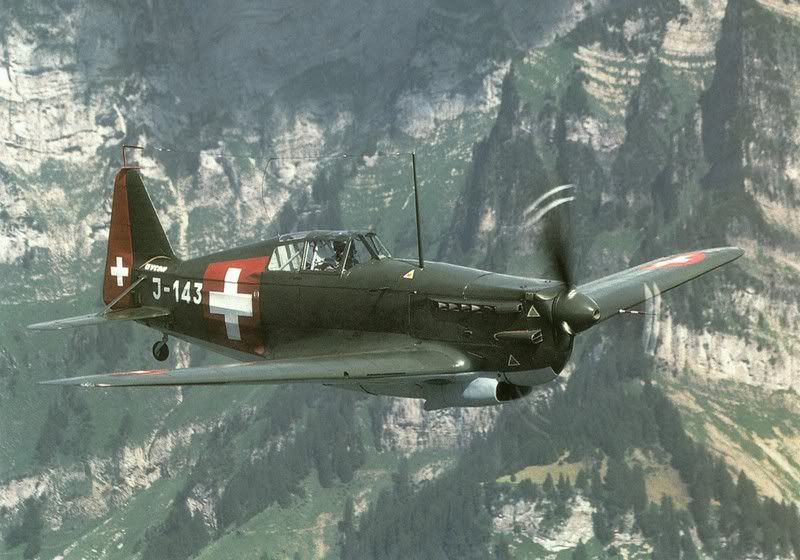
It is easy to forget the rapid pace of military aviaton development in the 1930s. It's often overlooked that the environment was very different in 1939 to what we saw in 1945, and what seems 'normal' in '45 was radical to a 1930s viewpoint.
JohnTerrell wrote:
The Hawker Hurricane, early to mid/late model Spitfires and almost all Bf-109s.
The Spitfire and Hurricane are actually interesting stories. The prototype Spitfire was originally fitted, like all good aircraft of the time, with a tail
skid and skids made sense as they acted as landing brakes to slow aircraft automatically on landing - remember most airfields everywhere were grass. Good RAF pilots three-pointed their aircraft so they landed short, using what would now be regarded as small (circular) grass airfields.


A tailwheel was soon specified for production aircraft (probably as soon as someone tried to push the a/c anywhere) and the retractable tailwheel improvement came in on the Spitfire Mk.VIII. The Mk.IX took the Mk.V structure with the two-stage Merlin, but kept the fixed tailwheel of the Mk.V.
The Hurricane was designed and built with a retractable tailwheel! (Not many people know that.)

However, as bdk's mentioned it gave endless trouble, and eventually, the prototype's tailwheel was fixed down.
Spin trials showed the Hurricane needed some ventral keel area at the tail, so a ventral fin was added to the early production Hurricanes, going some way to mask the now fixed tailwheel from some of the airflow; the tailwheel's keel effect being more useful, I suspect, than a couple of mph retracted.

(Other British types with retractable tailwheels that didn't work properly and were fixed down in frontline service, either permanently or temporarily, included the original Bristol Blenheim, Short Stirling, Avro Manchester / Lancaster and Handley Page Halifax, IIRC. That's short version of a complex topic)
Cheers,
(Pics from var websites...)


 Login
Login Register
 FAQ
FAQ Search