Warbird Information Exchange

DISCLAIMER: The views expressed on this site are the responsibility of the poster and do not reflect the views of the management.
It is currently Sat Jan 17, 2026 1:05 pm

All times are UTC - 5 hours


Classic Wings Magazine WWII Naval Aviation Research Pacific Luftwaffe Resource Center
When Hollywood Ruled The Skies - Volumes 1 through 4 by Bruce Oriss


Post new topic Reply to topic  [ 41 posts ]  Go to page Previous  1, 2, 3
Author Message
PostPosted: Wed Dec 02, 2009 10:48 pm 
Offline
2000+ Post Club
2000+ Post Club
User avatar

Joined: Sun Jul 31, 2005 7:28 pm
Posts: 2184
Location: Waukesha, WI
If I can stick my ugly nose in here for a moment, this discussion seems to revolve around an assumption that current fuel has deficiencies that could harm the durability of very expensive engines. One aspect of this fuel discussion seems missing. Regardless of the "standard" from the refinery for chemical content, octane rating, purity, color, etc., have you ever seen the wankers that handle and deliver this fuel? What controls are in place to maintain the purity from the refinery? Clean tanker trucks? Water in underground storage tanks? Other impurities gathered along the way? We have no control over that delivery stream. We look for color, water, and floating debris.

I can tell you of a time at Indy when our "pure" methanol was delivered in a tanker (compartmentalized to prevent slosh while driving) that added a compartment full of dry cleaning fluid not drained off from a prior load before to delivering it to the Speedway. Shall I tell you of the race teams that had interesting engine failures from that?

My point is, boiled down, the goal seems to be to protect the engines. Aside from Jack's dyno room and the ultimate controls he has in the test environment, we live in the real world. So I think that Vlado's approach, throw a bit more fuel at it and know you are safe is probably the most practical approach. No one is flying for endurance and fuel economy. Why take the chance even if you analyze each load of fuel for chemical purity? Couple extra bucks seem inconsequential.

_________________
"There are old pilots and bold pilots but few old, bold pilots."


Top
 Profile  
 
PostPosted: Thu Dec 03, 2009 7:33 am 
Offline

Joined: Sun Dec 12, 2004 7:27 pm
Posts: 264
Location: Indiantown, FL
Bill,

So todays 100LL is equivalent to which version of 100/130???

Image

The point is that their are claims that the fuel of today is exactly the same as the "old fuel".

Apparently, the "old fuel" wasn't the same as the "old fuel"!

So how does that work?


Top
 Profile  
 
PostPosted: Thu Dec 03, 2009 10:47 am 
Offline
Probationary Member

Joined: Wed Jun 21, 2006 7:53 pm
Posts: 3803
Location: Aspen, CO
Glen, if you have a fuel question, I am not the expert to ask on that. I don't see much relevance in a 1949 military order abut fuel leaking has to do with the subject of this topic, which was how you operate a V-12, (even though guys have come in with 4360 info also). Are you claiming now that 100 LL leaks more than the old 100? That is one that I have not heard in my 30 years in aviation. None of the warbird meetings or the P-51 seminars that we attend have ever brought that up as far as I know. I do know of reports that talk about 25w-60w oil being more prone to leaking as it seems to be, but not fuel.

And if fuel leakage is a problem, how would operation, that is running a Merlin at higher rpm and/or richer mixture help such leakage? Certainly if there is any fuel leaking near the engine it would be a safety item and should not be flown at all , whether high or low rpm.

Asking me about old fuel warnings, is probably not the best source, but you could try getting such info from Shell or Texaco or whoever makes 100 ll. When I have time, I'd like to talk to the producers also.

PS, maybe it's all Al Gore's fault.

_________________
Bill Greenwood
Spitfire N308WK


Top
 Profile  
 
PostPosted: Thu Dec 03, 2009 11:18 am 
Offline

Joined: Sun Dec 12, 2004 7:27 pm
Posts: 264
Location: Indiantown, FL
You completely missed the point!

It has nothing to do with leaking.

The fuel back then apparently had a variation of up to 30% in the aeromatic content or they would not have sent out a bulletin, which indicates that it was not consistent from batch to batch.

If todays 100LL is claimed to be the same as 100/130, what is it they are supposedly matching? Is it 0% or 30%, or somewhere in between in aeromatic content? We already know the lead content differs.


Last edited by Glenn Wegman on Fri Dec 04, 2009 5:51 am, edited 1 time in total.

Top
 Profile  
 
PostPosted: Thu Dec 03, 2009 2:04 pm 
Offline
Probationary Member

Joined: Wed Jun 21, 2006 7:53 pm
Posts: 3803
Location: Aspen, CO
Glen, I am not seeing the same point as you:
1st, your 1949 tech order has only one sentence about the 30% variation in aromatics. THE ENTIRE REST OF THE PAGE IS ABOUT THE LEAKS FROM THIS.
2nd, Even with a 30% variation, the only negative point was leakage, NOTHNING ABOUT ENGINES NOT RUNNING AS WELL.
3RD We can assume that the engines of 1949 ran just fine, even with the 30% variation that might occcur.
4th, This 30% variation was not in octane, there is nothing to indicate that the engines might suffer detonation, from the variation, and SURE NOTHING THAT SAYS TO INCREASE RPM TO MAKE THE ENGINE SAFE. I am not much of a chemical or petroleum expert to know what, OTHER THAN LEAKAGE, the 30% variation in aromatics means.
So, if the engines ran fine in 1949, even with a known possible variation, why is it that you assume that engines now would run badly if there was such a variation? Now, as far as I know we don't have any problem with leakage of avgas, so maybe, probably, we no longer have this variation.
5TH BUT IF WE DO HAVE SUCH A VARIATION, THEN THE ENGINE SHOULD RUN AS GOOD AS IN 1949, AND NO WHERE DOES IT SAY MORE RPM IN CRUISE SOLVES ANY PROBLEM.

So, I guess I don't see your point, other than maybe, just maybe, the fuel today has some variation and maybe, just maybe, that variation is harmful to engines, like detonation, and if so maybe if all that is true, then using more rpm even in slow cruise might, just might help the engine, even if LOW BOOST LOW RPM CRUISE, is not very demanding on the engine or on octane and should NOT risk detonation anyway.
But then again, maybe, just maybe,it might, I guess.

_________________
Bill Greenwood
Spitfire N308WK


Top
 Profile  
 
PostPosted: Fri Dec 04, 2009 12:16 pm 
Offline
1000+ Posts!
1000+ Posts!
User avatar

Joined: Sun Feb 18, 2007 12:39 pm
Posts: 1817
Location: Irving, Texas
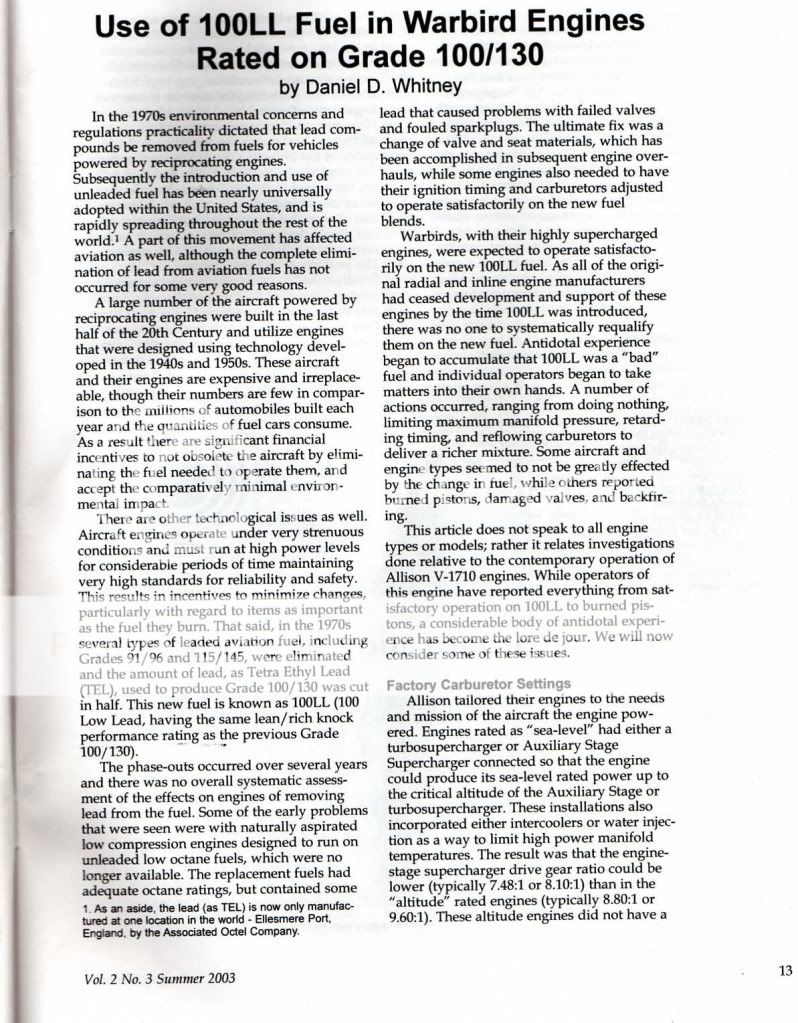
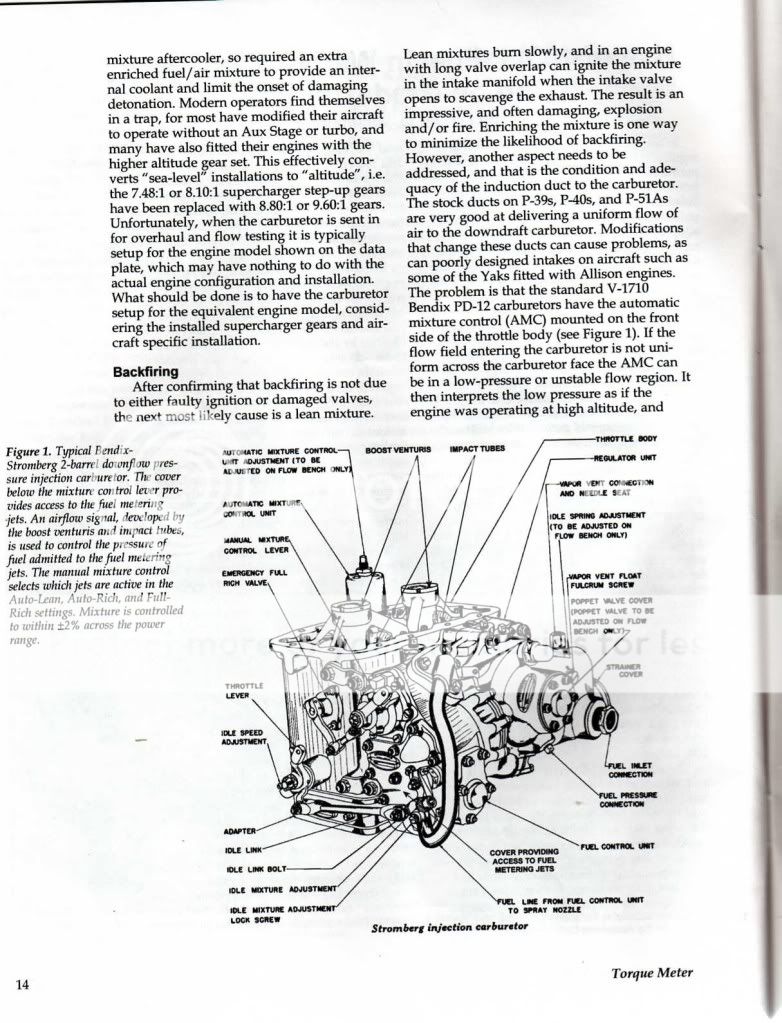
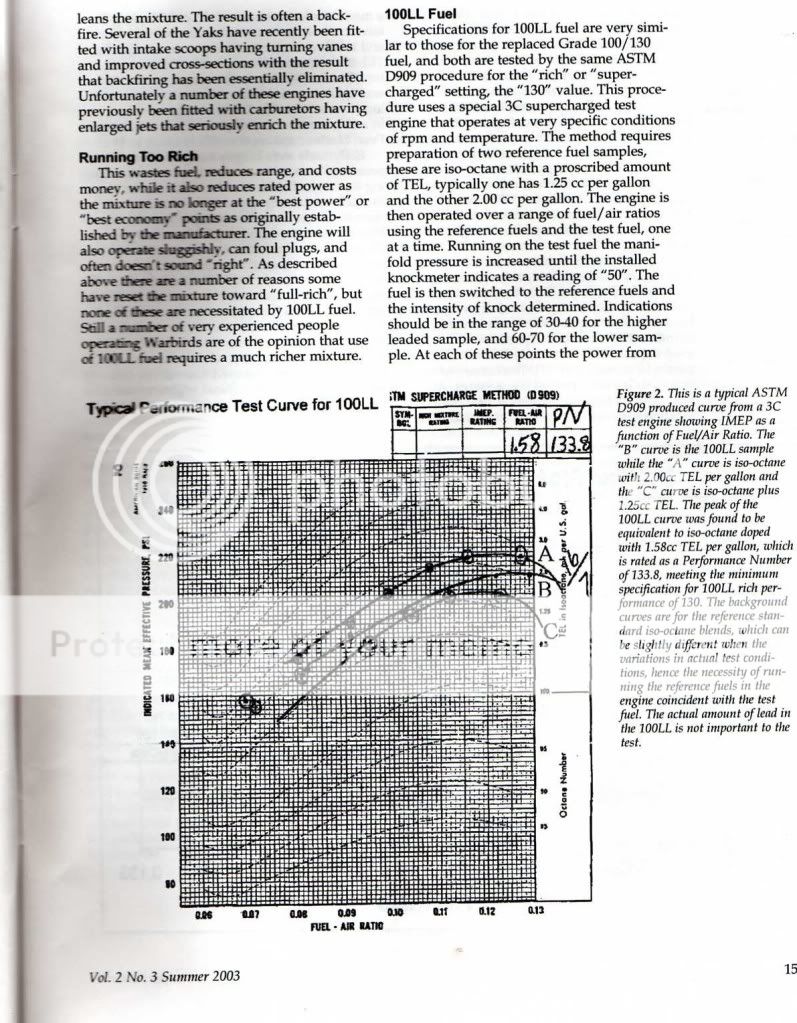
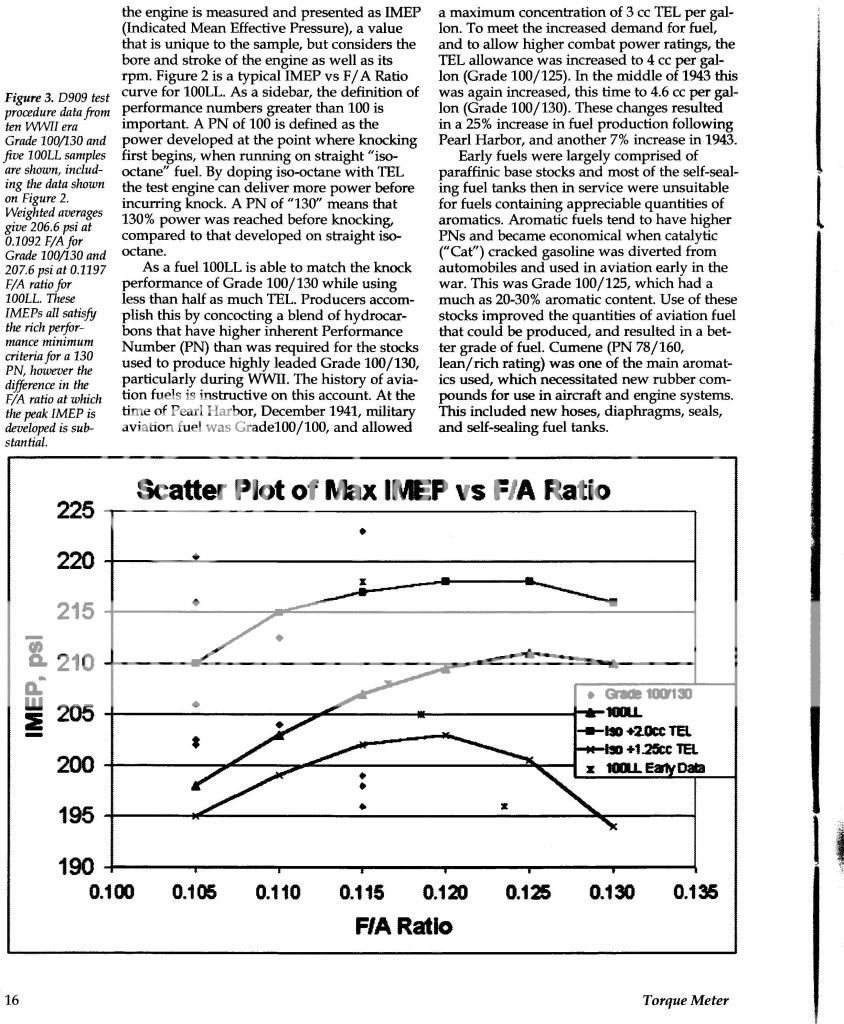
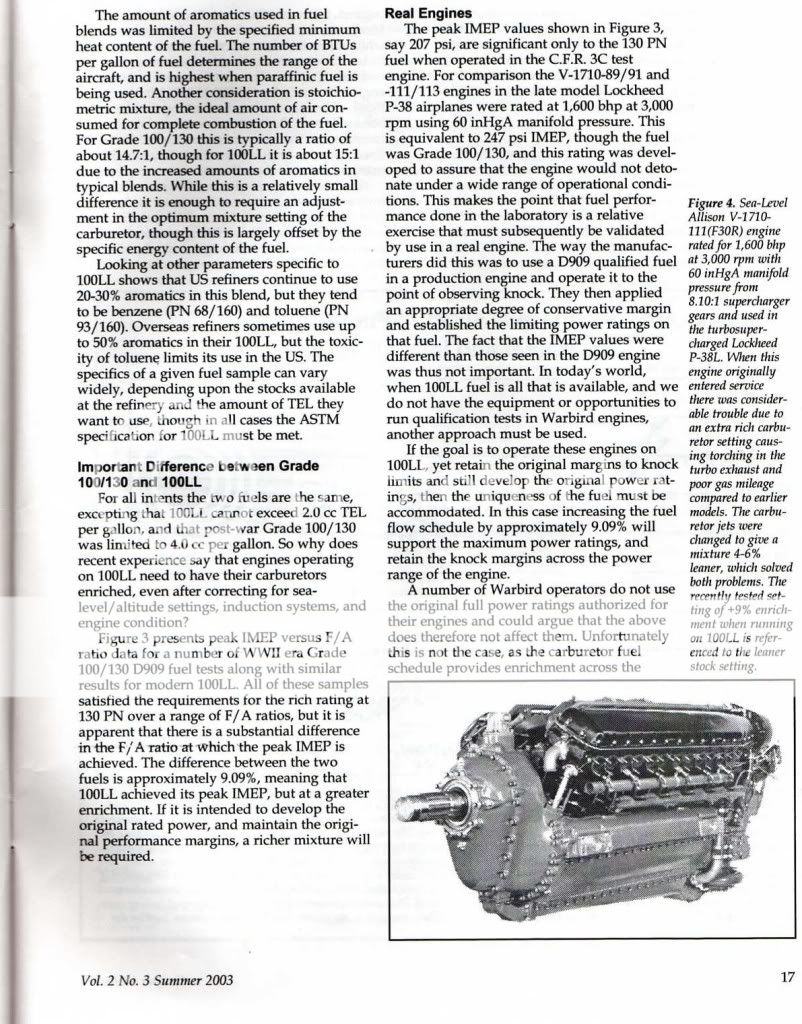
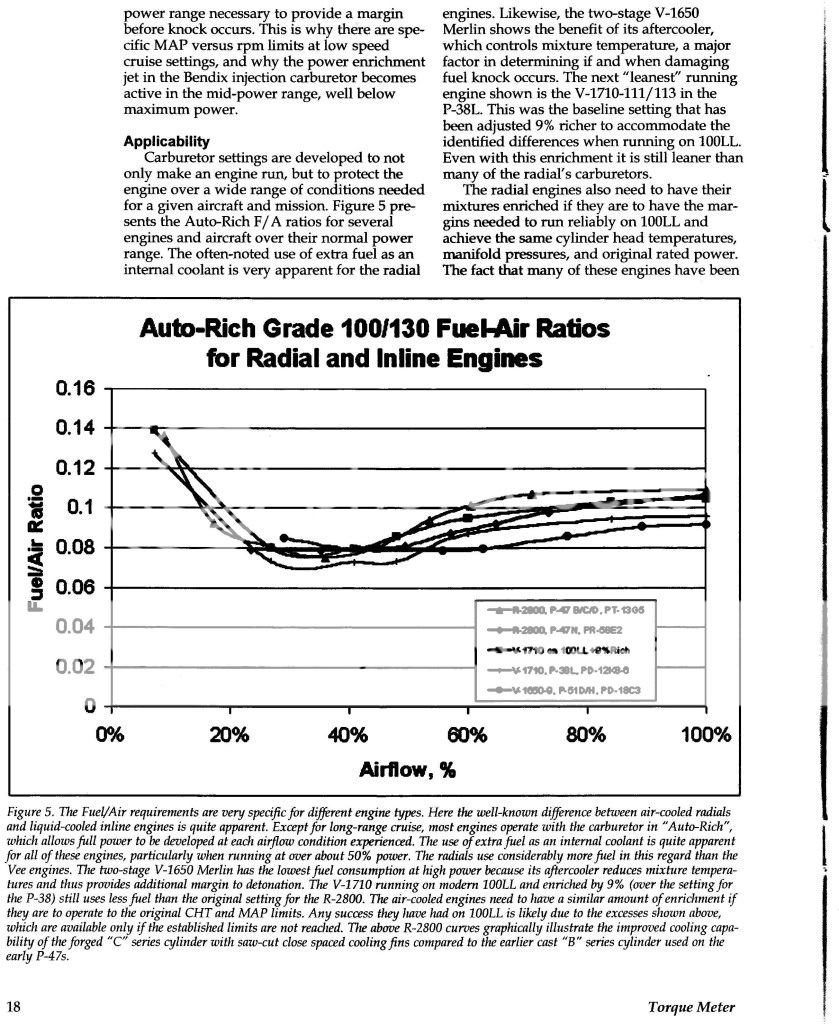
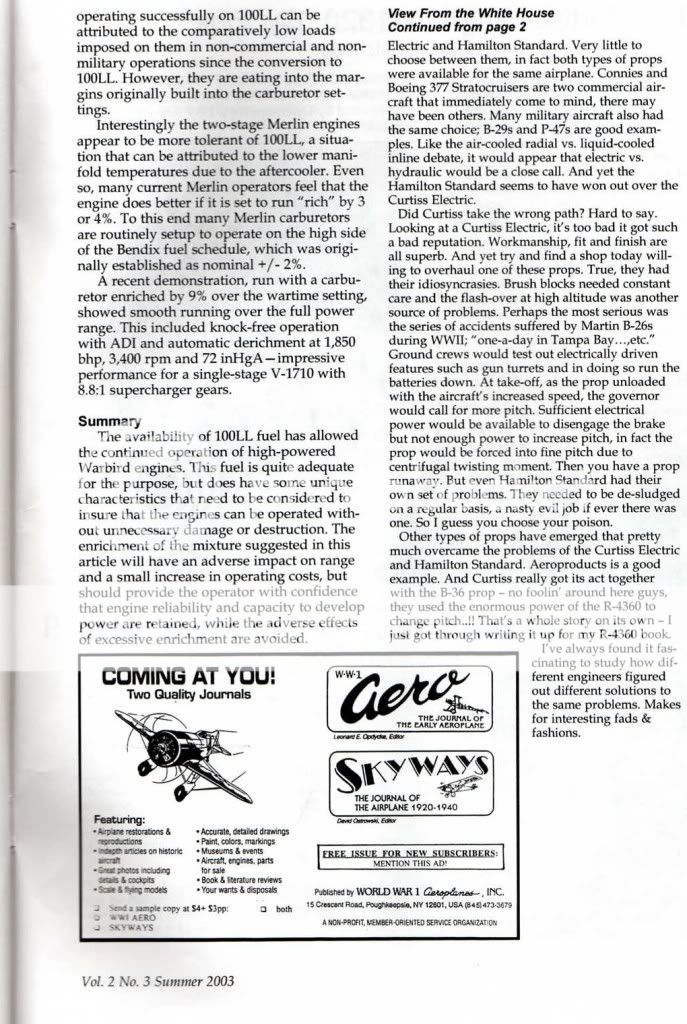
Here is the article about the use of 100LL in warbirds. It is taken from the Aircraft Engine Historical Society newsletter.

Image
Image
Image
Image
Image
Image
Image


Top
 Profile  
 
PostPosted: Fri Dec 04, 2009 1:08 pm 
Offline
Probationary Member

Joined: Wed Jun 21, 2006 7:53 pm
Posts: 3803
Location: Aspen, CO
B-29, Very interesting, and somewhat complicated.
A quick scan brought out this phrase, "the two stage Merlins seem to be most tolerant of running on 100ll". It appears that much of the problems are with the Allison, not Merlins.

I did not realize that we had 100ll in 1970s , can that be true.? I do recall that when I started flying back in 1978 we had all 3 grades of fuel, reg, a med grade and 100 octane. Thus red was too low, green was good, blue was better, for normal airplanes, I did not start Merlins until 1983.

So there may be something to what all the experts are saying.

BUT A BIG HOWEVER: 1st. this article is really focusing on protecting engines at full power type use, not operating at low boost and low rpm economy cruise, say 1800 and 30 in my plane or perhaps 2000 rpm and 34 in in a P-51.
2nd. The "cure" in this paper ,is to set the carb perhaps 3% to 9% richer or at least make sure that it is set at the upper, (richer) end of the specified range. If this is the practice in the 1970s then perhaps my carb which was part of my Jack Hovey overhaul about 1990 is set to the proper range, and is not super lean.

To summarize my point, is slightly richer carbs for 100 ll, maybe and probably.
Running more rpm even in economy cruise: not proven and probably not needed.

Lastly, we might like to know if 100ll in 2009, is the same as the fuel of this article in the 70s?

Good info, here, anyway, and I am glad that Spitfires are automatic as to mixture and I don't have to fiddle or worry aboutit over the last 26 years. The only fiddling of this type I have done is to adjust the idle speed and mixture with the tow screws on the outside of the carb for ground running, to make it idle nice and slow and smooth.
3rd. Much of our discussion, has been not just mixture settings on 100ll. but the idea that this new fuel requires you to run rpm 50 to 100 rpm richer in LOW POWER CRUISE. This is not in this article and is the part of the new ideology that seems unproven at best to me. I don't see much risk of detonation at these low power settings on 100 ll.

_________________
Bill Greenwood
Spitfire N308WK


Top
 Profile  
 
PostPosted: Fri Dec 04, 2009 1:24 pm 
Offline
1000+ Posts!
1000+ Posts!
User avatar

Joined: Sun Feb 18, 2007 12:39 pm
Posts: 1817
Location: Irving, Texas
Bill, I started pumping Avgas in 1974, I remember 100LL comming out about 1978. I think what warbird operators need to do is check with their carb shops and ensure your carbs are set up correctly, then I don't think you should have any problems and can use any power setting as listed in your flight manual. The problem of detonation is mostly confined to the high power settings, high RPM/MAP or at low RPM high MAP.

John


Top
 Profile  
 
PostPosted: Fri Dec 04, 2009 1:28 pm 
Offline
1000+ Posts!
1000+ Posts!
User avatar

Joined: Fri Nov 12, 2004 8:51 pm
Posts: 1068
Location: Illinois, USA
I think that for the very low power operations, all the previous discussins could be disregarded.
For normal operations above 33", the previous considerations are very valid.
VL


Top
 Profile  
 
PostPosted: Fri Dec 04, 2009 1:40 pm 
Offline
Probationary Member

Joined: Wed Jun 21, 2006 7:53 pm
Posts: 3803
Location: Aspen, CO
Vlado we just set a record on 6* below zero Wed night in Aspen. If we need any current test flights done on fuel/rpm plots can we call you? Things are beautiful here now, but it is COLD, kind of all of a sudden. I flew from ASE to BDU yesterday with the cockpit heat on full.

By the way, no self respecting Mustang pilot would ever cruise at 33inches, unless they were in formation and polite enough to wait for a Spitfire that has only 108 gal of fuel.

Nobody buys a Mustang to go slow, and what's the point of having one if you can't blow past a few T-28s between the Fon du Lac and the Island!

_________________
Bill Greenwood
Spitfire N308WK


Top
 Profile  
 
PostPosted: Fri Dec 04, 2009 6:43 pm 
Offline
1000+ Posts!
1000+ Posts!

Joined: Sun Sep 17, 2006 10:31 pm
Posts: 1672
I use Auto-Lean on the Allison V-1710-81A on the VWoC P-40 after it settles down and if the workload is low. Nothing beyond Auto-Lean. The engine re-builder and all the books recommend it. I want the temps up enough in the cylinders to keep the lead going out the exhaust valves, and the burnt-oil residue as well. I don't want things coking-up.

As for settings, heck yes. It's not a Lycoming. A low-power cruise setting on an Allison is about 25" and 1800 RPM, Auto-Lean. Nothing wrong with that. Decent cruise speed (over 200 mph) and fuel burn back about 35 US Gal/hr -- all to the good.

We have no EGTs -- just a single CHT. (Yes, there's a certain amount of trust involved.)

You also want to feel the airplane, and avoid an RPM that gives a harmonic, or similar odd noise.

I've commented to friends in the past that as far as the small aircraft engines go, 100 Low Lead should be re-named 100 Lotta Lead. It's great at high power in engines where settings make detonation a factor -- not so good in the little ones.

I don't want all that lead in the Warner in my Fairchild. I'd like to keep the exhaust valves seating. (It's rated on 73 octane.) I generally mix 100 LL with Shell 91, which is promoted (yeah, I know, they're probably lying) as having no ethanol in it.

Dave


Top
 Profile  
 
Display posts from previous:  Sort by  
Post new topic Reply to topic  [ 41 posts ]  Go to page Previous  1, 2, 3

All times are UTC - 5 hours


Who is online

Users browsing this forum: Google [Bot] and 217 guests


You cannot post new topics in this forum
You cannot reply to topics in this forum
You cannot edit your posts in this forum
You cannot delete your posts in this forum
You cannot post attachments in this forum

Search for:
Jump to:  
Powered by phpBB® Forum Software © phpBB Group