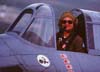
The first story linking the Corsair to the "whistling death" nickname appears in mid-October 1943 in an article about VMF-124 returning to San Diego:
Cincinnati Enquirer wrote:
The Japanese called the plane "whisling death" because it made a terrifying whistling sound that match its deadly performance.
(Source:
Newspapers.com)
The story resurfaces in an article from April 1944, which describes how another squadron (VMF-113, not identified as such in the article) named itself the "Whistling Devils" in reference to the moniker:
Daily American Republic wrote:
Somewhere in the Marshall Island [sic] (Delayed) - The Japanese already call Corsair fighter plans "Whistling Death," but now they have got something new to worry about out here - the "Whistling Devils."
(Source:
Newspapers.com)
As if to further underline its propaganda value, the story appears under the note that it was "written by Captain Ellis M. Trefethen [...] a Marine Corps Public Relations Officers [
sic]".
However, a quick search of Newspapers.com reveals "whistling death" was already in use in an aerial warfare context years before VMF-124 was departed for the Solomons, being used to describe bombings by the Japanese near Canton, the Nationalists in Barcelona and the Nazis in London in March 1938, July 1938 and September 1940, respectively.
[1][2][3]Furthermore, the date range slider shows that the term was quite popular as early as the late 1800s. Until the Corsair came along, it was associated with whizzing bullets and howling artillery shells in anecdotes about both the American Civil and First World Wars.
[4][5] There were apparently also claims during the latter that a "death whistle" - actually a single shot pistol - was used by the Germans to mercy kill their own wounded soldiers.
[6]Yet, what is perhaps most interesting, is an article from 1937 about how Australian Aboriginal "witch doctors" can use a "death whistle" to kill their targets by suggestion.
[7] Given its close geographic proximity to the battles of the southwest Pacific and the amount of Americans stationed there, it would not be unreasonable to assume that the phrase somehow made its way from the land down under to Guadalcanal. It is even more fascinating when you realize that the unit that was operating the Beaufighter when it was given the nickname "Whispering Death" under similar circumstances (i.e. supposedly by the Japanese) was 224 Group - an Australian squadron.
[8] Further supporting this is the fact that Australians were well known to appropriate Aboriginal names, such as Boomerang and Wirraway, for their aircraft.
_________________
Tri-State Warbird Museum Collections Manager & Museum Attendant
Warbird Philosophy Webmaster


 Login
Login Register
 FAQ
FAQ Search