This is the place where the majority of the warbird (aircraft that have survived military service) discussions will take place. Specialized forums may be added in the new future
Post a reply

prop & engine controls: constant speed vs variable pitch?

Wed Dec 30, 2009 2:46 am

howdy all

I have to admit that despite reading about airplanes since I could read, I am somewhat in the dark about how the prop and engine controls work. I can understand how, for example, and early Spitfire with a 2-pitch prop works; you have a throttle, and two settings on the blades, one for low-speed and one for higher speed, kinda like the 2spd automatic in my friend's early 60's Chevy (ah, except not automatic). But when you get into constant-speed props I get a bit confused; does the pilot set the prop speed, then the prop automatically adjusts the blades to keep them in the proper pitch range to maintain the selected prop speed? If so, how does the pilot know what speed to set the prop? And what happens if the throttle needs to be advanced or retarded to keep the engine rpm in the right range? I probably got a bunch of stuff wrong there...

Also, I understand that the '109 and '190 (and I guess some other German types as well) had a mechanical computer that took a bunch of these functions and linked them together, easing the pilot load.

Anyways, any (easy to understand) info most appreciated!

cheers

greg v.

P.S. next time someone can enlighten me on what the heck the purpose of 'swinging the compass" is.....

Re: prop & engine controls: constant speed vs variable pitch?

Wed Dec 30, 2009 5:58 am

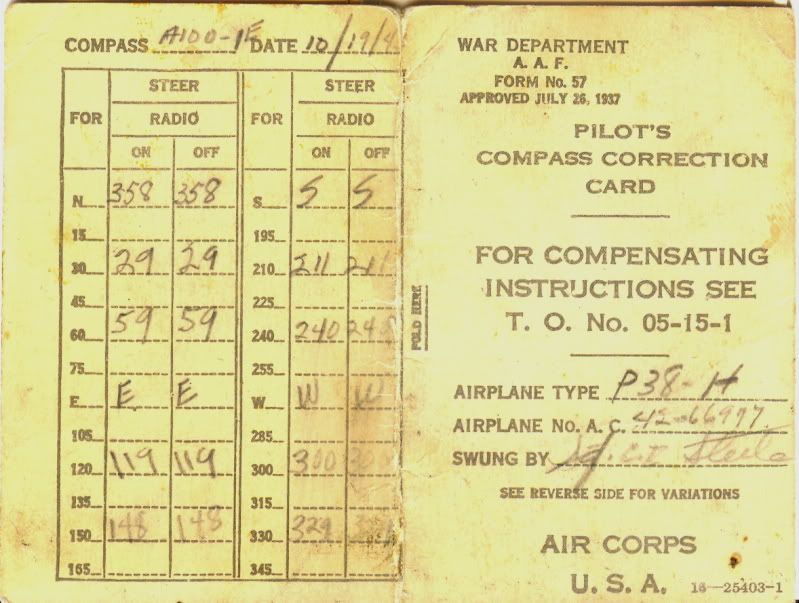
Swinging the compass- this applies to any compass attached to any vehicle- boat, ship, aeroplane, car etc. The machine is rotated on the spot and the variation between the true heading and the heading shown on the compass is noted for the 360 dgrees. This variation is then placed on a card so that for any given compass reading the true heading can be determined. Many compasses do have small magnets that can adjust some of the variations out, which are caused by the inevitable inteferences in the magnetic field casued by large lumps of metal in the compass's vicinity

Re: prop & engine controls: constant speed vs variable pitch?

Wed Dec 30, 2009 9:26 am

Constant speed is what it states, variable speed is a two speed propeller. The engine has a propeller governor on it which keeps the prop (engine) rpm at what the pilot set. The engine is started in low pitch/high rpm and controlled with the throttle. Once airborne the pilot will adjust the throttle to the correct manifold pressure then set the correct rpm with the prop control. the governor will keep the engine/prop at the set rpm regardless of throttle position. The two position prop has a high and low pitch setting, takeoff is done with low pitch/high rpm and cruise flight with high pitch/low rpm. The rpm will vary when the airplane is climbing or diving and the rpm is controlled with the throttle. Compare it to driving a stick shift car.

Re: prop & engine controls: constant speed vs variable pitch?

Wed Dec 30, 2009 10:03 am

From what I have read about the two position propellers on the early Spitfire, there were quite a few prangs due to the pilots not being able to get their heads around the low pitch/high rpm and high pitch/low rpm concept and consequently trying to take off in high pitch. The aeroplane would not accelerate to flying speed before running out of airfield. IIRC most Spitfires with two postion "airscrews" (gotta love the quaint pommy terms :lol: ) were converted to Constant Speed as CSU's became available.
Compass swinging - I've done a few - you usually check the main quadrants first, ie North, East, South and West, to see how bad the error is and correct as required via the adjusting screws. Note that the adjustment should be done with a non magnetic (usually brass) screw driver (for American) or key (for Pommy compasses). You then postion the aircraft with the engine running at each 10 degree heading and note the variation down and it should be within +or- 5 degrees. These compass readings should also be checked with the radios turned off and on. The readings are then filled out on the compass correction card for the pilot to use. Compass swinging becomes sporting with liquid cooled engines that overheat on the ground pretty quickly, especially when not faced into wind or with aeroplanes like the Avenger, that doesn't have a park brake and my poor legs feel like jelly at the end. :)

Re: prop & engine controls: constant speed vs variable pitch?

Wed Dec 30, 2009 12:17 pm

Greg v you basically have it correct.
A constant speed prop is sort of like an automatic transmission in a car, if you put the car in drive and went up a hill with the gas pedal down, then trans would shift into low gear, high rpm to let the engine rev up to make power and not lug. Over the crest when you went downhill, it would shift into high gear, low rpm so the engine loafs and is quieter and with less wear.

I have never flow a plane with a prop that had only two settings.

Any of the current Spitfires, really from very early in the war on, had constant speed props. They obtain the constant engine speed by varing the angle of the prop blades so that the engine runs at the set speed even as the load changes from climb to cruise or dive. Instead of just two settings,there are many. There was another type on some Spits, where the prop could also be set geared to the throttle, I have never seen one, and don't need to confuse anyone here.

The pilot knows what rpm is desired by the pilot manual as well as general practice.
The pilot sets the prop lever to give the rpm he wants, the constant speed unit in the prop shaft and hub changes the blade angle or bite. You want full rpm, low pitch, for takeoff and for the final stage of landing. You have 3000 rpm on takeoff, and they used 2850,and 12 lbs boost of combat type climb. At light weights for me, I climb at 2650 or even 2400, and 7lbs max boost. You still get over 2000 feet per min even coming out of 10,000 feet.
At cruise , you reduce the prop setting for less rpm, book gives anywhere from 1800 to 2400. This gives MUCH better fuel economy and less wear on the engine, still good speed. This is like pedaling your bike in high gear on level ground, if you used low gear you'd be spinning away and not getting much.
Same for descent , use lower rpm and let the prop pull you, with high pitch.
All out climb or combat might call for full rpm, low pitch at high power again
.
I have read of Brit pilots trying to take off in the wrong setting, that is low rpm, high angle and high pitch. I don't think it was very many, because most of them would have trained first in a Harvard and learned about this before the Spit or Hurri. Also the Brits got constant speed props early, I'll go look this up.
I could not find the reference yet, but my guess is that constant speed came into use by the summer of 1940. I think that was the MK Ia, but I am not sure.

Both Spit, Huri, P-51, etc. work the same, and the prop blade angle change is by engine oil pressure. There are some planes, maybe P-40? that did the change by electrics.
Last edited by Bill Greenwood on Wed Dec 30, 2009 1:58 pm, edited 6 times in total.

Re: prop & engine controls: constant speed vs variable pitch?

Wed Dec 30, 2009 12:30 pm

The engine is started in low pitch/high rpm and controlled with the throttle

With the T-6s and up motored Stearmans I've been around it was just the opposite. Prior to shutdown you run the power up to 1600 rpm and then put the prop in high pitch (low RPM) and run for 1 minutes prior to shutdown to scavenge the oil. If you don't when you start up the prop is getting the oil the engine needs for lubrication.

Re: prop & engine controls: constant speed vs variable pitch?

Wed Dec 30, 2009 12:46 pm

Prior to shutdown you run the power up to 1600 rpm and then put the prop in high pitch (low RPM) and run for 1 minutes prior to shutdown to scavenge the oil. If you don't when you start up the prop is getting the oil the engine needs for lubrication.

That's one of the foibles of the so called counterweight or bracket propellers. Putting the propeller control into coarse before shutdown also protects the piston by retracting the "dome".

Re: prop & engine controls: constant speed vs variable pitch?

Wed Dec 30, 2009 3:00 pm

I use to fly a two speed Ham Standard on a BT-13. Once airborne, you throttled back and pulled the prop lever back and the prop shifted to high pitch. It stayed in that pitch and it acted as a high pitch, fixed pitch prop. On short final you shifted to low pitch and once the rpm dropped to a certain point, the prop shifted to low pitch. In other words, a two speed prop is like having two props available, either a "takeoff" prop or a "cruise" prop. Simple...

Re: prop & engine controls: constant speed vs variable pitch?

Wed Dec 30, 2009 4:06 pm

hey guys

thanks for all the answers, I think I have it figured out now....mostly.

So in a combat situation would a pilot have to jockey both the throttle and prop controls? Sounds like a lot to keep track of, on top of flying & staying alive, never mind trying to hit something that's trying its best to get away from you. Oh and navigating. Then there's the mixture controls too I guess. Oh and fuel management.... and the radio... any ignition advance/retard controls in there, or was that automatic by then?

thanks!

greg v.

Re: prop & engine controls: constant speed vs variable pitch?

Wed Dec 30, 2009 6:08 pm

Greg, Spitfire mixture control is automatic, there isn't even a lever for it, there's nothing to set or worrry about, the carb automatically puts it in lean or rich mixture depending on how much boost, (throttle) you use. P-51 has a mixture control, they probably put it in auto rich going into combat.
As for prop pitch , going into combat you would likely put it about 2850 rpm, so you'd have good engine power and good throttle response, if you needed full speed and power you just push both (or all 3) levers full forward. It does not take any big management, just vary the throttle if you need to go fast or slow down.
I have never flown in combat, and my simulated ones were pretty much hard turns and climbs at constant power. But I do know that a pilot would be throwing the plane around with stick and rudder, to stay on the target or to shake off pursuit. Maybe snap the throttle closed as a surprise, but mostly he would not want to lose momentum. Some of it might be strenghts of different types. Let's say a P-40 or P-38 against a Zero, the P-40 can't turn with the Zero,it is foolish to get slow, his chance is to keep speed and maybe dive away, or the 38 make a high speed climb. The opposite would be a Spitfire attacked by a Me 262. No way to outrun it, but it if you can get the jet to follow you and down below 300mph,it would be easy to outturn.

There are folks now who try to sell airplanes like Cirrus? perhaps, that tout all sort of FADEC and other gadgets so that the plane had only one lever, a throttle, for control and the gizmo is supposed to do the prop and/or mixture for the pilot. Frankly, it has not caught on in the market and I don't see much real value in it.
In the real world, lets say I am flying to Oskhosh in my Spit. I start and take off in full prop rpm . I pull it back a little for climb, then when I level off, I pull it back once more for cruise. Then I may leave it there to descend, only reducing the throttle, and on final putting the prop full forward. So in a couple of hours, I have moved the prop about 3 times,and the throttle about 4 times. Not a big load. If I had mixture like in a Bonanza, I would take off rich, lean once for cruise and richen for short final.
Last edited by Bill Greenwood on Wed Dec 30, 2009 6:51 pm, edited 3 times in total.

Re: prop & engine controls: constant speed vs variable pitch?

Wed Dec 30, 2009 6:37 pm

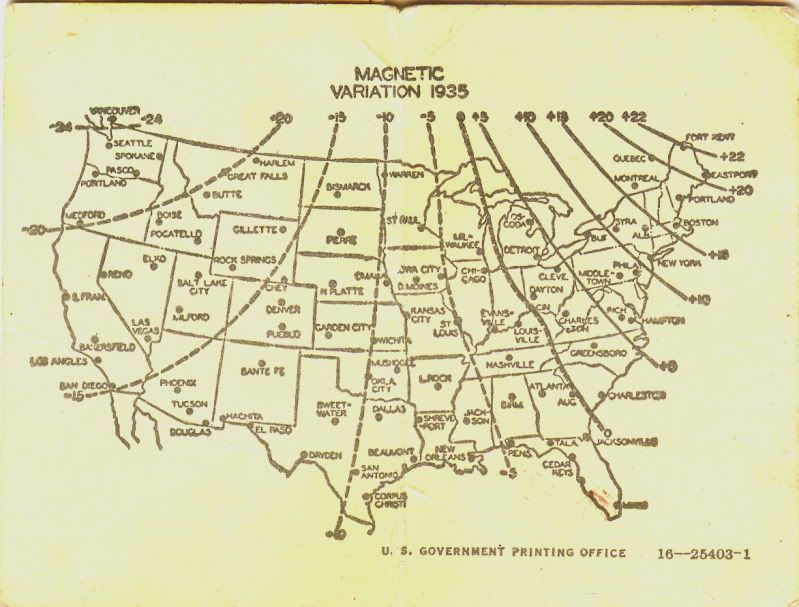
Compass Correction Card for P-38H 42-66977.

Image

Image

Mike

Re: prop & engine controls: constant speed vs variable pitch?

Wed Dec 30, 2009 9:42 pm

gregv wrote:hey guys

thanks for all the answers, I think I have it figured out now....mostly.

So in a combat situation would a pilot have to jockey both the throttle and prop controls? Sounds like a lot to keep track of, on top of flying & staying alive, never mind trying to hit something that's trying its best to get away from you. Oh and navigating. Then there's the mixture controls too I guess. Oh and fuel management.... and the radio... any ignition advance/retard controls in there, or was that automatic by then?

thanks!

greg v.


In combat (dog fight, etc.), the pilot would push all the engine/prop controls forward ("balls to the wall") and just use the throttle for power control. See the combat power question thread, viewtopic.php?f=3&t=33911

There wasn't any spark advance at that time.

Re: prop & engine controls: constant speed vs variable pitch?

Thu Dec 31, 2009 1:14 am

mightyauster wrote:
Prior to shutdown you run the power up to 1600 rpm and then put the prop in high pitch (low RPM) and run for 1 minutes prior to shutdown to scavenge the oil. If you don't when you start up the prop is getting the oil the engine needs for lubrication.

That's one of the foibles of the so called counterweight or bracket propellers. Putting the propeller control into coarse before shutdown also protects the piston by retracting the "dome".
Besides protecting the piston (not so important, but not a bad idea), you are moving the oil out of the prop cylinder and into the oil tank (once it gets scavenged which is why you run for a minute- otherwise it should already be scavenged). Otherwise when you check the oil you will get an erroneous oil level reading and could overfill the tank.
Post a reply