Japanese ace
Fri Jan 16, 2009 6:14 am
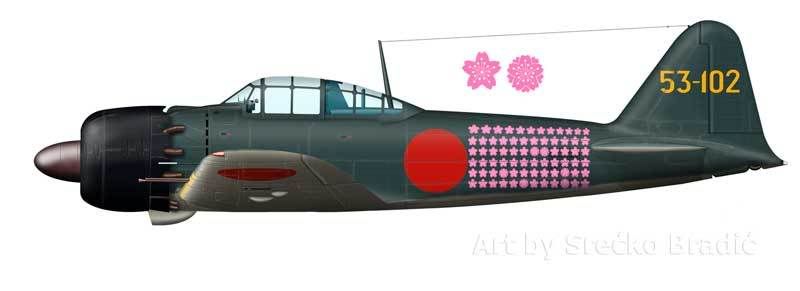
To be honest I don't know anything about this machine and maybe some of you have any info?
Fri Jan 16, 2009 7:38 am
That aircraft is featured on Aeromasters Decals "Eagles of the Rising Sun" set. It's the mount of Tetsuo Iwamoto, possibly the Japanese Navy's highest-scoring ace. Your profile shows the plane as an A6M5, but my references say it should be an A6M3..I don't know which is right.
SN
Here's some information on Iwamoto I found online.....
Lieutenant Junior Grade Tetsuz Iwamoto (15 June 1916- 20 May 1955) was virtually the top scoring ace among Imperial Japanese Navy Air Force (IJNAF) fighter pilots. He entered the Imperial Navy in 1934 and completed pilot training in December 1936. His first combat occurred over China in early 1938. He emerged as the top naval ace of the campaign, credited with 14 aerial victories. Subsequently he flew Zeros from the aircraft carrier Zuikaku from December 1941 to May 1942, including at the Battle of the Coral Sea.
In late 1943, Iwamoto's air group was sent to Rabaul, New Britain, resulting in three months of the hardest air combat ever for the Imperial Japanese Navy Air Force against air raids of U.S. and Allied air units.
Subsequent assignments were Truk Atoll in the Carolines and the Philippines, being commissioned an ensign in October 1944. Following evacuation of the Philippines, Iwamoto served in home defense and trained kamikaze pilots.
Like many Japanese veterans, Iwamoto was reported to have fallen into depression after the war. His diary was found after his death, with claims of 202 Allied aircraft destroyed.
As a result of the Japanese use of the British naval system, the IJNAF scoring system was based on the standard the Royal Navy, the Royal Air Force (RAF) adopted since World War I till World War II, different from the scoring system defined by U.S. Navy Air Force and U.S. Marine Air Force during World War II. Dr. Izawa and Professor Hata tried to reckon the figure at about 80 or more than 87 in their research work in Jan. 1971, Dr. Izawa wrote that Iwamoto was virtually the top ace of IJNAF, in Dec. 1993.
As of mid-1944, there remained only two IJNAF fighter pilots who were credited with over 100 victories. Depending on various totals cited, Tetsuz Iwamoto or Hiroyoshi Nishizawa was Japan's best ace. Iwamoto was known as the Chtai leader (Flying Company, Squadron of 8 to 16 fighters). Iwamoto was the few survived successors of the IJNAF airman's heritage, who flew over the Indian and the Pacific Ocean from north to south, showed his skilled fights against the Allied units and trained his young junior pilots even in the last months of the war.
SN
Here's some information on Iwamoto I found online.....
Lieutenant Junior Grade Tetsuz Iwamoto (15 June 1916- 20 May 1955) was virtually the top scoring ace among Imperial Japanese Navy Air Force (IJNAF) fighter pilots. He entered the Imperial Navy in 1934 and completed pilot training in December 1936. His first combat occurred over China in early 1938. He emerged as the top naval ace of the campaign, credited with 14 aerial victories. Subsequently he flew Zeros from the aircraft carrier Zuikaku from December 1941 to May 1942, including at the Battle of the Coral Sea.
In late 1943, Iwamoto's air group was sent to Rabaul, New Britain, resulting in three months of the hardest air combat ever for the Imperial Japanese Navy Air Force against air raids of U.S. and Allied air units.
Subsequent assignments were Truk Atoll in the Carolines and the Philippines, being commissioned an ensign in October 1944. Following evacuation of the Philippines, Iwamoto served in home defense and trained kamikaze pilots.
Like many Japanese veterans, Iwamoto was reported to have fallen into depression after the war. His diary was found after his death, with claims of 202 Allied aircraft destroyed.
As a result of the Japanese use of the British naval system, the IJNAF scoring system was based on the standard the Royal Navy, the Royal Air Force (RAF) adopted since World War I till World War II, different from the scoring system defined by U.S. Navy Air Force and U.S. Marine Air Force during World War II. Dr. Izawa and Professor Hata tried to reckon the figure at about 80 or more than 87 in their research work in Jan. 1971, Dr. Izawa wrote that Iwamoto was virtually the top ace of IJNAF, in Dec. 1993.
As of mid-1944, there remained only two IJNAF fighter pilots who were credited with over 100 victories. Depending on various totals cited, Tetsuz Iwamoto or Hiroyoshi Nishizawa was Japan's best ace. Iwamoto was known as the Chtai leader (Flying Company, Squadron of 8 to 16 fighters). Iwamoto was the few survived successors of the IJNAF airman's heritage, who flew over the Indian and the Pacific Ocean from north to south, showed his skilled fights against the Allied units and trained his young junior pilots even in the last months of the war.
Fri Jan 16, 2009 8:37 am
So this is Tetsuo Iwamoto  Thank you Steve
  I have to ask for more data arround regard to the images of his machine.
Cheers
Thank you Steve I have to ask for more data arround regard to the images of his machine.
Cheers
Fri Jan 16, 2009 10:35 am
Regarding the Japanese "scoring system", my understanding (per Sakai's book) was that the Japanese services did not track individual scores, therefore there was no "scoring system" other than personal records kept by individual pilots. And generally kept quiet by those pilots until after the war, because boasting about kill scores wasn't the norm among Japanese.
August
August
Fri Jan 16, 2009 1:09 pm
In the above profile illustration, there are two shapes used to signify kills. What do these represent? Why are there two different shapes - what do they mean?
Paging David Aiken or Ron Werneth...........
Paging David Aiken or Ron Werneth...........
Fri Jan 16, 2009 3:02 pm
warbird1 wrote:In the above profile illustration, there are two shapes used to signify kills. What do these represent? Why are there two different shapes - what do they mean?
Paging David Aiken or Ron Werneth...........
With apologies to both Mr. Aiken and Mr. Werneth...the suspense is killing me.
The left-hand symbol--the cherry blossom--typically represented a "probable" or "damaged" enemy. The marking on the right--a chrysanthemum--represented a definite kill. But both probable and definites were always a determination made by the pilot, as gun cameras were rarely (if ever) used in combat situations. Also, much variety exists in other forms of victory markings other than the cherry blossom and chrysanthemum.
Also note that victory markings in the Kaigun were typically attributed to the aircraft used in achieving the success rather than the pilot who was doing the flying.
Victory markings for individual successes were never officially sanctioned (and were to discontinue completely by 1943), but it seems the high command would often "look the other way" for the sake of morale.
Last edited by Dan K on Fri Jan 16, 2009 11:03 pm, edited 2 times in total.
Fri Jan 16, 2009 3:08 pm
Thanks, Dan!
Fri Jan 16, 2009 4:10 pm
So where are the Mr. Aiken and Mr. Werneth?
Fri Jan 16, 2009 4:29 pm
I may be mistaken, but this has stirred a memory from the deep, dark nether regions of my mind. Wasn't it the case that a Japanese pilot could not officially claim or display more kills than a higher ranking pilot, no matter how many they had really destroyed ie. a Lieutenant could not claim more than a Captain? I am not sure if this was just the navy, or the army, or both. Perhaps someone could confirm or deny this for me.
Fri Jan 16, 2009 5:09 pm
Mgawa,
I haven't been able to find an actual photograph of Iwamoto's machine. The only other profile I have is from the aforementioned decal instructions. They show the plane as an earlier A6M3, but still with the typical Mitsubishi color demarcation..the border between the green and gray runs along the lower fuselage, rather than sweeping up diagonally from the wing to the horizontal stabilizer, seen on Nakajima-built machines. The decal instructions show the tailcode as simply 3-102, and in white. I'll have to dig deeper into my references to see if I can find out anything more.
SN
I haven't been able to find an actual photograph of Iwamoto's machine. The only other profile I have is from the aforementioned decal instructions. They show the plane as an earlier A6M3, but still with the typical Mitsubishi color demarcation..the border between the green and gray runs along the lower fuselage, rather than sweeping up diagonally from the wing to the horizontal stabilizer, seen on Nakajima-built machines. The decal instructions show the tailcode as simply 3-102, and in white. I'll have to dig deeper into my references to see if I can find out anything more.
SN
Fri Jan 16, 2009 7:39 pm
