Shay wrote:
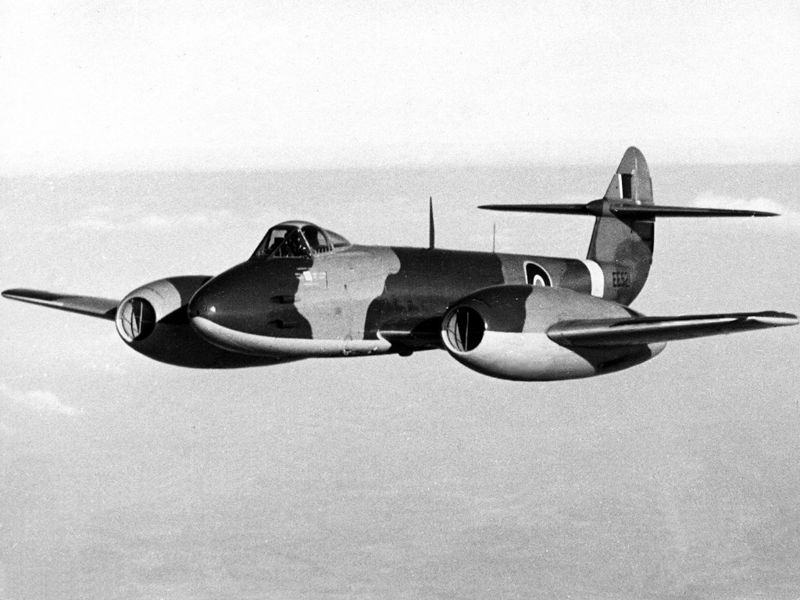
Can someone explain to me why the Gloster Meteor is no more than a footnote in the history of the 2nd World War?
It was onhand days before D-day, seems to me that the Meteor was in the right place at the right time to have contributed even more to the war effort than V-1 interception, armed recon and the few instances of ground interdiction.
I realize that the Meteor was restricted from engaging the Luftwaffe, especially over German-held territory due to intelligence concerns. It just seems odd, to me, to have a potentialy Me262 competitive weapons platform and not take advantage of it. Not to mention the lesser examples of the Luftwaffe.
Can anyone shed any light?
Whew, tough question!
Let's see. First: It was better than the Gloster E28/39 and the Bell Airacomet, both the first jets of the respective nations, both theoretically intended to be front line fighter types when on the drawing board, but in actual performance far too low to fulfil the role with any chance of success. However, the early Meatboxes weren't that good, and they did suffer, as Cripes A Mighty's stated, from poor performance due to the primitive jets.
Second: The British believed that it was hot stuff - too hot to risk losing an example over enemy territory and the dastardly Huns copying it and sending back German copies at us. Rather like the first tanks of W.W.I (We didn't really realise that the Germans were already well ahead.)
Both the Meteor and the Spider Crab (renamed Vampire, an improvement but still as name that ~um~ sucks) were first generation types that improved rapidly in development; the alternative the Gloster E1/44 was a dud.

The Lockheed P-80 was slightly later generation, with a better wing and without some of the early, poor, choices made by Gloster's team. (Remember, in 1940 - 45, we didn't even know what a jet engine really looked like, nor how it was best used.) Successful as the P-80 was, it begat the T-33, one of the greats,
and flown by WIX members, so it's all good.

The Italians went off up an even blinder alley with the Ciampini Caproni CC.1; a piston engine running an afterburner, and
slow.

Incidentally, Gloster did a spiffing sales job on the Meteor, and that's why it was so successful post-war, as well as holding the air speed record, thanks to some dedicated work by the RAF. IIRC, It was Canada, Australia and New Zealand's first jet type, as well as Britain's, the Aussie and Canuckian loaners sent to test cold weather and hot weather conditions. I guess the Kiwi's got one in case they sulked, or to test sheep ingestion risks.
HTH.



 Login
Login Register
 FAQ
FAQ Search