QEC def. ?
Tue Nov 20, 2007 9:34 pm
I'm still on the learning curve in warbirds and working on same. I like learning new stuff and details, details. Would one of you kindly explain the definition of the term QEC to me as it pertains to round engines?
Thanks,
Doug Ratchford, "canso42"
volunteer, Lone Star Flight Museum.
Thanks,
Doug Ratchford, "canso42"
volunteer, Lone Star Flight Museum.
Tue Nov 20, 2007 9:41 pm
Quick Engine Change. 
T
T
Tue Nov 20, 2007 10:01 pm
An engine that is ready to go with the mount and accessories(mags,starter, generator, prop gov. carb, pumps ect...) , some times baffling and cowling, some times on smaller engines the prop.
Tue Nov 20, 2007 10:07 pm
QEC= Quick Engine Change, does not mean changing a engine very quickly,
a QEC is a engine that is built up and ready to install, so when a engine change is required it can be done in the shortest amount of time.
The QEC for the C-119 was complete to the point of being cowled, all that was required was to seperate fluid lines and controls, remove the prop and remove the engine at the firewall.
The germans in WWII, were said to have been able to attack a in bound bomber stream, land, swap a engine out in a ME-109 in the time it took to rearm and service the plane for a attack on the bomber stream out bound.
a QEC is a engine that is built up and ready to install, so when a engine change is required it can be done in the shortest amount of time.
The QEC for the C-119 was complete to the point of being cowled, all that was required was to seperate fluid lines and controls, remove the prop and remove the engine at the firewall.
The germans in WWII, were said to have been able to attack a in bound bomber stream, land, swap a engine out in a ME-109 in the time it took to rearm and service the plane for a attack on the bomber stream out bound.
Wed Nov 21, 2007 2:11 am
I thought a QEC was the thing you WISHED you had when changing engines. 
Wed Nov 21, 2007 10:04 am
Matt Gunsch wrote:QEC= Quick Engine Change, does not mean changing a engine very quickly,
The germans in WWII, were said to have been able to attack a in bound bomber stream, land, swap a engine out in a ME-109 in the time it took to rearm and service the plane for a attack on the bomber stream out bound.
As another example: we had to change the seals in our Spitfire's radiator several times. It took 2 guys, Wentworth tools, British standard tools, metric tools, BA (British ?) tools, and US common tools, and about 9-13 man hours.
We had a leak on the Me 109 Radiator while it was in Houston. Having not changed a radiator seal in the 109 before, I assumed that it may take some time. I loaded up a van with tools, another mechanic and drove the 4 hours to Houston. From the time I walked in the door, until I walked out, was 30 minutes. I could have flown down, changed the seal and flown back in the 4 hours it took to drive and saved a over night stay in Houston. The Germans knew what Quick Change meant. The Brits were using labor union ideals.
Wed Nov 21, 2007 6:10 pm
I seem to remember that the Lancaster and its decendants had a similar set up, called a "Power Egg" by the Brits.
SN
SN
QEC def.?
Thu Nov 22, 2007 2:10 pm
The QEC's for our DC-7's have everything pre-installed,including the oil tank and oil cooler.Connies had something similar,but the oil tank was part of the airframe and had to be flushed following an engine failure that contaminated the oil.
The fastest engine change that I've experienced on a DC-7 had me on a test flight two and a half hours after parking the airplane with a bad engine at Butler's hangar in Redmond.The QEC had the prop installed and had been run on a test stand a few days prior.If there are no setbacks,a typical return to service is around 4 hours,so it isn't unusual for us to change an engine rather than change a cylinder during fire season.
The fastest engine change that I've experienced on a DC-7 had me on a test flight two and a half hours after parking the airplane with a bad engine at Butler's hangar in Redmond.The QEC had the prop installed and had been run on a test stand a few days prior.If there are no setbacks,a typical return to service is around 4 hours,so it isn't unusual for us to change an engine rather than change a cylinder during fire season.
Thu Nov 22, 2007 6:24 pm
RE the real world times on QEC.....I recently spent two and a half hours intslling the nut on an engine mount capture bolt on LSFM's Thunderbird. What is the supposed-to-be real time for QEC on a B-17 Cyclone, just out of morbid curiosity? ( The bad part about that bolt is that now they know I'm skinny enough with arms long enough to reach it.!)
Canso42
Canso42
????
Thu Nov 22, 2007 7:22 pm
A mech friend of mine compared a QEC to scrapple.
You know, everything but there squeel!
He was from the south BTW

You know, everything but there squeel!
He was from the south BTW
Thu Nov 22, 2007 8:07 pm
FG1D Pilot wrote:The Germans knew what Quick Change meant. The Brits were using labor union ideals.
Excellent post. However, while I'd be the last to disagree that British aircraft are 'labour intensive' that had nothing to do with 'labo(u)r union ideals' or similar in the inter war period.
A look at the history of the British 1920s and 30s aviation business, which was in a marginal position through most of that time, quickly reveals way staff were laid off with a days notice, and no pay, or expected to shift around the country off their own bat. Working conditions were often appalling in today's terms and highly dangerous, both for chronic and acute risks. Generally, the workforces weren't unionised (I can't think of any, but I don't claim expertise...) and labour was as cheap as the employer wished to pay. Not that it was easy running the business either, with few, small contracts given out and a remarkably ineffective and slow contracting system.
To make a massive generalisation, Britain essentially 'handbuilt' aircraft in the interwar period, and there were very few actual production lines as we'd understand them today. Henry Ford wasn't recognised as a model.
Labour was cheap, production numbers were low, the Empire was essentially a closed market for British product, and skilled workers were highly regarded (but not well paid or protected). There was no incentive for efficiency or mass-production until the advent of the mass Spitfire factory at Castle Bromwich.
R J Mitchell designed a hand-built one-off in Spitfire K5054. Thankfully Joe Smith was able to turn that into a produceable aircraft, but production and serviceability (gun access on the underside of the wing?!) were always the losers in the required compromises. Hawker's was a bit better, but wouldn't be held up as great exemplars today.
The Merlin Power Egg was used in the Beaufighter II as well as the Lancaster and the Miles M-20.
http://en.wikipedia.org/wiki/Miles_M.20
Thu Nov 22, 2007 8:14 pm
I remember watching a documentary on the Garber facility where the staff members would say that, in general, the British aircraft of the WW II time period were by far the most complex (labor intensive), while the German aircraft were the most simple (easier to maintain). Japanese aircraft were considered almost as complex as the British, and the American aircraft were closer to the German model.
QEC def.?
Thu Nov 22, 2007 11:28 pm
[img]
Direct Link
HTML Code
IMG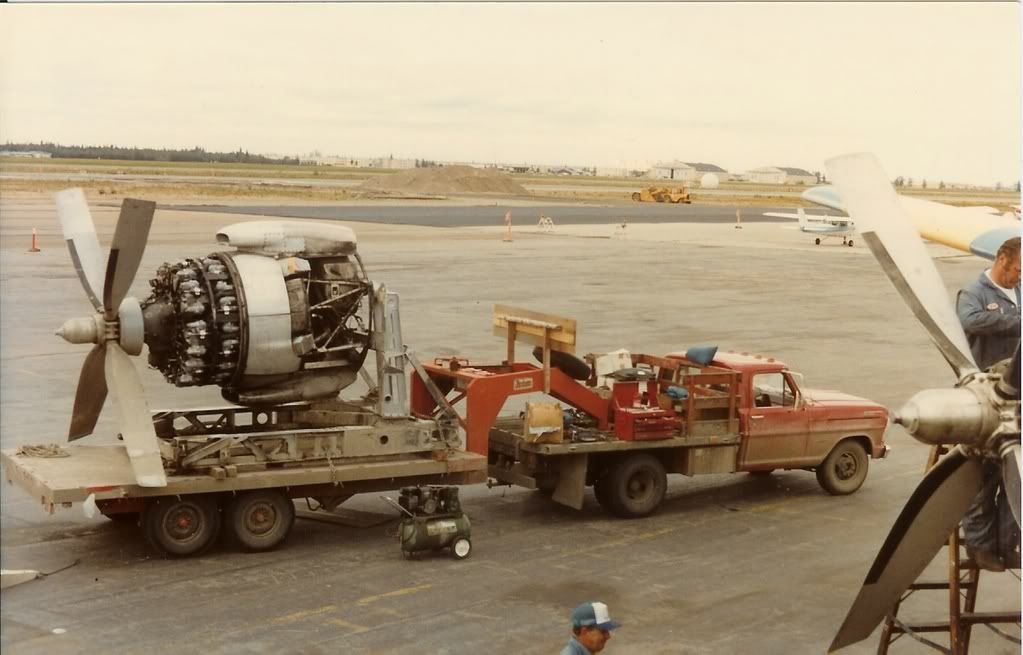
[/img]
Be patient,as this is my first attempt at posting a picture.This is a QEC ready to install in the #4 position on Tanker 66 at Ft.Wainwright (Fairbanks,AK.) in July of 1983.If this works,I'll try posting some additional pictures,assuming that I can remember what I did this time.I'm not sure how to adjust the size,so I hope that it isn't too big.
The top scoop is air induction to the master control,which is what they call the carburetor on a direct fuel injection turbo-compound R-3350.The bottom scoop contains the oil cooler.The oil tank (46 gl) is under the rear of the top scoop.
Direct Link
HTML Code
IMG
[/img]
Be patient,as this is my first attempt at posting a picture.This is a QEC ready to install in the #4 position on Tanker 66 at Ft.Wainwright (Fairbanks,AK.) in July of 1983.If this works,I'll try posting some additional pictures,assuming that I can remember what I did this time.I'm not sure how to adjust the size,so I hope that it isn't too big.
The top scoop is air induction to the master control,which is what they call the carburetor on a direct fuel injection turbo-compound R-3350.The bottom scoop contains the oil cooler.The oil tank (46 gl) is under the rear of the top scoop.
Sat Nov 24, 2007 10:43 am
That photo is what a QEC is suppose to be. Four bolts to mount it, connect the fluid lines and control cable/rods. Cowl it, and do your engine run. If everything goes well, four hours of work for three or four people. We did an MD-80 engine once in 1 1/2 hours. I unwrapped the new engine, prepped it and prepped the old engine for shipping while the other five guys did the engine change. They were done before I finished with the old engine. But the same crew has taken 12 hour to do the same as they ran into problems.
Sat Nov 24, 2007 12:29 pm
"Quick" can sometimes be a real misnomer....We had one engine change that turned into to a real problem. Took nearly an entire shift just to line the trailer up and roll the engine out. Normally, it could have been done easily in less than an hour from where we started, but nothing would go right on that job. Couldn't get the trailer to lione up right, had trouble getting the supports loaded right, thrust pins wouldn't unload at the same time and so on and so on. Next one we did was with the exact same crew and even the same engine trailer and it came out well under normal times for the procedure.
This is one of the few industries that I've worked in that things never go exactly according to plan, or the books....sometimes better, but more often than not, worse.
This is one of the few industries that I've worked in that things never go exactly according to plan, or the books....sometimes better, but more often than not, worse.