RMAllnutt wrote:
There's a former RAF PBY-5B at the US Naval Aviation Museum. It's the only pure flying boat version of the PBY left (although there are a couple of Australian PBY's which were converted back to flying boats). Not exactly an early variant, but the earliest survivor I can think of.
Cheers,
Richard
There is the complete PBY-5 owned by the Smithonian but displayed at Pensacola, suspended from the ceiling as well as the PBY-5 fuselage "cutaway" also displayed at Pensacola underneith the complete example.
In Australia/NZ we have 5 Flying boat examples, these consist of:
1.The composite A24-30 displayed at the former RAAF Seaplane base at Lake Boga, which is a original "pure" flying boat (more on this one below),
2. A24-46 a former RAAF PBY-5 in WA (also therefore a "pure" flying boat) from the former Whale world, and the last RAAF PBY-5 surviving and one of only two "complete" PBY-5's still surviving (exluding the "cutaway" fuselage) I have not studied which of these airframes is the oldest PBY-5 surviving?
3. A24-88, a former RAAF PBY-5A amphibian modified back to pure flying boat configuration by the RAAF at Lake Boga during WW2 to increase its operational range and payload and re-designated a PBY-5A(M), it flew operationally with 42 Squadron and took part in the Black Cat operations to mine Manila Harbour ahead of MacArthur's landings. This is the last RAAF PBY-5A of 46 delivered and last PBY-5A(M) of 29 so modified, and is the last geniune RAAF Black Cat surviving.
4. A24-384, VH-ASA is the last PB2B surviving in the world (a "pure" flying boat), and flown post war by pioneer PG Taylor in the first flights between Australia and South America, preserved in the Powerhouse Museum Sydney.
5. Interestingly in RNZAF Museum a former USAAF OA-10 built as a Canso is being restored as an RNZAF PBY-5 Flying Boat, despite being built as an Amphibian, it was delivered to Australia post war and flown by TAA Airlines who later did a similar conversion to the wartime RAAF PBY-5A's and modified it back to pure flying boat configuration.
A total of "7" flying boats surviving in the world as against the wider population of amphibians made up of Canso's PBY-5A's and PBY-6A's.
In regards to surviving PBY-4's David is correct to refer to the hull of PBY-4 A24-29 still surviving in Australia as a house boat, or more correctly a "Paddleboat" on the Murray River named "paddlecat"!
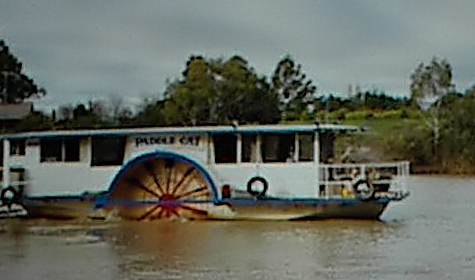 http://www.ruudleeuw.com/oz05/paddle-cat.jpghttp://www.ruudleeuw.com/search113.htm
Quote:
Allan wrote me the following information: "I have following information on BuAer 1216; it was of interest to me because it was from the original PW10 squadrons in the Philippines when the war began for the U.S. and my brother's squadron (VP-22) was sent out from Pearl with early-model PBY-5s as reinforcement. They lost almost all their a/c - I think two of the 4s survived, one or two of the -5s they had received from the Dutch, and one from VP-22, which was sent back to the U.S. and used as a trainer in Florida. I believe the -4s turned over to the Aussies were also used as trainers but were surplused after the war.
This Catalina was a PBY-4 for the US Navy until March or April 1942, when it was turned over to the Aussies, who used it as a trainer for the rest of the War. I am quite sure the BuAer 1216 is correct and that it was A24-28 or A24-29 in Australian Service. Also, since it wasn't part of the Lend-Lease program, it didn't have to be either returned or destroyed after the war. Jim Vale converted it to a houseboat at some point"
"I have an envelope from Jim Vale, Mildura, postmarked 27 March 1998. Here is a quote from his letter: "...regarding your query as to how I have managed to keep the hull free of water, the whole hull section is covered with fibreglass, it is completely dry and has not been out of the water for 11 years..."
ADF-Serials.com does confirm BU 1216 was former RAAF PBY-4 A24-29, however "PaddleCat" or A24-29 has had its top fuselage supersastructure removed and is little more than a boat "hull" survivor.
A24-30 on display at Lake Boga is restored as a composite from many scrapped Cats surviving on farms in the area, interestingly the fuselage is a pure flying boat having never been fitted with undercarriage or modified back as a PBY-5A(M) like A24-88.
More interesting A24-30 carries a number of manufacture plates describing parts of it as a PBY-4, yet it also carries Blisters (or did until HARS borrowed them to copy them)!
The RAAF received 2 PBY-4's from the Dutch/NEIAF, these being A24-28 and A24-29, with one surviving and accounted for above as "Paddle Cat".
However, a third PBY-4 came to the RAAF by more convoluted means, the MLD/NEIAF Y-72 was attacked in the air by Japanese fighters and abandoned in Java where the USN used its fuselage and the wings of USN PBY-5 BU 2305 to create a hybrid aircraft, that aircraft escaped to Australia and was passed to the RAAF as A24-30.
http://groups.yahoo.com/group/PBY/message/25503Quote:
You spotlight one of the things that my research has uncovered, the equation of the five Model 28-5MNE Catalinas sold (sold, pre-Lend lease) to the Dutch that were transferred to the USN in Java in January 1942.
Here is my data as it stands at present...
Patrol Wing TEN's side number was MLD's ex- Y-boat...
#41 = Y-41 burned on the water, Darwin 19 February
#42 = undetermined shot down on patrol by fighters, Makassar Straits, 24 February
#43 = undetermined burned on the water, Morokrembangan, Java, 03 February
#44 = Y-73 shot down on patrol by fighters, Bali, 25 February
#45 = undetermined shot down on patrol by fighters, Makassar Straits, 05 February
The three undetermined have to be, by process of elimination, Y-39, Y-40, and Y-50 in some order. The disposition of all other Y-Boats is determined.
Y-72 is another breed of cat. Damaged by fighters in the air over Java, the MLD abandoned her on the ramp in Mid-February as beyond repair. The PW10 men took their own damaged #12 (ex-22-P-12, BuNo. 2305, and matched #12's wing and engines to Y-72's hull and flew it out to Australia as PW10's #46.
This Catalina went to the RAAF base at Rathmines in July 1942 for overhaul, and thus passed to the RAAF as A24-30 in October. A24-30 is today a monument at Lake Boga, Victoria.
Thanks for adding your confirming data, Larry. Another source substantiates this analysis.
A24-30 is a composite restoration clearly based on a "pure" flying boat (there si no evidence of amphibian U/C being removed and skinned over), and is made up of parts from many aircraft including parts maked in Dutch and nameplated as PBY-4, It is therefore assumed some portion of the aircraft, (most likely at least the centre-fuselage and cockpit) are from A24-30 and is therefore the last surviving PBY-4 parts despite being fitted with PBY-5/5A Blisters (and most likely a rear fuselage of a PBY-5 or 5A with the Blister location).

Regards
Mark Pilkington



 Login
Login Register
 FAQ
FAQ Search