This is what I like about Jack's photos. It gives me something to do, like research BuNo.s
Take Jack's 2nd P-3 Picture BuNo. 152168:
Delivery date: 30 July 1965
Don't know when Jack's picture was taken but here is 152168 in 1975, assigned to VP-17 White Lightnings, returning to NAS Barbers Point, Hawaii after deployment to Okinawa.

And here in april of 1983 in Iceland assigned to VP-92

And here Joe Baugher list 152168 as:
152168 (c/n 185-5138) to AMARC as 2P0034 Jan 17, 1990. To go to Brazilian AF
The interesting thing about 152168 is that it was involved in the last official combat of the Vietnam War, known as the "Mayaguez Incident" and suffered combat damage.
Here's the story:
http://en.wikipedia.org/wiki/Mayag%C3%BCez_incident
Mayagüez incident
The Mayagüez incident with the Khmer Rouge in Cambodia on May 12-15, 1975, marked the last official battle of the U.S. involvement in the Vietnam War.
The names of the Americans killed are the last names on the Vietnam Veterans Memorial, as well as those of three Marines who were left behind on the island after the battle and who were believed to have been subsequently executed by the Khmer Rouge while in captivity.
Ironically, the ship's merchant-navy crew whose seizure at sea had prompted the US attack had been released in good health, unknown to the US Marines or the US command of the operation, before the Marines attacked.
Aerial surveillance photo showing two Khmer Rouge gunboats during the initial seizing of the SS Mayaguez.
 Khmer Rouge seize the Mayagüez
The crisis began on May 12, 1975, when Khmer Rouge naval forces operating former U.S. Navy "Swift Boats" seized the American container ship SS Mayagüez in recognized international sea lanes claimed as territorial waters by Cambodia and removed its crew for questioning. Surveillance by P-3 Orion aircraft indicated that the ship was then moved to and anchored at Koh Tang, an island approximately 50 miles off the southern coast of Cambodia near that country's shared border with Vietnam.
U.S. rescue preparations
U.S. President Gerald Ford was determined to end the crisis decisively, believing that the fall of South Vietnam less than two weeks before and the forced withdrawal of the United States from the country (Operation Frequent Wind) had severely damaged the U.S.'s reputation. Ford also wished to avoid comparisons to both the Tonkin Gulf Incident and the incident involving the USS Pueblo, a U.S. Navy intelligence ship captured by North Korea in 1968.
Negotiations were not feasible, as the United States had no diplomatic contact with the newly installed Khmer Rouge regime in Cambodia, then known as Democratic Kampuchea. Calling the seizure "piracy", President Ford ordered a military response to retake the ship and its 40-man crew, thought to be on Koh Tang. Ford ordered the aircraft carrier USS Coral Sea into the area, and moved a substantial number of Marines from Okinawa and Subic Bay in the Philippines to U Tapao Air Force Base in Thailand on May 14.
The main body of the "air contingency" reaction force was from 2nd Battalion, 9th Marines (BLT 2/9) (commanded by Lieutenant-Colonel Randall W. Austin), which had just participated in the evacuation of Saigon and was then in a training exercise on Okinawa. BLT 2/9 was chosen because most of the men of the designated reaction force, 1st Battalion, 9th Marines (BLT 1/9), were ending their tours of duty in the Far East and were not subject to further extension of their tours. Ironically, the 9th Marine Regiment had also been the first U.S. ground combat force committed to Vietnam in 1965.
Sixteen USAF HH-53/CH-53 Super Jolly Green Giant helicopters of the 40th Air Rescue and Recovery Squadron and the 21st Special Operations Squadron were available in Thailand for the rescue operation. On May 13, before the Marine forces had been alerted, the Air Force moved 125 Security Police to U Tapao as a contingency security force; one of the transporting CH-53s crashed, killing 23 airmen.
The Seventh Air Force was ordered to maintain surveillance on the Mayagüez in an attempt to keep the Khmer Rouge from moving the crew to the port of Kampong Som. F-111A fighter-bombers from the 347th Tactical Fighter Wing based at Korat Royal Thai Air Force Base in Thailand located the Mayagüez, and on May 14, the F-111As sank one of the gunboats escorting the Mayagüez. Early on the morning of May 14, four Khmer gunboats left Koh Tang for the Cambodian mainland. An AC-130 Spectre gunship on the scene was directed to fire across their bows and prevent them from reaching the coast. The gunship's 40 mm cannon and 105 mm howitzer turned three of the gunboats back. Flights of F-111A, F-4D, and A-7D fighter-bombers attacked in front of the remaining gunboat with 2,000 pound bombs, 2.75 rockets and riot-control gas, but the boat refused to turn back. An A-7D sank the boat using 20 mm cannon fire and 2.75 inch rockets.
A few minutes later, at approximately 0715, a Thai wooden fishing boat was observed leaving the island for the mainland. The crews of the U.S. aircraft suspected that the boat might be carrying the crew of the Mayagüez, so they did not fire directly on the vessel. During the four hours it took this boat to reach Kampong Som in Cambodia, A-7s and flights of F-4Ds employed rockets, strafing and riot-control agent in front of the vessel in an attempt to make it turn back to Koh Tang. It later turned out that the crew of the Mayagüez was on the small craft; however, since this could not be confirmed at the time, military planners proceeded as though the crew were still on the island.
Upon its arrival at U Tapao, the commander of BLT 2/9 and his staff undertook a surveillance of Koh Tang by helicopter during that same afternoon. They were prevented from closely approaching the island in order not to compromise the secrecy of the mission, but determined that the island was so covered in jungle growth that the only two viable landing zones available were beaches on the west and east shores of the northern portion of Koh Tang.
The rescue mission was organized into several groups. A unit of 57 Marines from Delta Company, 1st Battalion, 4th Marines was to be transferred by three helicopters to the destroyer escort USS Harold E. Holt for boarding the Mayagüez. A larger force of 600 Marines from BLT 2/9 -- comprised of Golf and Echo Companies -- were assigned to conduct a combat assault in eight helicopters to seize and hold Koh Tang. Two additional CH-53s (because of their superior firepower, all the rescue helicopters were used for troop lift) were tasked as Search and Rescue helicopters, supported by an HC-130 "King" command-and-control aircraft. The flight from U Tapao to Koh Tang was a four-hour round trip.
The guided missile destroyer USS Henry B. Wilson was assigned to support the Koh Tang operation, and the frigate USS Schofield was deployed in a blocking position between U.S. forces and the Cambodian mainland with the mission of intercepting and engaging any Khmer reaction forces. (However, despite numerous radar contacts and communications intercepts, the Schofield did not engage during the operation.) Navy aircraft from the Coral Sea were given the mission of striking targets on the Cambodian mainland to prevent interference with the rescue.
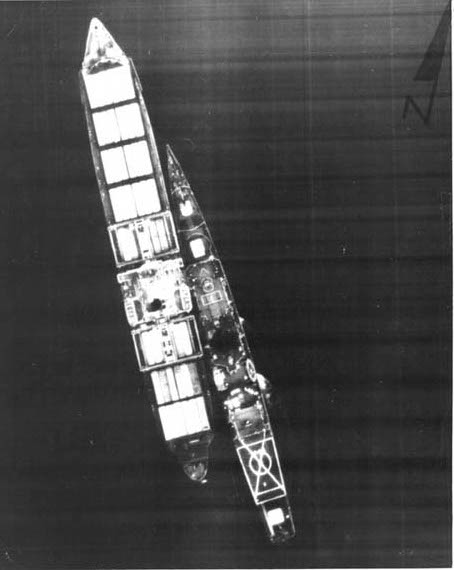
USS Holt during the retaking of the SS Mayaguez
 Rescue operation
At 0600 May 15, the first phase of the operation began with the transfer of D/1/4th Marines to the Holt. As the destroyer escort slowly came alongside, USAF A-7 aircraft "saturated" the Mayagüez with tear gas munitions. Equipped with gas masks, the Marines at 0720 hours then conducted the first hostile ship-to-ship boarding by the U.S. Navy since 1826, securing the vessel after an hour-long assault, finding it empty.
Simultaneously, the eight helicopters (five CH-53 and three HH-53) of the Koh Tang assault force approached the island at 0615, encountering intense automatic weapons and rocket propelled grenade (RPG) fire from Khmer forces entrenched there. A CH-53 crash-landed on the east beach but successfully off-loaded its 20 Marines and crew of five. They set up a defense perimeter but remained cut off from both reinforcement and rescue for twelve hours.
The second CH-53 in their section was shot down by two RPGs, exploding and crashing fifty meters off-shore. A pilot, five Marines, and two Navy corpsmen were killed in the crash, another Marine drowned swimming from the wreckage, and three Marines were killed by gunfire trying to reach the beach. A tenth Marine died of his wounds while clinging to the burning wreckage. The surviving ten Marines and three Air Force crewmen were forced to swim for four hours before being picked up by the gig of the arriving Henry B. Wilson. Among the Marine survivors was the battalion's Forward Air Controller, who used an Air Force survival radio while swimming to direct air strikes against the island.
On the western beach of the island, the first section of two CH-53 helicopters came in at 0630 hours. The first landed safely but while off-loading its Marines came under heavy automatic weapons fire, destroying an engine. It managed to take off, protected by suppressive fire from the second CH-53, and ditched a mile off-shore where all but one of its crew was picked up. The second CH-53 was damaged so severely that it turned back with its Marines (including the Golf Company commander) still aboard, and crash-landed on the Thai coast, where its passengers were picked up and returned to U Tapao.
Two other sections of the first wave, consisting of the remaining four helicopters, eventually landed all of their Marines between 0630 and 0930 hours, although the final insertion required support from an AC-130 Spectre gunship in order to penetrate the Khmer fire on its fifth attempt. 81 Marines landed on the west beach under the command of the company Executive Officer, and 29 Marines of the battalion command post and mortar platoon landed a kilometer to the southwest. 130 Marines had reached Koh Tang but in three isolated beach areas and in close contact with Khmer troops. Unknown to U.S. commanders, the Khmer were well entrenched in anticipation of a Vietnamese attack over an ongoing territorial dispute. While isolated, the Marines were able to use their 81 mm mortars as fire support for their contingents and devised a makeshift communications network for controlling supporting air strikes by USAF A-7 and F-4 aircraft.
Of the eight helicopters assaulting Koh Tang, three had been destroyed and four others damaged too severely to continue operations. One of the three helicopters used on the Holt portion of the operation had also been severely damaged attempting to pick up the platoon isolated on the east beach. This left only three helicopters of the original eleven available to bring in the followup forces of BLT 2/9, so the CH-53s whose mission had been search and rescue -- the last available helicopters -- were reassigned to carry troops. The five helicopters picked up 127 Marines of the second wave at U Tapao between 0900 and 1000 hours.
Release of the Mayagüez crew
The Mayagüez crew had been removed from Koh Tang and released before the Marines began their attack on the island. The men -- all alive and in good health -- were found on a fishing boat and subsequently transferred to the Holt.
The U.S. Joint Chiefs of Staff decided that, with the ship recaptured and the crew released, further reinforcement of Koh Tang was unnecessary and recalled the second wave. The helicopters with the second wave reversed course until the recall was cancelled when Lt. Col. Austin, on the ground on Koh Tang, convinced the commander of the Seventh Air Force that the reinforcements were necessary to prevent his units from being overrun.
The second wave was seriously delayed but eventually landed 100 additional Marines and evacuated 9 wounded, making a total of 202 Marines and 5 Air Force crewmen on Koh Tang. At midday the command post planned a linkup of its small contingent with the bulk of Golf Company on the west beach landing zone. Using mortar fire and A-7 airstrikes to clear the jungle between the two forces, it reached the west beach perimeter at 1245.
Extraction of Marine elements
Another attempt to extricate the Marines on the east beach was made at 1415 hours but was repulsed by heavy fire. One of the two helicopters employed had a fuel line damaged but made an emergency landing on the Coral Sea, which repaired it by 1700 hours. At 1600 hours Air Force OV-10 Forward Air Control (FAC) aircraft arrived and took over the direction of air support. Between 1730 and 1800 hours a third attempt to rescue the east beach force was successful, using two helicopters and the gig from the Henry B. Wilson for gunfire support. Two more HH-53s were put out of action by battle damage. The 3rd Platoon force had suffered one Marine and one helicopter crewman wounded (in addition to those killed in the crash off-shore).
The remaining three helicopters were then joined by a fourth that had been out of service at its Nakhon Phanom base but had been repaired and flown to the area. This force immediately began to withdraw the remaining 202 Marines from Koh Tang, protected by AC-130 fire and naval gunfire support from the Henry B. Wilson. The first load of 41 Marines was lifted out at 1830 hours by the only operable CH-53 and flown to the Coral Sea, followed by 53 taken aboard the helicopter with the repaired fuel line. When the HH-53 newly arrived from Nakhon Phanom picked up a load of 34, the remaining Marines on Koh Tang came under intense attack. The trip to the Coral Sea was a thirty minute round trip, so the pilot decided to deliver his Marines to the nearby Henry B. Wilson, made in complete darkness while hovering over the ship with only its front wheels touching down. He immediately returned and picked up 40 more, and by that time the SAR helicopter had almost returned from the Coral Sea.
With each withdrawal of troops, the Marines contracted their perimeter on Koh Tang. They carefully supervised the re-deployments to ensure no one was missing, but during the last reduction of the pocket, three Marines of an M60 machine gun team were mistakenly left behind on the beach. The last extraction, made in the dark at 2010 hours, withdrew under heavy mortar fire and flew to the Coral Sea.
Because of intense direct and indirect fire, the body of LCPL Ashton Loney, who had been killed by enemy fire early in the battle, was left behind. In addition, as mentioned, it was later discovered that the Marines had also left behind a three man machine gun team which had been assigned to protect the right flank of the constantly shrinking perimeter during the final evacuation. The members of this machine gun team were PFC Gary L. Hall, LCPL Joseph N. Hargrove, and Pvt. Danny G. Marshall. Radio contact with the team was lost after they were ordered to evacuate on the last helicopter. Major McNemar and Major James H. Davis made a final sweep of the beach before boarding the helicopter and were unable to locate them. They were subsequently declared Missing in Action.
The final action on Koh Tang included the dropping of a BLU-82 bomb, a 15,000-pound device that was the largest non-nuclear weapon in the U.S. arsenal
Casualties
Casualties during the operation were 14 Marines killed or missing (ten in the helicopter crash and four at the west beach), two Navy corpsmen killed, and two Air Force crewmen killed. Counting the 23 airmen killed on May 13th, 41 U.S. servicemen lost their lives during the crisis. Thirty-five Marines and 6 airmen were wounded. Estimates of Khmer Rouge casualties were 60 killed out of a land and sea force of about 300.
Controversy about Marines left behind
The missing Marines, including the three men of the machine gun squad left behind on the island, were initially listed by the Marine Corps as Missing in Action. After an investigation of the incident, the three were reclassified as "Killed In Action (Body Not Recovered)" on July 21, 1976, fourteen months after the incident. This reclassification was done on the basis of a lack of reliable information to corroborate the Marines' survival, rather than any concrete findings to establish that the men were killed. The families of the three men were not provided the findings of the investigation.[citation needed]
It has been reported that the three Marines survived the battle and were subsequently executed by the Khmer Rouge;[citation needed] however, there are no reliable accounts to corroborate this, and no forensic evidence has been found to confirm or deny the fate of these Marines.[citation needed]
Recovery efforts between 1995 and 2001 by Joint Task Force-Full Accounting later found bone fragments that might have belonged to the three abandoned Marines, but DNA tests have proven inconclusive due to the small size of the fragments. Hargrove, Hall, and Marshall all received obligatory Purple Hearts from the Marine Corps. However, Hargrove's family did not receive the award until 1999, after investigative journalist and author Ralph Wetterhahn published several articles in popular magazines about his findings.[citation needed]
The Marine Corps does not believe that the three Marines were left behind alive on the island, and none of the three Marines received any posthumous award for their heroism in defending the right flank of the Marine position on the West Beach of the island beyond the automatic issuance of the Purple Heart
Impact on Thailand
The Mayagüez incident had a direct effect on the political situation in Thailand. The U Tapao airbase had been used by U.S. rescue forces despite an explicit refusal of permission by the Thai government, resulting in considerable anger towards the United States. The Thai government called the act a violation of Thailand's sovereignty, and as soon as they returned to base, all the Marines were immediately flown to the Philippines. Many Thai groups called for the withdrawal of all U.S. forces from the country and exhibited an increased distrust of their own military, which they presumed to be complicit in the communications delay permitting the use of its airbase.
Impact on U.S. military rescue planning
The U.S. military received much criticism for its handling of the incident. In addition to the failure of intelligence to determine the whereabouts of the crew of the Mayagüez and the presence of a sizeable hostile force on Koh Tang, the timing of the operation was questioned until it became clear that combat had been underway four hours before the crew was released. Within the services the Marines in particular were critical of the ad hoc nature of the joint operation and the perceived pressure from the Administration for hasty action, although the success of Operation Frequent Wind had been the basis for many decisions made during the crisis. When many of the coordination and communications problems arose again during Operation Eagle Claw, the hostage rescue mission in Iran in 1980, significant changes in joint and special operations were brought about.
ZE-6 And The Mayaguez
by Bill O'Brien
On the recent 30th anniversary of the Mayaguez Incident (May 13, 1975), I tracked down old ZE-6 (152168). It was in the boneyard at Davis Monthan AFB slated for FMS (Foreign Military Sale) to the Brazilian Navy. So, I made a pilgrimage out there and visited the plane. I was very graciously hosted by Tim Horn of AMARC. I have attached some digital pictures showing the aircraft with some good close up shots of the tail. Apparently, after service with VP-17, 152168 was flown by VP-69, a reserve squadron out of Whidbey Island. Anyway, the old faded paint job is theirs and not the old White Lightning.


The amazing thing, as the AMARC guys pointed out to me (two former P-3 flight engineers), is that you can still see the metal patches on the vertical stabilizer where the three .50 cal. rounds penetrated. The three rectangular patches are just above the section of faded green paint. I was really surprised to see the actual damage repair, since I never thought there would be any tangible evidence of that day. The last time I was that close to the damage was when I was on a “cherry picker” in U-tapao after we landed, putting metal duct tape over the holes so we could re-fuel and fly back to Cubi with the film we shot of the Cambodians.


Here’s the story as I recalled it while taking pictures of old ZE-6 that day…......
On May 12, 1975, barely two weeks after the fall of Saigon, Khmer Rouge forces seized a U.S. flagged merchant ship, the S.S. Mayaguez.
On that same evening VP-17's Crew 9 was just finishing a 12-day I.O. circuit and were enjoying a few days off in U-tapao. Most of the crew were "out in town" enjoying the local flora and fauna (especially the fauna). Gary Ruffin (our 3P) and I were attending Harvey Wallbanger Night at the Air Force O-Club. Around midnight we were well into our cups when the duty officer walked in and told us we were flying. After laughing uproariously for a few minutes we realized he was serious. We pooled our money and Gary took a cab into town to round up the crew. I went down to Ops to get the brief. We fueled, filed and took off around 5 a.m.
Our brief was sketchy at best. We were told that a Mayday had been received from the Mayaguez, but the nature of the emergency was uncertain. We were to search southwest of Cambodia (last reported position) to locate and positively identify the ship and attempt to determine the problem (were they aground, on fire or what). After several hours of searching we received an HF message from Cubi (CTG 72.3) to disregard CPA restrictions to the Cambodian mainland. This was my first clue that something serious had happened to the ship. I only wish they had told us everything they knew or suspected; that the ship had been seized by several hundred Khmer Rouge soldiers and the crew was being held hostage on board.
At approximately 8:30 a.m. local time Jim Carlson spotted what looked like a ship anchored near one of the Poula Wai Islands (many of you may remember we called them the Peanut islands because that's what they looked like from the air). Radar never picked up the ship at all. We made our first pass up the starboard side from about 500 feet and saw no suspicious activity. We then circled and flew up the port side between the ship and the island. On the second pass, approaching the stern at about 250' altitude, we could read and photograph the name, making positive I.D. However, tied up amidships of the Mayaguez were two 1950's vintage former U.S. Navy Patrol Boats with deck mounted .50 caliber guns. Aboard the vessel and in the tree line were another 250 Khmer Rouge soldiers. As later documented in two books written about this event, the Cambodians opened fire on us from all points, the boats, the deck of the Mayaguez and the tree line. We could see the tracers in front of us, could see the rounds hitting the water and could hear three .50 cal. rounds penetrate the vertical stabilizer (the patches in the recent pictures show where they hit - luckily striking no control cables or the rudder).
The noise of the rounds actually woke up our flight engineer who was asleep on the galley floor at the time - that's how loud it was! In the seat at the time was Jim Carlson (left seat) and Gary Ruffin (right seat) and our second mech. I was standing behind Gary in the cockpit. Gary had a closer look at the firing and said "Those M***** F*****s are shooting at us, let's get outta here!" He applied max power and pulled back on the yoke.
It seemed to take forever for the engines to spool up and for us to climb clear of the firing. I reported the contact to Cubi and was quickly speaking with VP-4's XO, Brant Powell. We were told to keep visual contact with the ship until relieved. We replied that we would, once we determined if the aircraft was still safely flyable, and I also asked how high a .50 cal. could shoot. They said they would get back to me on that.
When we returned to the island 45 minutes later the ship and patrol boats were gone. After a rapid square search, we found them heading for the Cambodian mainland at 12 knots! We kept close surveillance from 5,500 feet and they shot at us every time. Eventually we made a few passes across their bow and they pulled in and anchored at Koh Tang Island. This is the island the Marines would assault two days later.
After five more hours of surveillance we were now approaching PLE and STILL awaiting relief from VP-4's Ready Alert aircraft from Cubi. We were actually told to disregard PLE and remain on station until relieved. We sort of did that (full story to be told only in person over a beer) and landed at U-tapao. We refueled, developed the film, patched the holes with metal duct tape and took off for Cubi.
Our route back to Cubi took us very near the action at Koh Tang Island, which was now under air assault by an AC-130 gunship, Air Force F-4's and F-111's from Thailand, and Navy A-7E's and A-6A's from the Coral Sea. Attacks were also being made at Kompong Song Harbor, and Ream airfield on the Cambodian mainland.
It was this bombing that convinced Phnom Penh to release the crew. They were sent out to sea along with a captured Vietnamese sailor in a fishing boat and would have been blown out of the water by Coral Sea's A-7's had not a sharp eyed P-3 pilot spotted what he thought looked like a beard on one of the crew! The attack was called off and the entire crew was rescued.
The sad epilogue to the story is the extremely high casualty rate of the Marines who assaulted the island. Forty-one Marines were killed within the first few hours of the assault. Of those 41 Marines who gave their lives, only 32 bodies ultimately were recovered and sent home for burial, nine of them recovered only five years ago as a result of the work of POW/MIA teams. However, the greatest tragedy was, of the nine bodies never recovered, three Marines were left alive on the battlefield, still manning their machine gun position—forgotten in the confusion by the Marine captain in the last evacuation helicopter. These three Marines, L/CPL Joe Hargrove, PFC Gary Hall and PVT Danny Marshall were eventually captured alive, tortured and killed by the Cambodians.
These names are on the last panel of the Vietnam Veterans Memorial. The Mayaguez herself remained in service for only four more years. She was cut up for scrap in 1979.
Bill
________________________________________________________
So there you have it. There's always a story in every picture.
I'm under the impresstion that 152168 is still flying today with the FAB.
Shay
_____________
Semper Fortis


 Login
Login Register
 FAQ
FAQ Search