Curtiss AT-9 Jeep Survivors
Mon Jun 04, 2007 11:18 am
I know there are only a couple of example that have survived, but are there any possible projects to be had? I find it hard to believe that all 400+ plus airframes of a training aircraft were lost.
Mon Jun 04, 2007 12:01 pm
Eric,
From what I have heard from fellows that went to Multi-engine Advanced Schools, the AT-9 was something the Air Forces would just as soon have forgotten about by 1943. A gentleman who went on to fly B-17s told us that when he was at Pampa for Advanced Multi the Base Policy was to NEVER allow students to fly the AT-9 without an instructor. He said it was actually fairly fun to fly until one fan stopped producing and that things went downhill pretty quickly (both figuratively and literally) immediately. I believe his solo work was with the AT-10 and even some in B-25s toward the end of this phase.
Scott
From what I have heard from fellows that went to Multi-engine Advanced Schools, the AT-9 was something the Air Forces would just as soon have forgotten about by 1943. A gentleman who went on to fly B-17s told us that when he was at Pampa for Advanced Multi the Base Policy was to NEVER allow students to fly the AT-9 without an instructor. He said it was actually fairly fun to fly until one fan stopped producing and that things went downhill pretty quickly (both figuratively and literally) immediately. I believe his solo work was with the AT-10 and even some in B-25s toward the end of this phase.
Scott
Mon Jun 04, 2007 7:58 pm
My Dad did his advanced in the AT-9 and loved it. Somewhat underpowered, but on cool days and lightly loaded, with it's high wing loading -- it performed very much like a hot rod. Many of the instructors of the day were scared of the beast and were ultra caution down low and at low speeds. It had a nasty stall characteristics, at the break the wing (left usually) would disappear, and you'd be looking at the daisies. But flown by the numbers, had a reputation as one of the finest handling aircraft in the inventory. The only example I know to exist in in the USAFM. One was rumored to be ot the Spartan school in OK in the late 50's, probably scrapped. Too bad. Would have made a GREAT airshow act, similar to Bobby Younkin's fabulous BE-18 routine.
Rob Gillman
Rob Gillman
Mon Jun 04, 2007 9:11 pm
There's a rather battered hulk at Pima..I was told it was salvaged from a mountain crash site. It's a bit mangled, but could be rebuilt into at least a static display. It's the only existing AT-9 that I know of other than the one at Dayton (which I think is a composite of multiple airframes.)
SN
SN
AT-9's
Mon Jun 04, 2007 11:07 pm
Steve Nelson wrote:There's a rather battered hulk at Pima..I was told it was salvaged from a mountain crash site. It's a bit mangled, but could be rebuilt into at least a static display. It's the only existing AT-9 that I know of other than the one at Dayton (which I think is a composite of multiple airframes.)
SN
Yeah I saw the Pima AT-9A a few years back...she's rough. I've never seen any
evidence of the wings and engine nacelles, just a bent and twisted carcass of a
fuselage with the wings missing at the root..looking as if they were axe-chopped
or violently ripped of the airplane, which is plausable considering the country
she went down in. The fuse is the remains of 42-56882, AT-9A which went down
10Dec1942 while on a search for a missing AT-17. She struck a ridge of the Black Mountains
in the Gila National Forest near Hot Springs(now Truth or Consequences), NM. The crew survived.
Baugher lists another AT-9(42-56999) reported seen in the Pima storage yard in 2002, but I've never
seen photos or Pima list that wreck...and keep forgetting to ask.

List's attribute the s/n# to the NMUSAF AT-9 as 41-12150..didn't know she was a composite.
But as rare as they are, I can see why.
The AT-9 is another of those Golden Age leftovers which filled in during the
early days of WW2 until the Nation got it's breath and geared-up for the task at hand...
It'd be neat to see one fly. She always looked like quite a "hot little ship"..though
I can see the resemblance of the Jeep(or Djeep) in the Popeye cartoons.

I keep hoping to see an AT-9 or 2 showup abandoned and engineless at some
defunct forgotten duster strip...similar to the hangar in the desert in "Always"..pipedreams.
If wishes were fishes Pee-Wee...
Pima AT-9A remains...
www.pimaair.org/Acftdatapics/Curtiss%20AT-9A.htm
Last edited by airnutz on Tue Jun 05, 2007 1:08 am, edited 3 times in total.
Tue Jun 05, 2007 12:23 am
I'm not certain, but I believe the Spartan AT-9 (or at least part of it) is the aircraft at the Air Force Museum. Spartan had some cool stuff during the post-war years and fortunately at least some of the warbirds survived.
Scott
Scott
Tue Jun 05, 2007 12:51 am
Second Air Force wrote:I'm not certain, but I believe the Spartan AT-9 (or at least part of it) is the aircraft at the Air Force Museum. Spartan had some cool stuff during the post-war years and fortunately at least some of the warbirds survived.
Scott
Last year I picked up a 1946(or 1948) Spartan graduation book at an estate sale. I was disappointed there
were few aircraft pics, but I picked it up anyway, just to have a memento of Spartan. I loaned it to one of
the old timers..I'll borrow it back and see if there's an AT-9 ID in the background. Thanks 2ndAF!
Tue Jun 05, 2007 8:45 am
Airnutz,
Those old yearbooks sometimes come through with some real gold! I have an old (1970's?) Air Classics or Wings with a couple of photos of the Seafire and B-24 at Spartan along with the multitude of C-45/Beech 18s that populated the school, but I have no idea which box it is in. I'm thinking that there was a P-38 at Spartan in the late 40's as well.
Scott
Those old yearbooks sometimes come through with some real gold! I have an old (1970's?) Air Classics or Wings with a couple of photos of the Seafire and B-24 at Spartan along with the multitude of C-45/Beech 18s that populated the school, but I have no idea which box it is in. I'm thinking that there was a P-38 at Spartan in the late 40's as well.
Scott
Tue Jun 05, 2007 9:29 am
I read an article one time about a comany in Greeneville, Tenn. That bought something like 240 Curtiss Jeeps in the 1940's and used the materials to build small pull behind trailers for camping. I have no idea if they modified the fuselage or if they just used the aluminum and wheels etc. Greeneville is very out of the way, and I've never had a reason to go tthere but always thought there may be some remains, bits and pieces up there in the weeds somewhere. Greenville isn't exactly a growing town.
Also, Neal Melton, founder of Tenn. Museum of Aviation is from Greeneville and went to high school with either Herb or Oscar Tischler, (whichever is the son) . Apparently the Tischler family lived there as there was a major repair facility there for aircraft. Maybe one of the Tischlers might know something about all those AT-9's. It's possible there was a training base during the war in that city.
I talked to the late Ferris Thomas of Knoxville, Tenn.about his experiences instructing in the AT-9. Basically the wings were too small for a trainer, the fuselage was too short for the design and the wheels were not set up correctly. The designs and preferred landing technique in the 1930's was the three point, of course. The At-9 would stall out a wing before landing if you tried to three point. this would result in a ground loop or worse. You had tp fly the airplane on with power and then bring the tailwheel down immediately. Waiting for the tail to come down on it's on would result in a groundloop. Applications of power had to be done very smoothly as otherwise this would result in a groundloop. He said once in the air it flew nicely.
Also, Neal Melton, founder of Tenn. Museum of Aviation is from Greeneville and went to high school with either Herb or Oscar Tischler, (whichever is the son) . Apparently the Tischler family lived there as there was a major repair facility there for aircraft. Maybe one of the Tischlers might know something about all those AT-9's. It's possible there was a training base during the war in that city.
I talked to the late Ferris Thomas of Knoxville, Tenn.about his experiences instructing in the AT-9. Basically the wings were too small for a trainer, the fuselage was too short for the design and the wheels were not set up correctly. The designs and preferred landing technique in the 1930's was the three point, of course. The At-9 would stall out a wing before landing if you tried to three point. this would result in a ground loop or worse. You had tp fly the airplane on with power and then bring the tailwheel down immediately. Waiting for the tail to come down on it's on would result in a groundloop. Applications of power had to be done very smoothly as otherwise this would result in a groundloop. He said once in the air it flew nicely.
Tue Jun 05, 2007 9:29 am
I read an article one time about a comany in Greeneville, Tenn. That bought something like 240 Curtiss Jeeps in the 1940's and used the materials to build small pull behind trailers for camping. I have no idea if they modified the fuselage or if they just used the aluminum and wheels etc. Greeneville is very out of the way, and I've never had a reason to go tthere but always thought there may be some remains, bits and pieces up there in the weeds somewhere. Greenville isn't exactly a growing town.
Also, Neal Melton, founder of Tenn. Museum of Aviation is from Greeneville and went to high school with either Herb or Oscar Tischler, (whichever is the son) . Apparently the Tischler family lived there as there was a major repair facility there for aircraft. Maybe one of the Tischlers might know something about all those AT-9's. It's possible there was a training base during the war in that city.
I talked to the late Ferris Thomas of Knoxville, Tenn.about his experiences instructing in the AT-9. Basically the wings were too small for a trainer, the fuselage was too short for the design and the wheels were not set up correctly. The designs and preferred landing technique in the 1930's was the three point, of course. The At-9 would stall out a wing before landing if you tried to three point. this would result in a ground loop or worse. You had tp fly the airplane on with power and then bring the tailwheel down immediately. Waiting for the tail to come down on it's on would result in a groundloop. Applications of power had to be done very smoothly as otherwise this would result in a groundloop. He said once in the air it flew nicely.
Also, Neal Melton, founder of Tenn. Museum of Aviation is from Greeneville and went to high school with either Herb or Oscar Tischler, (whichever is the son) . Apparently the Tischler family lived there as there was a major repair facility there for aircraft. Maybe one of the Tischlers might know something about all those AT-9's. It's possible there was a training base during the war in that city.
I talked to the late Ferris Thomas of Knoxville, Tenn.about his experiences instructing in the AT-9. Basically the wings were too small for a trainer, the fuselage was too short for the design and the wheels were not set up correctly. The designs and preferred landing technique in the 1930's was the three point, of course. The At-9 would stall out a wing before landing if you tried to three point. this would result in a ground loop or worse. You had tp fly the airplane on with power and then bring the tailwheel down immediately. Waiting for the tail to come down on it's on would result in a groundloop. Applications of power had to be done very smoothly as otherwise this would result in a groundloop. He said once in the air it flew nicely.
Tue Jun 05, 2007 9:44 am
I went to Greenville and checked that out several years ago. I was there shortly after the bulldozer had done its job. Nothing left that i could find except red soil.
marine air wrote:I read an article one time about a comany in Greeneville, Tenn. That bought something like 240 Curtiss Jeeps in the 1940's and used the materials to build small pull behind trailers for camping. I have no idea if they modified the fuselage or if they just used the aluminum and wheels etc. Greeneville is very out of the way, and I've never had a reason to go tthere but always thought there may be some remains, bits and pieces up there in the weeds somewhere. Greenville isn't exactly a growing town.
Also, Neal Melton, founder of Tenn. Museum of Aviation is from Greeneville and went to high school with either Herb or Oscar Tischler, (whichever is the son) . Apparently the Tischler family lived there as there was a major repair facility there for aircraft. Maybe one of the Tischlers might know something about all those AT-9's. It's possible there was a training base during the war in that city.
I talked to the late Ferris Thomas of Knoxville, Tenn.about his experiences instructing in the AT-9. Basically the wings were too small for a trainer, the fuselage was too short for the design and the wheels were not set up correctly. The designs and preferred landing technique in the 1930's was the three point, of course. The At-9 would stall out a wing before landing if you tried to three point. this would result in a ground loop or worse. You had tp fly the airplane on with power and then bring the tailwheel down immediately. Waiting for the tail to come down on it's on would result in a groundloop. Applications of power had to be done very smoothly as otherwise this would result in a groundloop. He said once in the air it flew nicely.
Tue Jun 05, 2007 12:23 pm
I've heard of an AT-9 project down in Boerne TX North of Austin. Can anyone confirm that?
Tue Jun 05, 2007 12:38 pm
Here are a couple of shots of AT-9 aircraft. lst is at Kelly AFB, TX awaiting shipment to the Air Force Museum. 2nd is same aircraft ready for display at the Air Force Museum. 3rd is one on active duty.
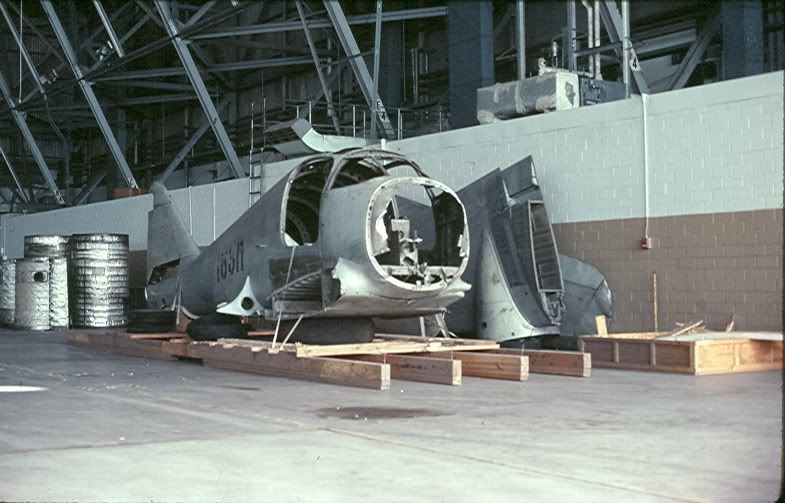
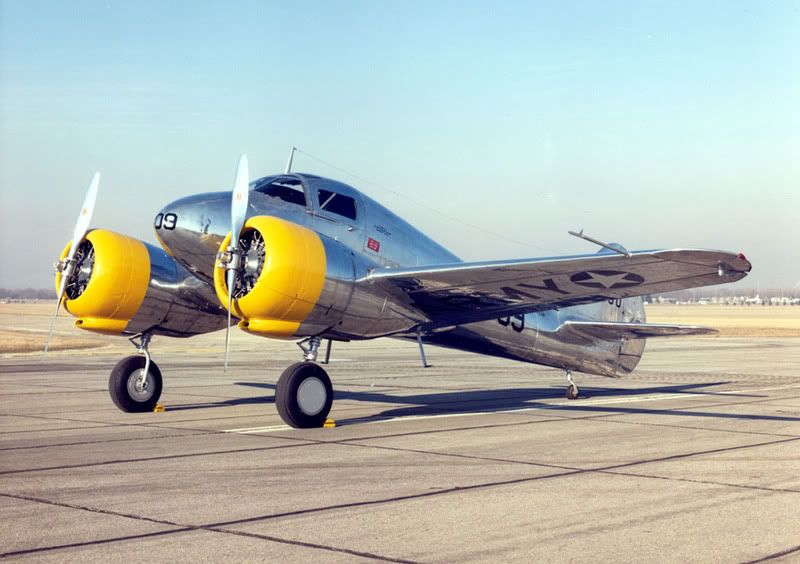
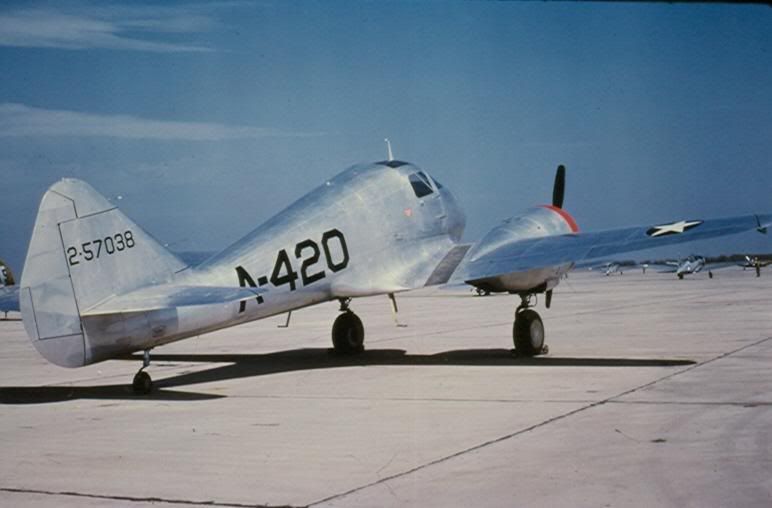
Tue Jun 05, 2007 12:43 pm
From the NMUSAF web site:
http://www.nationalmuseum.af.mil/factsh ... asp?id=482
"CURTISS AT-9 JEEP/FLEDGLING"
"The aircraft on display was not complete when the museum acquired it. Some of the parts used to restore it were taken from another incomplete AT-9, while other parts had to be built from "scratch" by museum restoration specialists."
"Serial number: 41-12150"
http://www.nationalmuseum.af.mil/factsh ... asp?id=482
"CURTISS AT-9 JEEP/FLEDGLING"
"The aircraft on display was not complete when the museum acquired it. Some of the parts used to restore it were taken from another incomplete AT-9, while other parts had to be built from "scratch" by museum restoration specialists."
"Serial number: 41-12150"
Tue Jun 05, 2007 12:51 pm
Taylor....it's an AT-10 not 9 at Boerne and at the moment is just the metal parts. I'll defer to Ober to come by later and possibly post a picture taken on our ramp but you have to imagine the wooden pieces in between the metal parts 