Thu Feb 05, 2009 2:03 am
daveymac82c wrote:Is that a Fairey Battle?
No. It's the sole surviving Fairey Fulmar, owned by Fairey's at that stage, it was in their silver & blue house scheme.
It was the prototype Mk.I, and then rebuilt into the Mk.II prototype. (Can't get more rare/historic than that!) It's now static in the Fleet Air Arm Museum, Yeovilton.
Thu Feb 05, 2009 2:14 am
A Fulmar eh? Cool. James, thanks for filling me in.
Was the Fulmar a development of the Battle, or did the Battle come after? By the way, where did the name Fulmar come from anyways?
Cheers,
David
Was the Fulmar a development of the Battle, or did the Battle come after? By the way, where did the name Fulmar come from anyways?
Cheers,
David
Thu Feb 05, 2009 2:42 am
Start here.
http://en.wikipedia.org/wiki/Fairey_Fulmar
http://en.wikipedia.org/wiki/Fulmar
The FAA named their aircraft after birds, for a while. The low point was the Blackburn Roc - named after a mythical bird, a turret fighter that should have been left mythical itself.
http://en.wikipedia.org/wiki/Roc_(mythology)
http://freespace.virgin.net/john.dell/blackburn_roc.htm
http://en.wikipedia.org/wiki/Fairey_Fulmar
http://en.wikipedia.org/wiki/Fulmar
The FAA named their aircraft after birds, for a while. The low point was the Blackburn Roc - named after a mythical bird, a turret fighter that should have been left mythical itself.
http://en.wikipedia.org/wiki/Roc_(mythology)
http://freespace.virgin.net/john.dell/blackburn_roc.htm
Thu Feb 05, 2009 2:54 pm
The low point was the Blackburn Roc...
You wouldn't consider the Sopwith Cuckoo the low point?

Thu Feb 05, 2009 6:16 pm
Chris Brame wrote:The low point was the Blackburn Roc...
You wouldn't consider the Sopwith Cuckoo the low point?
Good Lord, no! How many other 1918 vintage aeroplanes could carry an 18" torpedo? After the torpedo had been dropped the Cuckoo was aerobatic! Pilots liked them as they were immensely strong.
Warbirds in civl clothes
Fri Feb 06, 2009 5:54 pm
Here's another couple of civil Mustangs for the WIXers. Until the mid-1970's the Australian Dept of Civil Aviation rarely entertained the possibility of civilly registered ex military aircraft but there were exceptions as these two images show. The first is CAC Mustang VH-IVI ex RAAF A68-119. In 1964 it was sold to a civilian buyer and was restored to airworthy. It changed hands several times before becoming the property of of businessman Ray Whitbread in 1970. It had been registered VH-IVI. In 1973 the aircraft crashed killing Mr. Whitbread.

CAC Mustang VH-BOY was originally A68-39 and finished it's RAAF career as an instructional airframe. In 1959 it was purchased by Fawcett Aviation and converted for target towing and radar calibration duties to fulfill a contract gained by Fawcett from the Australian Army. It continued to fulfill these duties with Illawarra Flying School. Today it flies in the United States.
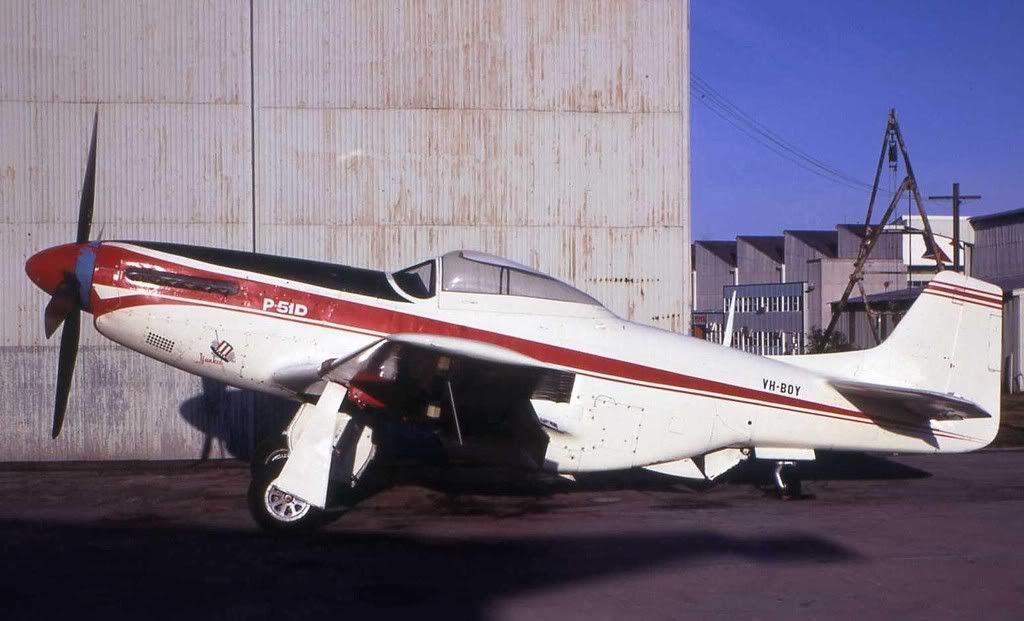
CAC Mustang VH-BOY was originally A68-39 and finished it's RAAF career as an instructional airframe. In 1959 it was purchased by Fawcett Aviation and converted for target towing and radar calibration duties to fulfill a contract gained by Fawcett from the Australian Army. It continued to fulfill these duties with Illawarra Flying School. Today it flies in the United States.
Fri Feb 06, 2009 7:50 pm
daveymac82c wrote:Was the Fulmar a development of the Battle, or did the Battle come after?
Hi David, nobody else answered this part, so I'll have a go.
The Battle and Fulmar were roughly contemporaries, from the same design department, and the relationship shows. The Fulmar was slightly smaller than the Battle, but obviously from the same design office. The first Fulmar flew on 13 January 1937, and the first Battle on 10 March 1936. The Fulmar was designed to a requirement for a long range fighter/scout, hence the large size and second seat (for a navigator). The air-to-air performance was poor, even by pre WW2 standards, but the specification expected the main enemy aircraft encountered at sea would be long range patrol flying boats, or float planes off catapults. Early experience in the Mediterranean and the Far East showed that this was wrong, and the Fulmar had a brief, disastrous career as a fighter. The Firefly was an attempt to get better performance, still with two crew in a large airframe, but is was only really successful as a patrol/bomber aircraft and night fighter.
This idea of long range fighter versus patrol bombers carried over to the RCAF. The First RCAF Battles were ordered in 1939 as long range fighters, again assuming that the enemy would be in flying boats and such along the coasts. Fortunately for the RCAF, the theory was never tested.
Fri Feb 06, 2009 8:58 pm
Bill Walker wrote:daveymac82c wrote:Was the Fulmar a development of the Battle, or did the Battle come after?
Hi David, nobody else answered this part, so I'll have a go.
Um, I actually directed the question to the Wiki entry, which I felt was an adequate explanation.
The Battle and Fulmar were roughly contemporaries, from the same design department, and the relationship shows. The Fulmar was slightly smaller than the Battle, but obviously from the same design office. The first Fulmar flew on 13 January 1937, and the first Battle on 10 March 1936.
All correct.
The Fulmar was designed to a requirement for a long range fighter/scout, hence the large size and second seat (for a navigator).
The term 'scout' was redundant by then, a Great War term. Better a Reconnaissance aircraft, which it did, indeed undertake with the Bismark chase. The RAF and Air Ministry were responsible for the Navy's aircraft and requirement, but didn't place them at a high priority either.
The air-to-air performance was poor, even by pre WW2 standards, but the specification expected the main enemy aircraft encountered at sea would be long range patrol flying boats, or float planes off catapults.
All true enough!
Early experience in the Mediterranean and the Far East showed that this was wrong, and the Fulmar had a brief, disastrous career as a fighter.
Not true. The Fulmar was unarguably 'inadequate' yet the crews and aircraft managed to defend fleets even in the Mediterranean - and achieved a reasonable kill/loss ratio. They were critical on the few occasions night-fighters were needed. By the time of the Japanese attacked in December 1941, the Royal Navy had been at war for over two years - hardly 'early', and by then the Fulmar was being replaced as a day fighter with the Martlet (Wildcat) and Sea Hurricane etc.
See: http://www.fleetairarmarchive.net/aircraft/Fulmar.htm as well as the Wiki page.
The Firefly was an attempt to get better performance, still with two crew in a large airframe, but is was only really successful as a patrol/bomber aircraft and night fighter.
An often made statement based on looks. the Fairey-Youngman flaps enabled a very respectable performance, and again, the Firefly has a better achievement than its looks imply. It didn't face significant enemy fighter opposition - either over Norway or in the Far East.
Postwar the RCN FAA used Fireflies like most of the Commonwealth navies.
This idea of long range fighter versus patrol bombers carried over to the RCAF. The First RCAF Battles were ordered in 1939 as long range fighters, again assuming that the enemy would be in flying boats and such along the coasts. Fortunately for the RCAF, the theory was never tested.
I've not heard that theory before, although I agree it sounds viable - can you provide contemporary data to support that?
Certainly another factor was the Battle was a key 'expansion period' aircraft produced in huge numbers before the war, like the Blenheim. After the debacle in France, they were obviously useless for the light-bomber role, so were shunted off to the Canadians and Australians (for training) and tertiary theatres like Iceland. Canada had to fight tooth and nail to get British permission to build a modern fighter (the Hurricane) as well as Lysanders, Stranraers etc. The SBAC members weren't too keen on colonial factories until the going really got tough.
An example of what a small change can make a huge difference is that the Canadians put the Blenheim into production as the Bollingbroke, while Australia chose the slightly later torpedo bomber the Beaufort for licence production, and put American engines in it. The Bollingbrokes proved only useful for patrol and training, being obsolete, while the Beauforts were just viable in the Pacific in their original role and then as bombers and transports.
Just some thoughts!
Fri Feb 06, 2009 10:04 pm
JDK wrote:Um, I actually directed the question to the Wiki entry, which I felt was an adequate explanation.This idea of long range fighter versus patrol bombers carried over to the RCAF. The First RCAF Battles were ordered in 1939 as long range fighters, again assuming that the enemy would be in flying boats and such along the coasts. Fortunately for the RCAF, the theory was never tested.
I've not heard that theory before, although I agree it sounds viable - can you provide contemporary data to support that?
Sorry, didn't bother to read the Wiki link because there is so much cr*p there
 .
.
The first batch of RCAF Battles were ordered before the war, in early 1939. They began to arrive in Canada in August 1939. First operational unit to receive these aircraft was No. 115(F) Squadron in Montreal, who trained for long range fighter patrols on the coasts. They later received some of the first Bolingbrokes with fixed forward guns in place of the Battles. Don't have the exact titles in front of me, but see the multi-volume official RCAF history published by U of T Press, probably Volume 3 "The Crucible of War". The majority of RCAF Battles came latter, intended for the BCATP, as you said.
The fear of sea launched German bombers directed a lot of the early Canadian government planning in the War and before the War, even when the RCAF disagreed. For example, the invitation to the US Army to set up AA guns on the Canadian side of Sault St. Marie was driven by a fear of u-boat launched bombers from Hudson's Bay. Seems pretty wacky today, but it was obviously important to many people back then. Also, see the Toronto Telegraph and the Globe and Mail newspapers in late 1939 for several "sightings" of German aircraft over the east coast of Canada. The trouble with democracies is that you have to listen to the electorate, even when they are just plain wrong.
Your comments about Bolingbrokes compared to Beauforts could start a whole new topic, on the aircraft the RCAF asked for all through the war versus the aircraft they got. Again, see the official histories for a long sad story of requests denied (Stirlings, Liberators, Spitfires, Lightnings, Marauders, and Mustangs) and second best aircraft substituted (Lysanders, Hurricanes, Hampdens and Blenheims). The latter production of Harvards, Helldivers, Lancasters and Mosquitos only came after years of Canadian government lobbying.
Getting miles away from the original topic, but very interesting stuff. To me, anyway
.
Another thought: see Winston Churchill's books, where he regularly complains about the RN only having Fulmars for the Malta convoys in 1941 and 1942, and sends off memo after memo asking where the Martlets were.
Last edited by Bill Walker on Fri Feb 06, 2009 10:17 pm, edited 1 time in total.
Fri Feb 06, 2009 10:10 pm
Bill Walker wrote:Sorry, didn't bother to read the Wiki link because there is so much cr*p there
Sure. However Wikipedia gets, IMHO a bad rap. Any competent researcher can use it well; at the very least the cited sources are useful - and, bluntly, it's a lot better than any paper encyclopaedia and lot of specialist websites.
As ever, competent research skills is what counts - not just where one looks.
Bill Walker wrote:Getting miles away from the original topic, but very interesting stuff. To me, anyway
Me also.
Thanks for the response on the Battles - I wasn't aware of that, appreciate the insight.
Yes, the 'who can build what' politics is a fascinating and rarely covered aspect of the war. The tools to do the job...
Cheers,
warbirds in civilian cloths
Sat Feb 07, 2009 5:43 pm
It's probably stretching the warbird label a little but the Wackett trainer was the only totally designed Australian built aircraft to see service in World War 2. It was built by CAC and named after CAC's Managing Director, Lawrence Wackett and used primarily for training radio operators. After the war many entered civilian service.
One of these aircraft was involved in a tragic tale. In January 1962 James Knight was to fly from Ceduna in South Australia to Cook in Wackett VH-BEC (ex A3-139). He never made it to Cook and he was never seen again. Three years later the Wackett was discovered down in the desert. It was found that the compass was out by 30 degrees and Knight had force landed when he realised he was lost. He stayed with the aircraft and scratched his will and a diary into the metal cowlings. His body was never found.
At the time of his death Knight was engaged to be married and in the three years after he disappeared life had moved on for his fiance. On the day the Wackett was discovered, by an ironic twist of fate, she was getting married. The Wackett remained in the desert until 1977 when it was recovered by the Central Australian Aviation Museum in Alice Springs.
The images below show the aircraft as it was originally discovered and after it was restored to its civilian identity.


One of these aircraft was involved in a tragic tale. In January 1962 James Knight was to fly from Ceduna in South Australia to Cook in Wackett VH-BEC (ex A3-139). He never made it to Cook and he was never seen again. Three years later the Wackett was discovered down in the desert. It was found that the compass was out by 30 degrees and Knight had force landed when he realised he was lost. He stayed with the aircraft and scratched his will and a diary into the metal cowlings. His body was never found.
At the time of his death Knight was engaged to be married and in the three years after he disappeared life had moved on for his fiance. On the day the Wackett was discovered, by an ironic twist of fate, she was getting married. The Wackett remained in the desert until 1977 when it was recovered by the Central Australian Aviation Museum in Alice Springs.
The images below show the aircraft as it was originally discovered and after it was restored to its civilian identity.