This is the place where the majority of the warbird (aircraft that have survived military service) discussions will take place. Specialized forums may be added in the new future
Tue Mar 12, 2013 8:05 pm
The Vought OS2U Kingfisher never struck me as being all that complicated an aircraft..... they were/are for the Grumman JRF series Goose. After all, just like the Goose, the Kingfisher was also a significant US Navy type in service during WW2.
The OS2U was a very complicated aircraft. It is spot welded together like the Corsair and would be a difficult aircraft to re-manufacture. Any of the Grumman products are much easier to prototype. I think the BT idea is a much more affordable approach. I would be using the birdcage as a basis with faux panels, faux monocoque/empennage, and faux wing to make it closer to what the OS2U looked like. I know where a very beat birdcage is sitting if you want to go that way.
Tue Mar 12, 2013 10:21 pm
The straight float on the OS2U looks like it was designed by EDO. You could use an old float. Suggest looking at whatever EDO float goes on a Norduyn Norseman or Beech 18.
Engine manufacturers typically design the firewall forward. THe engine mounts, exhaust, and cowling. SO The P&W R-985 was used on many U.S. designs back then. THe BT-13, Howard, DGA/NE-1/AH-1, the Norseman, C-43 Staggerwing, and Beech 18. YOu need a deeper cowling than the BT-13, I would suggest the Howard.
YOu need a carcass with a steel tube fuselage to build out. All of the above except the BE 18 qualify. YOu can also add an old ag 450 Stearman, or a Snow A2A Agplane.
You might be able to find a ferriable old SNow with the R-985AN1 engine and two speed Hamilton standard prop, complete for about $10,000. THe SNow has rounded wingtips and tail surfaces and really fat wing airfoil like the OS2U and a flat turtle deck which would be easier to add the greenhouse than the other types. Greenhouse will probably have to be made from scratch, but simplified.
Tue Mar 12, 2013 10:31 pm
If you want something that is "stand off scale" and will last outside, make it out of foam and fiberglass. If it were to be an inside display you could make a box fuselage out of angle iron or square tubing and pop rivet some sheet metal bulkheads to it. Then either pop rivet or solid rivet some skins over the bulkheads.
Wed Mar 13, 2013 8:40 pm
Why not a Curtis SOC Seagull? I would bet the Texas carried them longer than the OS2U. The fuselage could be made up of mild steel tubing rather than chrome-moly and the wings could be made out of cheaper lumber than original too. You might only need fiberglass for the floats and engine cowlings and it would be the only one of its kind unless you made a short run to sell.
Wed Mar 13, 2013 10:00 pm
If you need some drawings of the actual bird give me a shout.
bill
Wed Mar 13, 2013 10:35 pm
I'm still not opposed to fiberglass, but I had an idea pop into my head today. Why not ,just build the entire thing out of stainless steel? I can weld stainless with relative ease. The inner structure could be stainless as well or powder coated steel. It would hold up to the elements and once it is painted, no one would know what it was made of. The price of making the fiberglass molds is probably going to be in excess of $100,000 based on it costing me nearly $30,000 for several much smaller molds 10 years ago. Then it still costs a lot to have the actual fiberglass parts made in the molds. I know stainless steel isn't cheap, but I can't see it costing anywhere near $100,00 for the raw materials
Wed Mar 13, 2013 11:11 pm
There is a OS2U-3 Kingfisher in Havana Cuba - Museo del Aire
http://www.airteamimages.com/vought-sik ... 52358.htmlJust convince them that they don't need an old American plane. Or maybe a trade for it, They need the money.
OR
there are a few scraps from one that crashed in Arizona
Marine Corps Vought OS2U Kingfisher # 5351 crashed in Chiricahua Mountains in southeastern Arizona, October 12, 1941
http://www.aircraftarchaeology.com/OS2U ... 0Crash.htm
Thu Mar 14, 2013 3:29 am
Might be hard trading the Cubans for that plane - it was the last Kingfisher to see combat. Quoting an old post of mine from 2007:
According to John Dorschner and Roberto Fabrizio's book The Winds of December, in early 1958 Fidel Castro's rebels got hold of a Cuban Navy Kingfisher landplane that had force-landed with engine trouble.
After it was repaired, pilot Luis Silva flew the plane to the army cuartel at La Maya, Oriente province, and dropped two homemade napalm bombs, then strafed the base with the plane's single .30-cal weapon. This caused little damage but was a morale booster for the rebels.
This plane may be the one on display at the Museum of the Revolution in Havana. The authors did make one mistake - they call the aircraft a "King-Fischer!"
Thu Mar 14, 2013 9:54 am
carlisle1926 wrote:The price of making the fiberglass molds is probably going to be in excess of $100,000 based on it costing me nearly $30,000 for several much smaller molds 10 years ago. Then it still costs a lot to have the actual fiberglass parts made in the molds.
Why do you need to make a mold? Carve the foam to shape and fiberglass the outside like a Vari-Eze. If you need to make more than one, then a mold makes sense.
Thu Mar 14, 2013 10:58 am
bdk wrote:carlisle1926 wrote:The price of making the fiberglass molds is probably going to be in excess of $100,000 based on it costing me nearly $30,000 for several much smaller molds 10 years ago. Then it still costs a lot to have the actual fiberglass parts made in the molds.
Why do you need to make a mold? Carve the foam to shape and fiberglass the outside like a Vari-Eze. If you need to make more than one, then a mold makes sense.
The problem with carving the shape is working with the density of foam needed for structure and weight and having to also build a metal skeleton to support the whole thing. This would make it difficult.
John Dupre wrote:Why not a Curtis SOC Seagull? I would bet the Texas carried them longer than the OS2U. The fuselage could be made up of mild steel tubing rather than chrome-moly and the wings could be made out of cheaper lumber than original too. You might only need fiberglass for the floats and engine cowlings and it would be the only one of its kind unless you made a short run to sell.
BB-35 was assigned an OS2U sometime between 29 April 1941 and August 1941. If you go about half way down
this page, you'll find what the volunteers have found on her aircraft assignment. As the ship in its current state is most representative of it's WWII service, then I would go with the aircraft it had embarked when it entered the War in December 1941.

Thu Mar 14, 2013 12:04 pm
I would much rather see an authentic appearing fiberglass Kingfisher FSM than something less accurate in shape that might be assembled (with lots of hard work and money, surely) from bits of other airframes. As stated previously, a fiberglass FSM will withstand the salt air much better. Granted, the FSM would have a steel frame that would eventually corrode but as long as it is well corrosion proofed (preferably inside as well as out) it should last a long time before structural integrity becomes an issue. I also believe that an accurate appearing FSM would be a better educational tool.
An authentic appearing Seagull would be very, very cool if it could be built to withstand the environment. However, if Texas didn't carry Seagulls in the ship's current configuration and color, then I think a Kingfisher would be more appropriate if displayed aboard the ship. If displayed ashore, though, I think a Seagull would be fine. In a quick Google search the only Texas/Seagull photos I found were when she was painted gray.
Thu Mar 14, 2013 12:54 pm
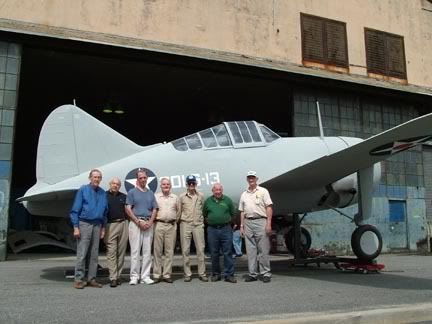
Ultimately you want something that "looks the part" and lasts long enough to justify the cost of the project. Nailing Beech 18 wings onto a Nanchang or a BT-13 fuselage and fitting it to a Norseman float won't cut it - not to mention that it'd all fall apart shortly in that salty environment. If it was me I'd be thinking along the lines of a welded steel framework fleshed out with commercial sheet metal, fiberglass, and wood. The only "real" bits I'd use might be an old -985 shell and a scrap prop. Didn't someone on the east coast mock up a couple of pretty good looking Brewster Buffaloes a few years ago? I'd talk to them about how they did it and what they might do differently in retrospect. They might even be interested in helping.
Thu Mar 14, 2013 1:56 pm
Dan Jones wrote:Didn't someone on the east coast mock up a couple of pretty good looking Brewster Buffaloes a few years ago? I'd talk to them about how they did it and what they might do differently in retrospect. They might even be interested in helping.
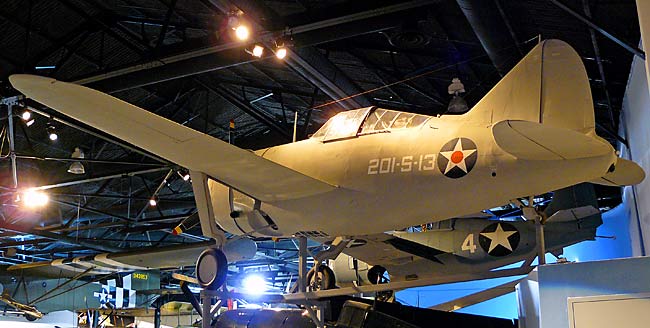
Volunteers from the Cradle of Aviation Museum on Long Island built a very realistic looking Buffalo replica.


More shots here:
http://www.williammaloney.com/Aviation/CradleOfAviationMuseum/BrewsterF2A2Buffalo/index.htm
Thu Mar 14, 2013 4:17 pm
CAPFlyer wrote:The problem with carving the shape is working with the density of foam needed for structure and weight and having to also build a metal skeleton to support the whole thing. This would make it difficult.
You could still use an internal frame made from stainless steel. The foam can also be carved out after the shell is completed. When assembled it would be no different than the Tallichet replicas (which did use a mold).
Fri Mar 15, 2013 5:09 am
Jason,
In my stock I have a T6 tubular that somebody butchered up and is only good for some kind of one-off project. There is an engine mount for an 1820 or 30 that fits it. It's in really good shape but I don' know what to do with it. Next time you are down this way feel free to come take a look.
Gary Henry
Powered by phpBB © phpBB Group.
phpBB Mobile / SEO by Artodia.