Tue Jun 15, 2004 5:48 am
Brett
As I said this is just my opinion and it is not fact as are your coments - at the end of the day governments make decisions - usually for fairly cynical reasons - in the UK for instance Governments make resources available through the lottery fund and in the US through various Government museums and private collections.
As you are aware this doesn't happen in Australia and for good measure the Government largely ignores their responsability by putting in place an unworkable legislation which isn't supported properly or balanced as you say by resources to support it It then fails to fund any meaningful contribution to National Aviation museums . I still agree that where possible aircraft of signifigance should stay here and we will have to agree to disagree over the 109 ( Although we should probably swap it with the recently grounded Hendon 109 which does have a 3sqn RAAF history!!!!).
Anyway thanks for your post and I think we are all roughly heading in a common direction . All good fun
Kindest regards
John Parker
As I said this is just my opinion and it is not fact as are your coments - at the end of the day governments make decisions - usually for fairly cynical reasons - in the UK for instance Governments make resources available through the lottery fund and in the US through various Government museums and private collections.
As you are aware this doesn't happen in Australia and for good measure the Government largely ignores their responsability by putting in place an unworkable legislation which isn't supported properly or balanced as you say by resources to support it It then fails to fund any meaningful contribution to National Aviation museums . I still agree that where possible aircraft of signifigance should stay here and we will have to agree to disagree over the 109 ( Although we should probably swap it with the recently grounded Hendon 109 which does have a 3sqn RAAF history!!!!).
Anyway thanks for your post and I think we are all roughly heading in a common direction . All good fun
Kindest regards
John Parker
AWM BF-109
Wed Jun 16, 2004 4:22 am
Dave,
My reference to the AWM selling the BF-109G as scrap came from an article by Bob Livingstone, a contributing editor to Flightpath magazine (Vol 5, No.4). He interviewed Roy Coburn, who was working for Doug Arnold in 1979 to prepare the 109 for export. The article tells the story from Roy's perspective, so may not be the most objective piece of reporting.
And guys, don't get me wrong. The AWM is the ideal place for the 109. As a timecapsule, it is an invaluable research item and teaching tool. A national museum with the ability to protect this artifact is the perfect place for it to be. My comments about how it is not covered by the Australian Moveable Heritage Act aren't an arguement to say that it shouldn't stay in Australia, but to point out that the legislation doesn't cover items that some people think it should.
Cheers,
Brett
My reference to the AWM selling the BF-109G as scrap came from an article by Bob Livingstone, a contributing editor to Flightpath magazine (Vol 5, No.4). He interviewed Roy Coburn, who was working for Doug Arnold in 1979 to prepare the 109 for export. The article tells the story from Roy's perspective, so may not be the most objective piece of reporting.
And guys, don't get me wrong. The AWM is the ideal place for the 109. As a timecapsule, it is an invaluable research item and teaching tool. A national museum with the ability to protect this artifact is the perfect place for it to be. My comments about how it is not covered by the Australian Moveable Heritage Act aren't an arguement to say that it shouldn't stay in Australia, but to point out that the legislation doesn't cover items that some people think it should.
Cheers,
Brett
Re: australian me 109
Sat Jan 01, 2011 8:01 pm
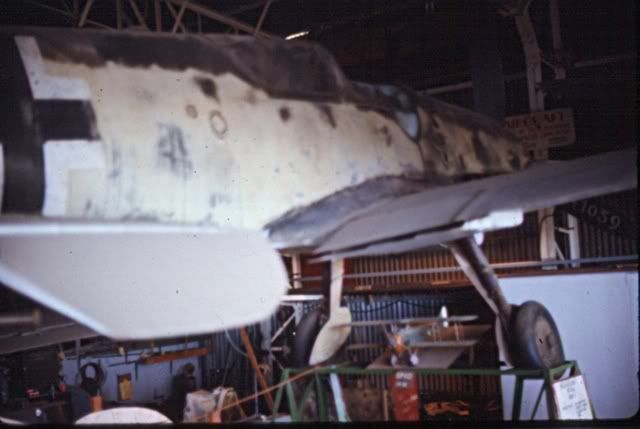
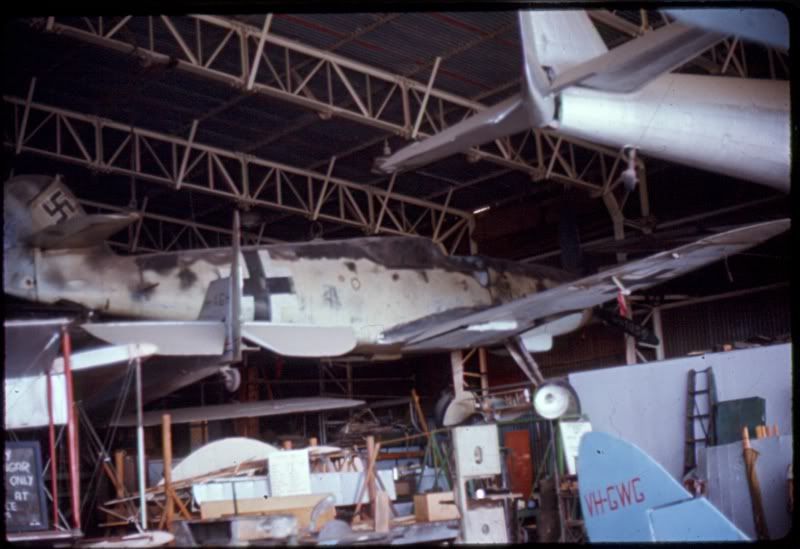
I have just posted these on another forum and have just picked up on this discussion. The photos were taken in Sid Marshall's hangar in Bankstown. I see that it is said that it was painted in silver yet the AWM says it is in original paintwork. Which is correct?
Re: australian me 109
Sat Jan 01, 2011 8:24 pm
Here is a colour photo of the Me109 on display in the Australian War Memorial museum.
http://www.awm.gov.au/exhibitions/strik ... /bf109.asp
http://www.awm.gov.au/exhibitions/strik ... /bf109.asp
Re: australian me 109
Sat Jan 01, 2011 8:28 pm
Nice shots-it was coated in a silver plastic type material as part of a clandestine effort to remove it from Oz. This peeled off, so didn't compromise the original paint work.
Tail of the Ki-43 Oscar at the right of the bottom shot ( restored to taxi in NZ and now at FHC, Seattle)
Tail of the Ki-43 Oscar at the right of the bottom shot ( restored to taxi in NZ and now at FHC, Seattle)
Re: australian me 109
Sat Jan 01, 2011 9:24 pm
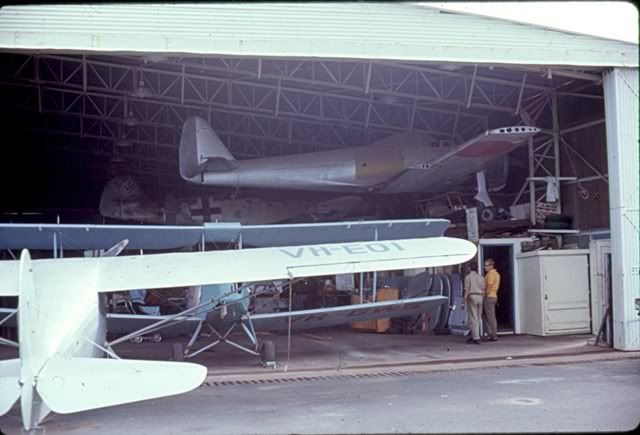
The Oscar.
Re: australian me 109
Sat Jan 01, 2011 9:31 pm
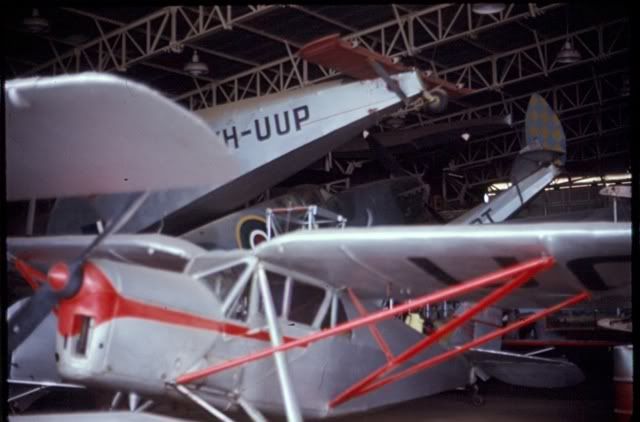
The Spifire.
\
\
Re:
Sat Jan 01, 2011 10:11 pm
Given the rising of this thread "from the dead" I felt it was worth while correcting some of the mis-information being provided above, regarding the Australian Moveable Cultural Heritage Laws:
Regardless of the motives and intentions of the exporter, and the "reasons" for spraying the airframe in a coating, the export was clearly illegal under the act, the resulting forfeiture evidences that.
The above analysis does not reflect the obligations under the Act itself, points "a to f" above in terms of "describing the object" for export are irrelevent to the exporters obligations under the act.
The reference to "the need to have an association with an Australian event or personality" is not the full criteria that the export of the 109 would be required to meet, the first being an export permit application, regardless of its significance to an Australian event of personality!
The reference to an Australian event or personality arises from section 9 of the regulations:
While its not associated with a person or event in Australian history the 109 clearly was an object being used against Australian's in war, that clause doesnt need the object to have specific use against persons or an event, Australia was at war with Germany, this is a German 109.
But those are not the only elements of the Act that are relevent to this story.
Clearly the remains of a Me 109 sitting in Australia immediately falls under clauses (d) and (j), but specifically under (j) in relation to the Control List:
The Control list is specified in the regulations:
The 109, complete or in parts clearly meet the criteria of section 4.4. (c), and regardless of being described as either "scrap or aircraft parts' clearly meets criteria 4.4 (c)(vi) "ANY" aircraft "engine", "equipment" "part".
The area of loop hole with the Me-109 "might" be its significance to Australia, but the exporter is not the one who gets to determine and decide that themselves:
Seperate to its very likely qualification under clause 9.4 above as an object used against Australian defence forces the significance would also be tested under clause 4.3.
The Me-109 was clearly not of Australian Origin, and was in use in Australia at least 30 years ago as a war prize and example of captured ww2 enemy aircraft, and is clearly covered by clause 4.4 as stated earlier, so it complies with clause 4.3 (b)(iii), and 4.3 (c) and as the only example in Australia it clearly complies with 4.3 (d).
The debate would be its significance to Australia under 4.3 (a) and if that would preclude its export - the buyer did not try to obtain an export permit, and therefore that significance was never assessed or determined - but note - its not the perogative of the exporter to determine and judge that significance. and to therefore not apply for an export permit on that self determination!
It seems clear that the attempted export of the 109 did not comply with Australia's Moveable Cultural Heritage Act or its regulations, as the object even as scrap (and that would likely extend to other recoveries such as "spitfire firewalls" recovered for their data plates) is clearly on the Control List as a Class B protected object.
The exporter was either ignorant of the law, mis-informed about the law as exampled by incorrect opinions above, or intentionally running the gauntlet of the known law.
I find it hard to believe a wealthy buyer purchasing a rare and expensive aircraft and with any knowledge of Australia's limitations of such exports would not have sought legal advice?, or even discussed it with their export agent who should have known the obligations in anycase.
The Act is clear that the obligation sits with the exporter to gain the correct permits or exemptions to remove a moveable cultural object from Australia:
Without resolving the debate as to the 109 being listed as "aircraft parts" or a "mustang" it did not have a valid export permit, it was a class B protected object that DID require such a permit, and the exporter had ommitted to apply for an export permit.
The aircraft was impounded and forfeited, without knowledge of any legal attempts by the exporter to regain ownership, the resulting ownership and display of the aircraft in the AWM suggests any such legal efforts were unsuccessful, if even attempted.
Australia is often criticised for this law, and its claimed imports and free trade of such objects should be permitted, yet the traffic of "significant" aircraft is predominately one way, and the imports are largely of "toys for the boys" or types that are not significant or relevent to Australia, and hardly compensation for the loss of aircraft with individual Australian connections not just by type.
The reality is those in countries such as the UK and US, with large wealthy populations and large/multiple Government collections do not face that result or threat, (at least until the economic pendulum swings further to China and India?), but that is simply arguing "free trade" on an un-even playing field.
Interestingly those same countries do not support free trade in Agriculture or automotive imports - I wonder why?
The earlier export of the Spitfire Mk VIII, predated this specific law and therefore has different attributes, the number of aircraft "denied" export can be counted on one hand.
But export outside of compliance with the Act is clearly an illegal act, as was the outcome of the attempted export of the 109, and its forfeiture.
Having being directly involved in a successful denial of export under the Act I support it fully.
regards
Mark Pilkington
As for the Bf109 being exported as a P-51, that was not the case. The Bf-109 was sprayed in Spraylat for protection (which gave it a silver finish) and was being exported as "aircraft parts", which seems a valid description considering that
a: this was the common description for disassembled aircraft
b: the aircraft was a hulk, or at least significantly distant from being airworthy
c: the aircraft had been sold as scrap by the AWM
d: the aircraft had never flown in Australia
e: the aircraft never had a civilian identity
f: it was illegal to fly ex-military aircraft in Australia at the time, so it could not have been registered as an aircraft anyway.
Customs were alerted to the export by local historians, concerned that an item of significance was being exported. Advising Customs that some skullduggery was afoot with regard to exporting the Bf-109 as a Mustang (which I understand did have the correct paperwork for export) resulted in Customs seizing both aircraft.
It is worth noting that the Bf-109 still does not meet the criteria as an aircraft that would be denied an export certificate. To meet the criteria it would need to have an association with an Australian event or personality. The Bf-109 might be 'representative' of an aircraft that meets that criteria, but this particular individual aircraft does not.
Regardless of the motives and intentions of the exporter, and the "reasons" for spraying the airframe in a coating, the export was clearly illegal under the act, the resulting forfeiture evidences that.
The above analysis does not reflect the obligations under the Act itself, points "a to f" above in terms of "describing the object" for export are irrelevent to the exporters obligations under the act.
The reference to "the need to have an association with an Australian event or personality" is not the full criteria that the export of the 109 would be required to meet, the first being an export permit application, regardless of its significance to an Australian event of personality!
The reference to an Australian event or personality arises from section 9 of the regulations:
9.1 This Part lists heritage objects of the category Objects of Historical Significance.
9.2 An object is in this category if it is:
(a) an object of the kind mentioned in item 9.2A; or
(b) an object of the kind mentioned in item 9.3 that:
(i) is associated with a person, activity, event, place or business enterprise, notable in Australian history; and
(ii) is at least 30 years old; and
(iii) is not represented in at least 2 public collections in Australia by an object of equivalent quality.
While its not associated with a person or event in Australian history the 109 clearly was an object being used against Australian's in war, that clause doesnt need the object to have specific use against persons or an event, Australia was at war with Germany, this is a German 109.
9.4 In this Part:
Australian military history means the history of:
(a) wars, and operations or activities relating to warfare, in which Australians have been actively engaged; and
(b) any army, navy or air force unit in which Australians have taken part; and
(c) the Australian Defence Force; and
(d) operations, or other activities, conducted in Australia by any army, navy or air force personnel or unit of a country other than Australia; and
(e) objects used against the Australian Defence Force, whether in Australia or overseas.
But those are not the only elements of the Act that are relevent to this story.
(1) A reference in section 8 to the movable cultural heritage of Australia is a reference to objects that are of importance to Australia , or to a particular part of Australia , for ethnological, archaeological, historical, literary, artistic, scientific or technological reasons, being objects falling within one or more of the following categories:
....
...
..
(d) military objects;
...
..
(g) objects of scientific or technological interest;
...
..
(j) any other prescribed categories.
Clearly the remains of a Me 109 sitting in Australia immediately falls under clauses (d) and (j), but specifically under (j) in relation to the Control List:
(1) Subject to subsection (2), the regulations shall prescribe a list, to be known as the National Cultural Heritage Control List, of categories of objects that constitute the movable cultural heritage of Australia and are to be subject to export control.
(2) The Control List shall divide such objects into 2 classes, namely:
(a) Class A objects, being objects that are not to be exported otherwise than in accordance with a certificate; and
(b) Class B objects, being objects that are not to be exported otherwise than in accordance with a permit or certificate.
(3) Subsection (2) does not prevent the division of Class A objects and Class B objects into sub-classes and other divisions or categories
The Control list is specified in the regulations:
4.4 Objects in this category are Class B objects for the Act, and include:
(a) any agricultural object, including:
(i) an object used for agricultural production; and
(ii) an object used for processing agricultural products; and
(iii) an object relating to an industry producing products for use in agriculture; and
(iv) any tool, implement or equipment used or intended for use in agriculture or in farming life; and
(v) scientific equipment relating to agricultural research; and
(vi) any other thing related to agriculture; and
(b) any engineering object, including:
(i) a manufactured object relating to any branch of engineering, including any object that is a machine or hand tool, engine or workshop equipment, a control system or control mechanism, or an invention, prototype or related model or patent object; and
(ii) any other thing related to engineering; and
(c) any object of air transport, including:
(i) any lighter-than-air craft, including an airship; and
(ii) a glider, or kite, including a hang glider; and
(iii) any power driven aircraft; and
(iv) any equipment used, or intended for use, in aircraft manufacture or repair; and
(v) any aircraft communication and guidance system, or component of that kind of system; and
(vi) any aircraft instrument, engine, equipment, part or weapon; and
(vii) any prototype aircraft or experimental material relating to the design or manufacture of aircraft; and(viii) any other thing related to air transport; and
The 109, complete or in parts clearly meet the criteria of section 4.4. (c), and regardless of being described as either "scrap or aircraft parts' clearly meets criteria 4.4 (c)(vi) "ANY" aircraft "engine", "equipment" "part".
The area of loop hole with the Me-109 "might" be its significance to Australia, but the exporter is not the one who gets to determine and decide that themselves:
4.3 An object is in this category if:
(a) it is of significance to Australia; and
(b) for an object:
(i) of Australian origin — it was made in Australia at least 30 years ago; or
(ii) that has substantial Australian content — the Australian content was made in Australia at least 30 years ago; or
(iii) that is not of Australian origin — it was in use in Australia at least 30 years ago; and
(c) it is an object of the kind mentioned in item 4.4; and
(d) it is not represented in at least 2 public collections in Australia by an object of equivalent quality.
Seperate to its very likely qualification under clause 9.4 above as an object used against Australian defence forces the significance would also be tested under clause 4.3.
The Me-109 was clearly not of Australian Origin, and was in use in Australia at least 30 years ago as a war prize and example of captured ww2 enemy aircraft, and is clearly covered by clause 4.4 as stated earlier, so it complies with clause 4.3 (b)(iii), and 4.3 (c) and as the only example in Australia it clearly complies with 4.3 (d).
The debate would be its significance to Australia under 4.3 (a) and if that would preclude its export - the buyer did not try to obtain an export permit, and therefore that significance was never assessed or determined - but note - its not the perogative of the exporter to determine and judge that significance. and to therefore not apply for an export permit on that self determination!
Grant of permits in respect of particular objects
(1) A person may apply to the Minister for a permit to export a Class B object.
(2) An application shall be made in writing in the prescribed form, or, if no form is prescribed, the form approved by the Minister.
(3) On receipt of an application, the Minister shall refer it to the Committee and the Committee shall refer it to one or more expert examiners.
(4) The expert examiner or examiners shall submit to the Committee a written report on the application, and the Committee shall forward the report to the Minister together with the written recommendations (if any) made by the Committee.
(5) The Minister shall consider the report and recommendations (if any) and:
(a) grant a permit to export the Class B object concerned, subject to such conditions (if any) as the Minister specifies; or
(b) refuse to grant a permit.
(6) In considering the application, an expert examiner, the Committee and the Minister:
(a) shall have regard, among other things, to the reasons referred to in subsection 7(1) that are relevant to the object to which the application relates; and
(b) if satisfied that the object is of such importance to Australia, or a part of Australia, for those reasons, that its loss to Australia would significantly diminish the cultural heritage of Australia—shall not recommend the grant of a permit, or grant a permit, as the case may be, to export the object permanently.
(7) If the Minister refuses to grant the permit, the Minister shall, within the prescribed period after the decision is made, cause to be served on the applicant notice in writing of the refusal, setting out the reasons for the refusal.
It seems clear that the attempted export of the 109 did not comply with Australia's Moveable Cultural Heritage Act or its regulations, as the object even as scrap (and that would likely extend to other recoveries such as "spitfire firewalls" recovered for their data plates) is clearly on the Control List as a Class B protected object.
The exporter was either ignorant of the law, mis-informed about the law as exampled by incorrect opinions above, or intentionally running the gauntlet of the known law.
I find it hard to believe a wealthy buyer purchasing a rare and expensive aircraft and with any knowledge of Australia's limitations of such exports would not have sought legal advice?, or even discussed it with their export agent who should have known the obligations in anycase.
The Act is clear that the obligation sits with the exporter to gain the correct permits or exemptions to remove a moveable cultural object from Australia:
Unlawful exports
(1) Where a person exports an Australian protected object otherwise than in accordance with a permit or certificate, the object is forfeited.
(2) Where a person attempts to export an Australian protected object otherwise than in accordance with a permit or certificate, the object is liable to forfeiture.
(3) A person is guilty of an offence if:
(a) the person exports, or attempts to export, an object; and
(b) the object is an Australian protected object; and
(c) the person’s conduct referred to in paragraph (a) is otherwise than in accordance with a permit or certificate.
(3A) A person is guilty of an offence if:
(a) a permit or certificate relates to an Australian protected object; and
(b) the person engages in conduct; and
(c) the conduct contravenes a condition of the permit or certificate.
(3B) A person who is convicted of an offence against subsection (3) or (3A) is punishable by:
(a) if the person is an individual—a fine not exceeding 1,000 penalty units or imprisonment for a period not exceeding 5 years, or both; or
(b) if the person is a body corporate—a fine not exceeding 2,000 penalty units.
Note: See subsection 46(4) for penalties that may be imposed by a court of summary jurisdiction.
(4) For the purposes of this section, an object shall be taken to be exported at the time when:
(a) the object has been placed on board a ship or aircraft at a particular place in Australia with the intention that it be taken out of Australia by that ship or aircraft and the departure of the ship or aircraft from that place has commenced; or
(b) the object has been delivered as a postal article into the control of the Australian Postal Corporation at a particular place in Australia with the intention that it be sent out of Australia by post and the movement of the postal article from that place has commenced.
(5) Without limiting the meaning of references in this section to a person attempting to export an object, a person shall be taken to attempt to export an object if the person conveys, or has possession of, the object with intent to export it or knowing that it is intended to be exported.
(6) For the purposes of this section, a person who exports or attempts to export an Australian protected object shall be taken to export, or attempt to export, the object otherwise than in accordance with a permit or certificate unless, before exporting or attempting to export the object, the person produces a permit or certificate authorising the export:
(a) where the export is not from an external Territory to an officer of Customs; or
(b) where the export is from an external Territory—to an inspector performing duties in relation to the export of Australian protected objects.
(7) In this section:
"engage in conduct" means:
(a) do an act; or
(b) omit to perform an act.
Without resolving the debate as to the 109 being listed as "aircraft parts" or a "mustang" it did not have a valid export permit, it was a class B protected object that DID require such a permit, and the exporter had ommitted to apply for an export permit.
The aircraft was impounded and forfeited, without knowledge of any legal attempts by the exporter to regain ownership, the resulting ownership and display of the aircraft in the AWM suggests any such legal efforts were unsuccessful, if even attempted.
Australia is often criticised for this law, and its claimed imports and free trade of such objects should be permitted, yet the traffic of "significant" aircraft is predominately one way, and the imports are largely of "toys for the boys" or types that are not significant or relevent to Australia, and hardly compensation for the loss of aircraft with individual Australian connections not just by type.
The reality is those in countries such as the UK and US, with large wealthy populations and large/multiple Government collections do not face that result or threat, (at least until the economic pendulum swings further to China and India?), but that is simply arguing "free trade" on an un-even playing field.
Interestingly those same countries do not support free trade in Agriculture or automotive imports - I wonder why?
The earlier export of the Spitfire Mk VIII, predated this specific law and therefore has different attributes, the number of aircraft "denied" export can be counted on one hand.
But export outside of compliance with the Act is clearly an illegal act, as was the outcome of the attempted export of the 109, and its forfeiture.
Having being directly involved in a successful denial of export under the Act I support it fully.
regards
Mark Pilkington
Re: australian me 109
Sat Jan 01, 2011 11:45 pm
nice explanation of the law mark,i wonder why this law failed in the case of the spitfire now at the nmusaf?
it was granted an export permit on the grounds that it had been partially restored therefore no longer a historic artifact,seems odd to me seeing as the law seems to indicate the parts are protected.
i'm not against a market in historic aircraft but a genuine ex raaf mkvc seems to me one thing that this law should protect,hell the awm stepped in when the p-40 "polly" was being restored to fly as it was a genuine survivor of the milne bay operations and therefore to valuable to be risked by being flown.
it was granted an export permit on the grounds that it had been partially restored therefore no longer a historic artifact,seems odd to me seeing as the law seems to indicate the parts are protected.
i'm not against a market in historic aircraft but a genuine ex raaf mkvc seems to me one thing that this law should protect,hell the awm stepped in when the p-40 "polly" was being restored to fly as it was a genuine survivor of the milne bay operations and therefore to valuable to be risked by being flown.
Re: australian me 109
Sun Jan 02, 2011 1:23 am
Unfortunately the reports from the Expert Examiners are not made public (to my knowledge) and therefore cannot be easily challenged or scrutinised at the time by third parties, let alone used to understand precedents, use as examples/ education etc.
I dont know much about the history of the AWM's acquisition of the P-40 from Nelson Wilson who was restoring the aircraft to fly for many years, I understood they purchased it directly and I'm not sure it was ever listed for export.
In regards to the NMUSAF Mark V Spitfire, I know this airframe quite well, having been associated with it from the time the owner acquired it, helping move it and watching/filming its restoration, and even spending some time bucking rivets on it myself.
From private feedback I understand it qualified for export due to the substantial reproduction of its fuselage (the original section of fuselage was little more than the lower half of the cockpit section) therefore its intactness as an original airframe was compromised, it was considered a hybrid of restoration and reproduction, and on that basis I consider it was at risk.
I also suspect it was contrasted against the two other spitfires "in public collections", the mark II in the AWM (although that is an object of the European war not the Pacific or defence of Darwin) and the mark Vc in SAAM (although that is privately owned and therefore strictly not "in" a public collection).
It would have therefore been an interesting case study.
I personally would have preferred it to have been acquired by the RAAFM and retained in Australia given its history, however the RAAFM had opportunities to do so long before it left Australia if there was interest.
I personally would have preferred the mark I Beaufighter to remain in Australia and be acquired by the AWM, however again the AWM had opportunities to do so before it left Australia, I'm not sure that its export was under this Act so I cant comment on its assessment? (The Act was promulgated in 1987, I recall the Beaufighter was exported in 1986?)
As Setter mentions above, the Oscar was another export that seemed difficult to explain, and similarly there are other examples of concern that I wont list here.
Australia introduced this Act after the loss of many aircraft across the 1960s to 1980s including an original Maurice Farman Shorthorn from Point Cooks early days (now in the Canadian National Collection), the last Supermarine Seagull (now in the RAF Museum) etc
While the Act tried to stem this exodus, the lack of transparency of the export permit and expert examiner process, including the lack of third party scrutiny and appeal has caused many to be concerned that the process is open to manipulation or poor assessment.
In addition, while the Act has a fund to allow collections to acquire significant aircraft to avoid them being exported, that aspect is difficult to utilise, and as most of the government/public collections are military collections, the export focus and concern seems to fall primarily onto military aircraft.
Unfortunately there is still no government funded National Aviation Museum to pursue types such as civil aircraft, and interestingly Australia has recently lost Avro Avians, Junkers 50 , and I believe a Westland Widgeon, yet its hard to discover any of these existing in the form of 2 equivalent examples in Public Collections?, and I do wonder if they are all departing with valid export permits?
The simple issue is - export of an aircraft, or parts, including engine, from Australia, that is over 30 years old, requires an export permit from the Minister, and that process requires an examination of the significance of the object under the act, and testing against the export criteria.
Regards
Mark Pilkington
I dont know much about the history of the AWM's acquisition of the P-40 from Nelson Wilson who was restoring the aircraft to fly for many years, I understood they purchased it directly and I'm not sure it was ever listed for export.
In regards to the NMUSAF Mark V Spitfire, I know this airframe quite well, having been associated with it from the time the owner acquired it, helping move it and watching/filming its restoration, and even spending some time bucking rivets on it myself.
From private feedback I understand it qualified for export due to the substantial reproduction of its fuselage (the original section of fuselage was little more than the lower half of the cockpit section) therefore its intactness as an original airframe was compromised, it was considered a hybrid of restoration and reproduction, and on that basis I consider it was at risk.
I also suspect it was contrasted against the two other spitfires "in public collections", the mark II in the AWM (although that is an object of the European war not the Pacific or defence of Darwin) and the mark Vc in SAAM (although that is privately owned and therefore strictly not "in" a public collection).
It would have therefore been an interesting case study.
I personally would have preferred it to have been acquired by the RAAFM and retained in Australia given its history, however the RAAFM had opportunities to do so long before it left Australia if there was interest.
I personally would have preferred the mark I Beaufighter to remain in Australia and be acquired by the AWM, however again the AWM had opportunities to do so before it left Australia, I'm not sure that its export was under this Act so I cant comment on its assessment? (The Act was promulgated in 1987, I recall the Beaufighter was exported in 1986?)
As Setter mentions above, the Oscar was another export that seemed difficult to explain, and similarly there are other examples of concern that I wont list here.
Australia introduced this Act after the loss of many aircraft across the 1960s to 1980s including an original Maurice Farman Shorthorn from Point Cooks early days (now in the Canadian National Collection), the last Supermarine Seagull (now in the RAF Museum) etc
While the Act tried to stem this exodus, the lack of transparency of the export permit and expert examiner process, including the lack of third party scrutiny and appeal has caused many to be concerned that the process is open to manipulation or poor assessment.
In addition, while the Act has a fund to allow collections to acquire significant aircraft to avoid them being exported, that aspect is difficult to utilise, and as most of the government/public collections are military collections, the export focus and concern seems to fall primarily onto military aircraft.
Unfortunately there is still no government funded National Aviation Museum to pursue types such as civil aircraft, and interestingly Australia has recently lost Avro Avians, Junkers 50 , and I believe a Westland Widgeon, yet its hard to discover any of these existing in the form of 2 equivalent examples in Public Collections?, and I do wonder if they are all departing with valid export permits?
The simple issue is - export of an aircraft, or parts, including engine, from Australia, that is over 30 years old, requires an export permit from the Minister, and that process requires an examination of the significance of the object under the act, and testing against the export criteria.
Regards
Mark Pilkington
Re: australian me 109
Sun Jan 02, 2011 9:25 am
thanks for your input mark
i only mentioned the awm pf40 not because it was going to exported but that it was acquired(i believe your right about it being bought direct for nelson)but that they deemed it to historic to fly so they bought it to save it from the risks involved in flying(iirc it was headlined as being rescued in the 11th hour) so they seem to be able to find the money to "rescue" these artifacts when it suits them but not so much when something significant(like the mk1 beau or ki43).in my opinion both of these should never have left this country!!
as for the spitfire it seems your right about the "hybrid" nature of that restoration being the reason it was aloud to leave,but iirc the aircraft you helped save is pretty much a hybrid of many different airframes (btw i'm glad you did save it from leaving)although all original ones not new build.
as i said in my earlier post i'm not against the proper sale of warbirds (i would never been able to see a flying meteor for one thing!!)but certain historic airframes Representative of aircraft that our forefathers used in battle or fought against should never be sold(can you imagine the outcry if the NASM sold flakbait or the NUSAFM sold bocks car)
Paul
i only mentioned the awm pf40 not because it was going to exported but that it was acquired(i believe your right about it being bought direct for nelson)but that they deemed it to historic to fly so they bought it to save it from the risks involved in flying(iirc it was headlined as being rescued in the 11th hour) so they seem to be able to find the money to "rescue" these artifacts when it suits them but not so much when something significant(like the mk1 beau or ki43).in my opinion both of these should never have left this country!!
as for the spitfire it seems your right about the "hybrid" nature of that restoration being the reason it was aloud to leave,but iirc the aircraft you helped save is pretty much a hybrid of many different airframes (btw i'm glad you did save it from leaving)although all original ones not new build.
as i said in my earlier post i'm not against the proper sale of warbirds (i would never been able to see a flying meteor for one thing!!)but certain historic airframes Representative of aircraft that our forefathers used in battle or fought against should never be sold(can you imagine the outcry if the NASM sold flakbait or the NUSAFM sold bocks car)
Paul
Re: australian me 109
Sat Jun 23, 2012 2:08 pm
Hi everybody. I thought I would add what I can to this discussion from memory. I was only a kid at the time but my father Roy spoke about the “whole sorry affair” for many years afterwards.
My father was employed by Mr Arnold to oversee the proper dismantling of the aircraft in his capacity as a licensed aircraft engineer. It was to be a gift to the Dusseldorf??? War Museum in honour of the Luftwaffe pilots who lost their lives during WW2 and was to go with a Spitfire that had already been donated. A very fitting tribute in my opinion.
Not true. The aircraft was seized and spent the following years in a storage shed at Regents Park far away from the view of the “general public” tied up in bureaucratic red tape to nobodys benefit.
The 2 aircraft and 10 merlin engines (I think) were listed as aircraft parts which is exactly what they were no matter what the Act says. What’s an engine if it isn’t an aircraft part? This approach was taken due to a total lack of confidence in the Australian Government at the time.
Well that covers everything ever used in a “World War” don’t you think? This particular aircraft was of no historical significance to Australia whatsoever.
Nobody had to be sharp eyed as there was never any attempt to dismantle the aircraft in secret. All of this took place in the Illawarra hangar in full view of anybody that cared to watch.
I agree with all of that.
As I said it was buried away in a storage shed in Regents Park. A very sad end at the time. I believe it was only thru the efforts of some concerned members of the aviation community, of which I think my father was one, that it was eventually resurrected and is now on display at the AWM.
Incorrect. As I said there was nothing clandestine about it. As Brett rightly pointed out the Bf-109 was sprayed in Spraylat for protection of the original paintwork during shipping. Evidently it did a good job.
It was after getting legal advice that the course of action was chosen. As I said Mr Arnold had no confidence in the Government to see that the 109 was not of historical significance to Australia.
So were rocks. To suggest that because 109’s were shooting at Australians over Europe gives it historical significance to Australia is absurd in my opinion. Surely “historical significance to Australia” is referring to Australian shores is it not?
At the end of this sorry mess the main players all left the country before the customs officials arrived after being tipped off. The only person arrested was my father even though he was employed only to see that the Bf-109 was correctly dismantled and put into the container while not involved in the attempted export whatsoever. He was found guilty of smuggling at the first trial and faced 8 years in prison suspended on appeal to the High Court where he was found not guilty with the apologies of the court. Thankfully all his legal costs were covered personally by Mr Arnold.
Have a nice day.
Leon.
Brett wrote: He interviewed Roy Coburn, who was working for Doug Arnold in 1979 to prepare the 109 for export
My father was employed by Mr Arnold to oversee the proper dismantling of the aircraft in his capacity as a licensed aircraft engineer. It was to be a gift to the Dusseldorf??? War Museum in honour of the Luftwaffe pilots who lost their lives during WW2 and was to go with a Spitfire that had already been donated. A very fitting tribute in my opinion.
Ben wrote:The Australian customs stopped the export and returned it to the museum
Not true. The aircraft was seized and spent the following years in a storage shed at Regents Park far away from the view of the “general public” tied up in bureaucratic red tape to nobodys benefit.
DaveM2 wrote: Customs stopped the export due to false documentation which tried to describe the aircraft as something it wasn't [ ie less valuable ]
The 2 aircraft and 10 merlin engines (I think) were listed as aircraft parts which is exactly what they were no matter what the Act says. What’s an engine if it isn’t an aircraft part? This approach was taken due to a total lack of confidence in the Australian Government at the time.
setter wrote: The aircraft was refused an export order as it was of historical significance
Well that covers everything ever used in a “World War” don’t you think? This particular aircraft was of no historical significance to Australia whatsoever.
Guest wrote:apparently only a sharp eyed Customs official, who was a warbird aficianado stopped the export
Nobody had to be sharp eyed as there was never any attempt to dismantle the aircraft in secret. All of this took place in the Illawarra hangar in full view of anybody that cared to watch.
Brett wrote: As for the Bf109 being exported as a P-51, that was not the case. The Bf-109 was sprayed in Spraylat for protection (which gave it a silver finish) and was being exported as "aircraft parts", which seems a valid description considering that
a: this was the common description for disassembled aircraft
b: the aircraft was a hulk, or at least significantly distant from being airworthy
c: the aircraft had been sold as scrap by the AWM
d: the aircraft had never flown in Australia
e: the aircraft never had a civilian identity
f: it was illegal to fly ex-military aircraft in Australia at the time, so it could not have been registered as an aircraft anyway
I agree with all of that.
DaveM2 wrote: It is my understanding the 109 was sold as there was no space for it at the AWM at the time
As I said it was buried away in a storage shed in Regents Park. A very sad end at the time. I believe it was only thru the efforts of some concerned members of the aviation community, of which I think my father was one, that it was eventually resurrected and is now on display at the AWM.
DaveM2 wrote: it was coated in a silver plastic type material as part of a clandestine effort to remove it from Oz
Incorrect. As I said there was nothing clandestine about it. As Brett rightly pointed out the Bf-109 was sprayed in Spraylat for protection of the original paintwork during shipping. Evidently it did a good job.
Mark_Pilkington wrote: I find it hard to believe a wealthy buyer purchasing a rare and expensive aircraft and with any knowledge of Australia's limitations of such exports would not have sought legal advice?
It was after getting legal advice that the course of action was chosen. As I said Mr Arnold had no confidence in the Government to see that the 109 was not of historical significance to Australia.
Mark_Pilkington wrote: While its not associated with a person or event in Australian history the 109 clearly was an object being used against Australian's in war
So were rocks. To suggest that because 109’s were shooting at Australians over Europe gives it historical significance to Australia is absurd in my opinion. Surely “historical significance to Australia” is referring to Australian shores is it not?
At the end of this sorry mess the main players all left the country before the customs officials arrived after being tipped off. The only person arrested was my father even though he was employed only to see that the Bf-109 was correctly dismantled and put into the container while not involved in the attempted export whatsoever. He was found guilty of smuggling at the first trial and faced 8 years in prison suspended on appeal to the High Court where he was found not guilty with the apologies of the court. Thankfully all his legal costs were covered personally by Mr Arnold.
Have a nice day.
Leon.
Re: australian me 109
Sun Jun 24, 2012 1:08 am
Leon Coburn wrote:Mark_Pilkington wrote: I find it hard to believe a wealthy buyer purchasing a rare and expensive aircraft and with any knowledge of Australia's limitations of such exports would not have sought legal advice?
It was after getting legal advice that the course of action was chosen. As I said Mr Arnold had no confidence in the Government to see that the 109 was not of historical significance to Australia.Mark_Pilkington wrote: While its not associated with a person or event in Australian history the 109 clearly was an object being used against Australian's in war
So were rocks. To suggest that because 109’s were shooting at Australians over Europe gives it historical significance to Australia is absurd in my opinion. Surely “historical significance to Australia” is referring to Australian shores is it not?
At the end of this sorry mess the main players all left the country before the customs officials arrived after being tipped off. The only person arrested was my father even though he was employed only to see that the Bf-109 was correctly dismantled and put into the container while not involved in the attempted export whatsoever. He was found guilty of smuggling at the first trial and faced 8 years in prison suspended on appeal to the High Court where he was found not guilty with the apologies of the court. Thankfully all his legal costs were covered personally by Mr Arnold.
Have a nice day.
Leon.
Hello Leon,
I'm sure your father was simply employed to undertake engineering work but you also seem to clearly indicate the export was intentionally flouting Australian Law, following the provision of specific legal advice of how to try and do so?
The object was successfully impounded and forfeited under the law, and while your father might have had his conviction overturned on appeal I suspect the others who fled Australia on tip-off might not have been so fortunate had they been apprehended.
N0 - the object doesnt need to have been involved in War on Australian soil to be "significant to Australia" or covered by the act:
9.4 In this Part:
Australian military history means the history of:
(a) wars, and operations or activities relating to warfare, in which Australians have been actively engaged; and
(b) any army, navy or air force unit in which Australians have taken part; and
(c) the Australian Defence Force; and
(d) operations, or other activities, conducted in Australia by any army, navy or air force personnel or unit of a country other than Australia; and
(e) objects used against the Australian Defence Force, whether in Australia or overseas.
Australia was at war with Germany, the RAAF was flying Lancaster missions in Europe and was facing such German aircraft in combat! as did Australians in RAF Fighter Command and Coastal Command. Only 2% of Australians serving in WW2 flew in Bomber Command, yet they represented 20% of Australian casualties, and the largest contribution of RAAF casualties.
Its why Avro Lancaster G for George has a pride of place within the AWM, yet it never flew in combat over Australia either, but it is considered by most to be of great significance to Australia.
The 109 clearly has some significance to Australians under the act even if it didnt fight over Australian soil, your opinion might be different to mine, and to a formal assessor under the act, which is why the opinion of a formal assessor is what counts.
On your opinion, no enemy material captured or confiscated from the opposing forces against Australian's other than on Australian soil has any significance to Australia?
I guess the same then extends to a beach or lone pine tree in Turkey somewhere too?, or pieces of the Fokker Triplane of the Red Baron shot down by Australian ground forces?
Significance is not measured by geographic location of use? its measured by association or links to an important historical event, or period or person.
The issue here is the oversea's purchaser strongly suspected the export permit application would be un-successful and so imtentionally chose not to apply for one at all, - an illegal act in itself, the suspicion of the motives for presenting the aircraft in silver spray on latex, and documenting it as a Mustang or "aircraft parts" all follows from that clear motive and clear intent to break the law.
In the US legal system they look for "motive", I think the actions clearly fit with the motive.
The act requires an export permit for "aircraft" or "aircraft parts" as well, so your and Brett's previous suggestions that there was no attempt to fraudulently export the aircraft simply by not declaring it as a 109 do not fit the facts or even your own advice above, especially since the exporter is claimed to have sought legal advice and all this was done due to a "lack of confidence" in the Australian government? ie it was concern the item "would be" determined to be "significant" and "denied" export!
Taken the extreme, someone might seek to export Smithy's Fokker or the Smith Brothers Vimy on the basis that their exploits relate to flights originating elsewhere overseas, and over international waters and other many countries and so they are just as significant (or more so?) to the USA or the UK, and therefore worthy of better display elsewhere
- "so if I can just sneak them out without asking"
Hence from your proverbial rock, to the 109 under discussion, or those two iconic Australian historic aircraft, the significance isnt left to the exporter to determine.
4.4 Objects in this category are Class B objects for the Act, and include:
(a) any agricultural object, including:
(i) an object used for agricultural production; and
(ii) an object used for processing agricultural products; and
(iii) an object relating to an industry producing products for use in agriculture; and
(iv) any tool, implement or equipment used or intended for use in agriculture or in farming life; and
(v) scientific equipment relating to agricultural research; and
(vi) any other thing related to agriculture; and
(b) any engineering object, including:
(i) a manufactured object relating to any branch of engineering, including any object that is a machine or hand tool, engine or workshop equipment, a control system or control mechanism, or an invention, prototype or related model or patent object; and
(ii) any other thing related to engineering; and
(c) any object of air transport, including:
(i) any lighter-than-air craft, including an airship; and
(ii) a glider, or kite, including a hang glider; and
(iii) any power driven aircraft; and
(iv) any equipment used, or intended for use, in aircraft manufacture or repair; and
(v) any aircraft communication and guidance system, or component of that kind of system; and
(vi) any aircraft instrument, engine, equipment, part or weapon; and(vii) any prototype aircraft or experimental material relating to the design or manufacture of aircraft; and(viii) any other thing related to air transport; and
No legal "wriggle room" or "ambiguity" there, remembering this Act was written in direct response to an earlier complete Spitfire being described for export to the UK as "aircraft scrap metal".
Clearly the concern it "would be" considered of "significance" to Australia was sufficient to encourage the purchaser to attempt the illegal export attempt, and so clearly even the purchaser considered there was some "significance".
And yes even a rock, if thrown at Gallipoli and hitting Simpson off his Mule, might be refused export due to being considered being of "great significance" to Australia, it again depends on the specifics of the objects links to Australia and the findings of an expert assessment.
It is the "level" of significance that defines if the object is denied an export permit, and that judgement is not left to the exporter for obvious reasons, nor to your or my opinions.
The fact that you consider its absurd that it might be assessed as significant to Australia doesnt allow you, or your father, or the purchaser to simply export it on your own opinions.
I'm sorry for your father's result of being left by the purchaser to "carry the can", particularly if he honestly wasnt aware of the law, and that might be the reason for his acquittal, but a crime was clearly committed, and apparantly with the full knowledge of the purchaser and with specific legal advice too?
I'm pleased your father had his conviction quashed, but lets not white wash what occurred here.
Unlawful exports
(1) Where a person exports an Australian protected object otherwise than in accordance with a permit or certificate, the object is forfeited.
(2) Where a person attempts to export an Australian protected object otherwise than in accordance with a permit or certificate, the object is liable to forfeiture.
(3) A person is guilty of an offence if:
(a) the person exports, or attempts to export, an object; and
(b) the object is an Australian protected object; and
(c) the person’s conduct referred to in paragraph (a) is otherwise than in accordance with a permit or certificate.
(3A) A person is guilty of an offence if:
(a) a permit or certificate relates to an Australian protected object; and
(b) the person engages in conduct; and
(c) the conduct contravenes a condition of the permit or certificate.
(3B) A person who is convicted of an offence against subsection (3) or (3A) is punishable by:
(a) if the person is an individual—a fine not exceeding 1,000 penalty units or imprisonment for a period not exceeding 5 years, or both; or
Lawyers providing advice dont make the law, nor do our individual opinions, or those purchasers who wish to export the objects, the Act is quite specific and clear in regards to exporting aircraft or aircraft parts, and in this case its clear a law was broken intentionally, and the objects (109 and Mustang) forfeited on those grounds.
I note the confiscation was not ever overturned and the objects were not released to the purchaser for export!
Perhaps at the time Australia should have tried extraditing the principals back from overseas, rather than simply prosecuting the "local hired help" as a way of enforcing the act, and stopping further attempts to side step it.
I hope next time they are!
regards
Mark Pilkington
Last edited by Mark_Pilkington on Sun Jun 24, 2012 2:19 am, edited 3 times in total.
Re: australian me 109
Sun Jun 24, 2012 1:37 am
I am confused.
Did the 109 belong to a free and private citizen of Australia?
Was it sold to a free and private citizen of Britain?
Then it wasn't allowed to be exported?
Just curious.
Chris...
Did the 109 belong to a free and private citizen of Australia?
Was it sold to a free and private citizen of Britain?
Then it wasn't allowed to be exported?
Just curious.
Chris...
Re: australian me 109
Sun Jun 24, 2012 1:44 am
I realise this aircraft has been in storage and with the AWM for many years, anyone have an idea of when the engine was last run?