|
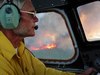
Flying low and slow in turbulent conditions and fluctuating visibility deep in a canyon full of snags will never be completely safe or easy on airframes.That said,it is possible to operate a suitable aircraft regularly under these conditions with careful general and type-specific airframe and engine inspections.It is obviously helpful to operate well within the design limits of the the airframe.Most tanker pilots,including MAFFS guys,get the job done without doing anything too spectacular.Actually,most of the time,especially on Initial Attack missions to small fires,the conditions are relatively benign,other than operating close to the ground where situational awareness is the key to survival.
Once in a while,you'll see an impossible looking maneuver performed on a retardant drop on the news or in print.Most of the time these are the result of camera angles and/or long lenses.I'm not saying that we don't have to get in and out of some deep and tight places,but,I for one,look the situation over very carefully prior to comitting myself and my co-pilot to a retardant run.I also let my c/p know what the plan is and how we will recover and possible escape routes and hazards.
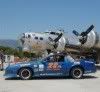
I learned the business in B-17's.I learned to plan escape routes out for several miles because you weren't likely to climb out of a hole very quickly.The DC-7 is an improvement,but we use a climb speed of 170 kts clean in the DC-7 vs.140mph in the B-17.so,everything happens more quickly in the "7" vs. the "17".In the DC-7 and most other tankers (now limited pretty much to P-2's and P-3's in the 2000-3000 gallon capacity for retardant) our speed in the drop pattern runs 140kts and 130kts on final.This takes place,ideally,at 150-200 ft. above the canopy.The idea is to have the reatardant stop its forward motion and fall straight down for penetration of the canopy rather than try to drive it through the trees with momentum.
There is always the possibility of a problem with an engine at an inopportune moment or a sudden loss of lift due to unstable or "down air".This last bit is apparently what caught the crew of Tanker 910 (the DC-10).Although the DC-10 crew are not really tanker pilots in the old school sense,they must be pretty competent in the airplane to salvage a situation that could easily have turned out to be a lot worse.
Most of the contract tanker pilots who flew the "A" model Herk's,at least the ones that had the Aero Union constant flow tank system,still say that it was the best tanker around.I'll have to take their word for it as I haven't flown the airplane.Unfortunately,it is unlikely that contractors will ever fly C-130's for the U.S.Forest Service again.This is mainly due to the spectacular accident with Tanker 130 that played endlessly on the news in 2000.
There are mixed feelings in the tanker world concerning the introduction and use of very large tankers (Evergreen's B-747 and the DC-10).One argument is that this is a logical evolution.The tanker business began in the late 1950's with Stearmans and N3N's and progressed through TBM's,PBY's to B-17's and PB4Y's,among others There is a need for a variety of aircraft,including large and small tankers,helicopters and many others.As usual,the budget will only stretch so far and it seems to get cut each year rather that being increased,so hard choices have to be made.Add to that politics and pet projects typical of any government program and you have the current situation.That's all part of the realities of life,I suppose.
|


 Login
Login Register
 FAQ
FAQ Search