O-52 question raised by the Lysander thread...
Thu Jun 11, 2009 7:22 am
warbird1 wrote:Every time I see the Lysander, I am always reminded of the O-52 Owl. Those 2 planes together are unsung heroes which always hold a high place of esteem in my mind.
Ok, I know the Lysander did yeoman service in Europe - especially with the undercover units, but what did the O-52 Owl actually do? Do we know anything about it's wartime service? Anyone have any good pictures, stories, etc.?
Ryan
Thu Jun 11, 2009 8:33 am
My understanding is that during the Louisiana manuevers of 1940-41 the Army learned that the small O (later L) types from Piper, Stinson, Aeronca etc. could do a much better job than the larger types like the O-52 with a smaller footprint on the ground and for a lot less money. The Army pretty quickly bought more L-4s and L-5s among other types and the big prewar O types were mostly kept stateside. I have never heard of the O-52 or O-47 for example being used in a combat theater though there may have been some on Oahu or in the Philippines. I believe the )-49?/L-1 was used in Burma.
Thu Jun 11, 2009 8:39 am
John Dupre wrote:My understanding is that during the Louisiana manuevers of 1940-41 the Army learned that the small O (later L) types from Piper, Stinson, Aeronca etc. could do a much better job than the larger types like the O-52 with a smaller footprint on the ground and for a lot less money. The Army pretty quickly bought more L-4s and L-5s among other types and the big prewar O types were mostly kept stateside. I have never heard of the O-52 or O-47 for example being used in a combat theater though there may have been some on Oahu or in the Philippines. I believe the )-49?/L-1 was used in Burma.
The L-1 was used in Europe, in North Africa, in Alaska, and in the CBI. (Yes I have pictures).
Haven't seen ANYTHING on the O-52.
Ryan
Thu Jun 11, 2009 8:53 am
John Dupre wrote:My understanding is that during the Louisiana manuevers of 1940-41 the Army learned that the small O (later L) types from Piper, Stinson, Aeronca etc. could do a much better job than the larger types like the O-52 with a smaller footprint on the ground and for a lot less money.
The British also found out the hard way in France in May 1940 that this size and performance aircraft had a hard time just surviving in a modern battle, unless they had air superiority. The French found the same with their ANF Les Mureaux 113 and 115, the equivalent types. The Germans were able to use the Henschel Hs126 for much longer. Essentially these experiences, as John touches on, were the end of this size of aircraft in the artillery and observation roles.
Mureaux:
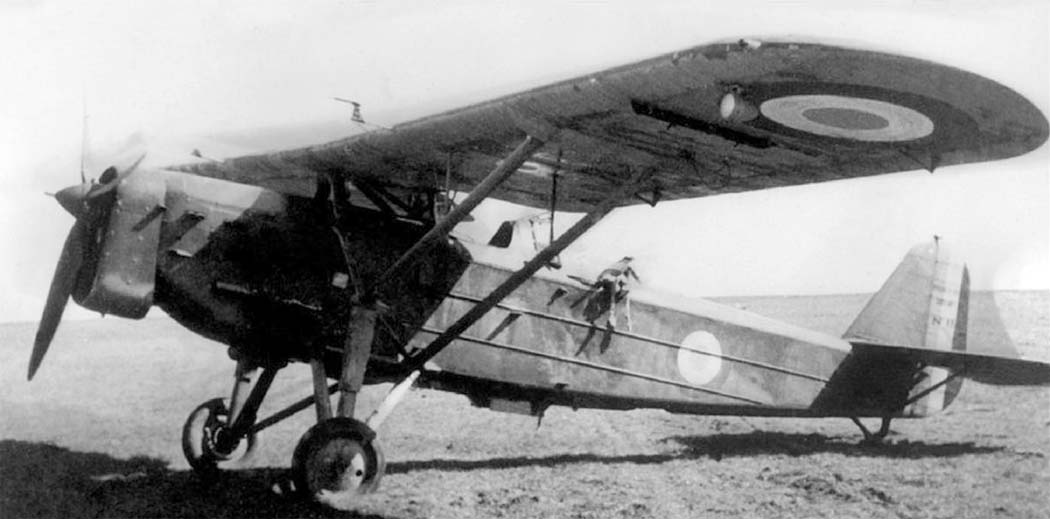
http://www.airwar.ru/enc/other1/mureaux115.html
Hs 126

http://en.wikipedia.org/wiki/Henschel_Hs_126
It's of interest that pre-war the RAF didn't want to know about 'light' aircraft to do the job, despite British Army attempts to trial them - even at a cost saving. However after May 1940 and subsequent exercises in the UK, the Lysander was phased out from the role, tactical artillery spotting was taken over by Taylorcraft-derived Austers AOPs (Air Oberservation Posts) and tactical reconnaissance by, initially, Curtiss Kittyhawks and then early Mustangs.
On the Owl, the nice Air Force Museum website says this:
CURTISS O-52 OWL
In 1940 the U.S. Army Air Corps ordered 203 Curtiss O-52s for observation duties -- signified by the designation "O" -- and used them for military maneuvers within the continental United States. Upon America's entry into World War II, however, the U.S. Army Air Forces realized that the airplane lacked the performance necessary for combat operations overseas. As a result, the Army relegated the O-52 to stateside courier duties and short-range submarine patrols off the coasts of the United States.
The O-52 was the last "O" type airplane procured in quantity for the Army. Following the attack on Pearl Harbor, the Army Air Forces cancelled the "O" designation and adopted "L" for the liaison type airplanes that replaced it.
http://www.nationalmuseum.af.mil/factsh ... asp?id=346
Chimes is with what's been said, although the Sub patrols was a new one to me.
Thu Jun 11, 2009 9:48 am
I would love to see pictures of the L-1 in Europe and North Africa. I remember seeing an L-1 on TV back in the 80s. Does anyone remember
"Spencer's Pilots"?
>>The L-1 was used in Europe, in North Africa, in Alaska, and in the CBI. (Yes I have pictures). <<
"Spencer's Pilots"?
>>The L-1 was used in Europe, in North Africa, in Alaska, and in the CBI. (Yes I have pictures). <<
Curtiss O-52
Thu Jun 11, 2009 10:51 am
Twenty-six O-52's were sent (via Lend-Lease) to the Soviets. According to the book "Red Stars Vol 4" by Geust they were used for artillery spotting during operations in Leningrad, Karelin and Kalinin fronts. As they were deemed "too slow" many were re-assigned to photo mapping and recon. Some were still operating as late as 1952! On page 178 of the book there are 3 photographs of the 'Owls' in Russia nd page 213 there are two color profiles in factory applied OD.
L-1
Thu Jun 11, 2009 2:15 pm
I have somewhere, but no chance of finding it, a photo of an L-1 medevac-ing soldiers from the far side of the Rhine after Operation Varsity. The 14th Liaison Squadron flew a thoracic surgeon into Bastogne on Christmas Day 1944 with an L-1. The rumor, unconfirmed, was the aircraft came from US Army 19th Corps.
Thu Jun 11, 2009 2:27 pm
This is the European shot that's fairly well known (cropped a bit).
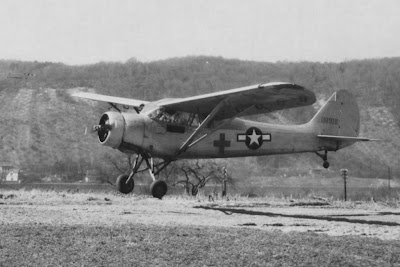
I'm not quite ready to pull out the North African or Alaskan ones yet.
Here's a shot from Burma, though!
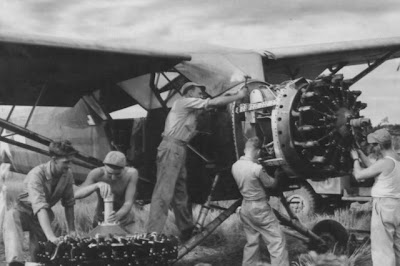
Those mechanics give you an idea of just how BIG that thing was!
Ryan
I'm not quite ready to pull out the North African or Alaskan ones yet.
Here's a shot from Burma, though!
Those mechanics give you an idea of just how BIG that thing was!
Ryan
Thu Jun 11, 2009 3:12 pm
I'm pretty sure the O-52 remained stateside like the Aeronca O-58/L-3A.
Thu Jun 11, 2009 3:15 pm
marine air wrote:I'm pretty sure the O-52 remained stateside like the Aeronca O-58/L-3A.
You mean like the L-2, right? A squadron or two of L-3s made it out for sure.
Ryan
L-3
Thu Jun 11, 2009 3:16 pm
The L-3 went overseas. They were in New Guinea and the Admiralty Islands campaigns.
Thu Jun 11, 2009 3:19 pm
And L-3s were used by the Free French.
Ryan
Ryan