JDK's pointless quiz No.427
Fri Dec 12, 2008 6:13 pm
Back by unpopular demand. 
Usual rules - What, where? Winner gets a warm feeling, provides own pony.

Clue: It's NOT what it looks like.
Usual rules - What, where? Winner gets a warm feeling, provides own pony.
Clue: It's NOT what it looks like.
Fri Dec 12, 2008 6:28 pm
SS-20 ICBM in it's missle silo, or an engine intake for a Meteor?
Fri Dec 12, 2008 11:50 pm
Creative! But wrong in both cases.
Rarer than either of those. Definitely a manned aircraft, not a missile.
Rarer than either of those. Definitely a manned aircraft, not a missile.
Sat Dec 13, 2008 12:38 am
How about radar in MiG-17 or MiG-18?
Sat Dec 13, 2008 1:01 am
A "Mr. Juicer 3000", and I'm guess'n somewhere south of the equator because it appears to be right hand rotation. 
C'mon James you gotta make these harder if you wanna play with the big dawgs.
Shay
____________
Semper Fortis
C'mon James you gotta make these harder if you wanna play with the big dawgs.
Shay
____________
Semper Fortis
Sat Dec 13, 2008 1:13 am
GregP wrote:How about radar in MiG-17 or MiG-18?
Nope! Right airframe area (no radar though) wrong type of aircraft. Further West and rarer.
Shay wrote:A "Mr. Juicer 3000", and I'm guess'n somewhere south of the equator because it appears to be right hand rotation.
This might squeeze your lemons, but no. Also wrong hemisphere.
As an aircraft and engine type, I believe this beast is technically unique.
Sat Dec 13, 2008 1:31 am
Caproni Campini N.1 (CC.2)
Scott
Scott
Sat Dec 13, 2008 2:02 am
Scott gets a warm feeling...

Sat Dec 13, 2008 4:06 pm
WOW! Never seen one before. Thanks for the quizes to help enlighten us uneducated....
Sat Dec 13, 2008 5:15 pm
Second Air Force wrote:Caproni Campini N.1 (CC.2)
Scott
geek.

Sat Dec 13, 2008 7:00 pm
b29flteng wrote:WOW! Never seen one before. Thanks for the quizes to help enlighten us uneducated....
Glad you liked it. For those googlychallanged,

It is perhaps surprising at first sight that, having been the second nation to fly an air-breathing jet-propelled aeroplane, Italy did not feature among the leading nations in this field of technology. But in truth the Caproni-Campini N.1 was no more than an ingenious freak which employed a conventional piston engine to drive a variable-pitch ducted-fan compressor with rudimentary afterburning. As such it did nothing to further gas turbine research, and was to all intents and purposes a technical dead-end.
http://www.aviastar.org/air/italy/caproni_campini.php
As designed by Campini, the aircraft did not have a jet engine in the sense that we know them today. Rather, a conventional piston engine 500 kW (750 hp) Isotta Fraschini L. 121/R.C. 40) was used to drive a compressor, which forced compressed air into a combustion chamber where it was mixed with fuel and ignited. The exhaust produced by this combustion was to drive the aircraft forward. Campini called this configuration a "thermojet" but the term motorjet is in common usage today since thermojet is now used to refer to a particular type of pulsejet (an unrelated form of jet engine).
Operational history
Campini turned to the Caproni aircraft factory to help build the prototypes, and two aircraft and a non-flying ground testbed were eventually constructed. The first flight was on August 27, 1940 with test pilot Mario De Bernardi at the controls.
Great propaganda use was made of the aircraft by Mussolini and the Fédération Aéronautique Internationale recognised this at the time as the first successful flight by a jet aeroplane.
Following World War II, one of the prototypes was shipped to the United Kingdom for study at the Royal Aircraft Establishment at Farnborough.
Survivors
Prototype taken to UK for tests subsequently disappeared. The other prototype is now on display at the Aeronautical Museum of Vigna di Valle in Rome and the ground testbed is at the Museum of Science and Technology in Milan.
http://en.wikipedia.org/wiki/Caproni_Campini_N.1
This is the example in the Italian Air Force Museum.
Sat Dec 13, 2008 7:34 pm
I wonder what it sounded like...
Sat Dec 13, 2008 7:35 pm
How many other jet type aircraft had a tailwheel?
Sat Dec 13, 2008 7:43 pm
me109me109 wrote:How many other jet type aircraft had a tailwheel?
Me-262!
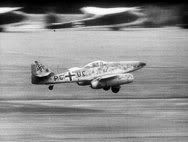
Now, what are you doing on-line on a perfectly good Saturday night?

Sat Dec 13, 2008 7:50 pm
Neal Nurmi wrote:I wonder what it sounded like...
You know I've never even thought about that, but it's a good question!
me109me109 wrote:How many other jet type aircraft had a tailwheel?
More than you'd think. As well as some V model 262s, the Yak 15.

Dan K wrote:Now, what are you doing on-line on a perfectly good Saturday night?
Well, it's Sunday morning here, so I'm avoiding work.
