361st Fighter Group 'Yellow Jackets'
Wed May 14, 2008 11:45 am
Greets,
Any restored P-51's out there in this groups colors?
Any color pics from WW2?
Thanks!
.
Any restored P-51's out there in this groups colors?
Any color pics from WW2?
Thanks!
.
Wed May 14, 2008 4:39 pm
Wed May 14, 2008 5:19 pm
Wed May 14, 2008 6:49 pm
Thank you for the links guys. I was looking for color shots of the yellow nosed P-51's. The B model 'Queen Jean' from the groups website is really really nice.
Thanks again.
.
Thanks again.
.
Thu May 15, 2008 1:35 am
enjoy:
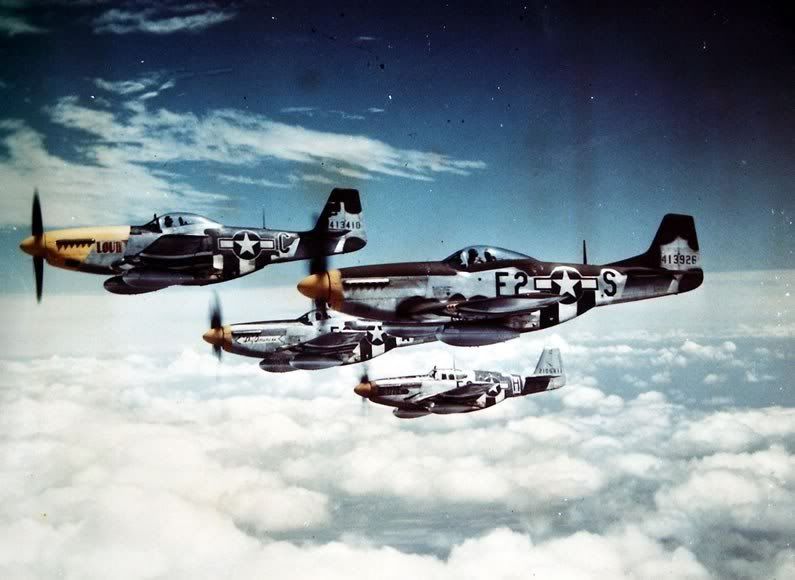
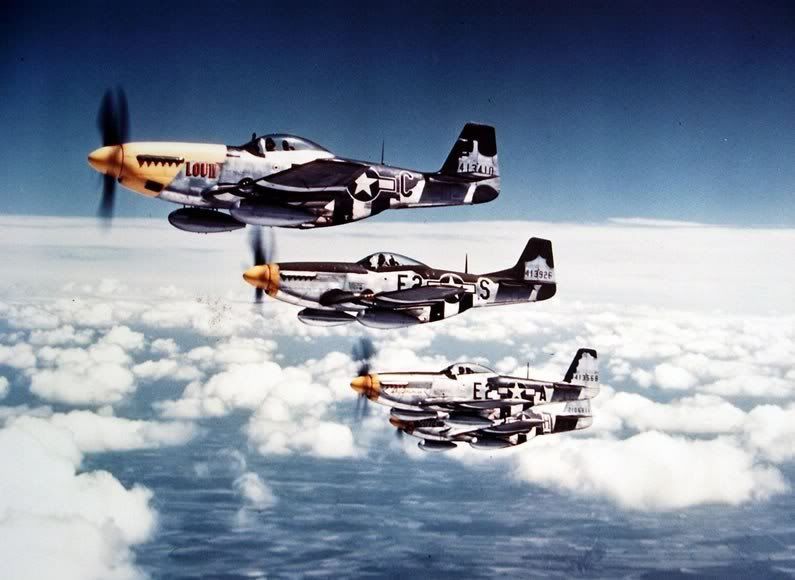
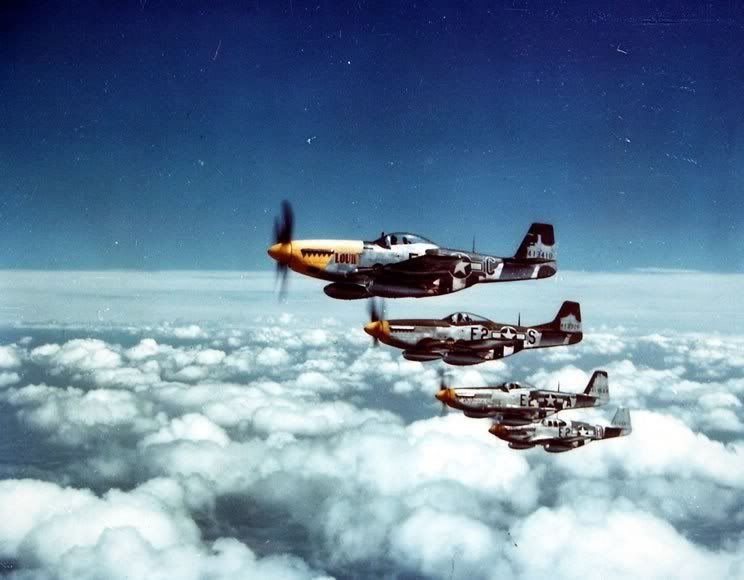
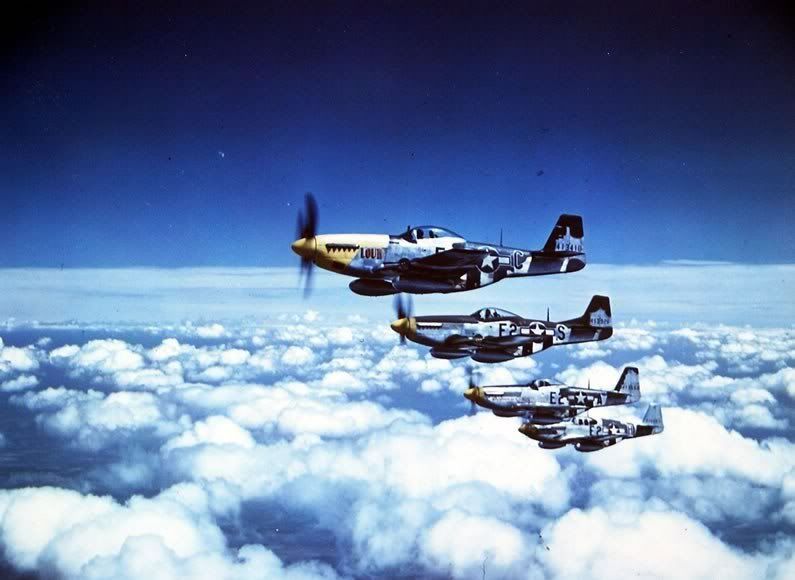
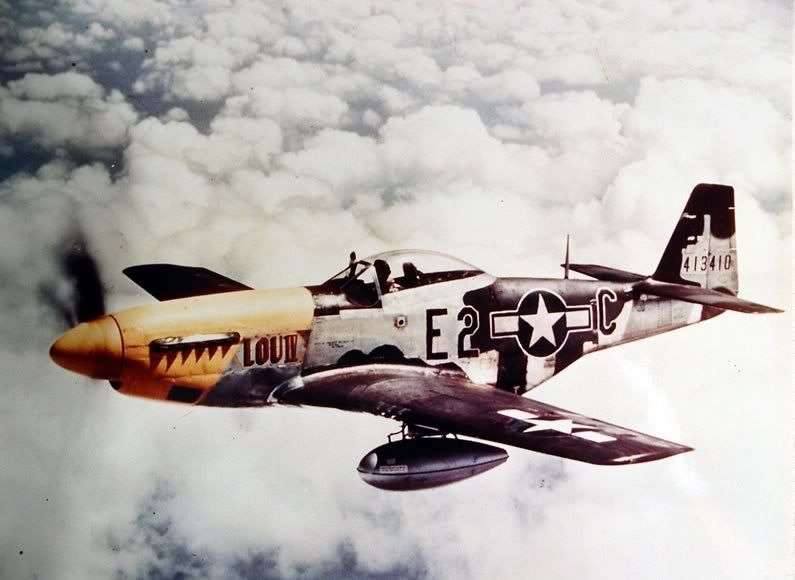
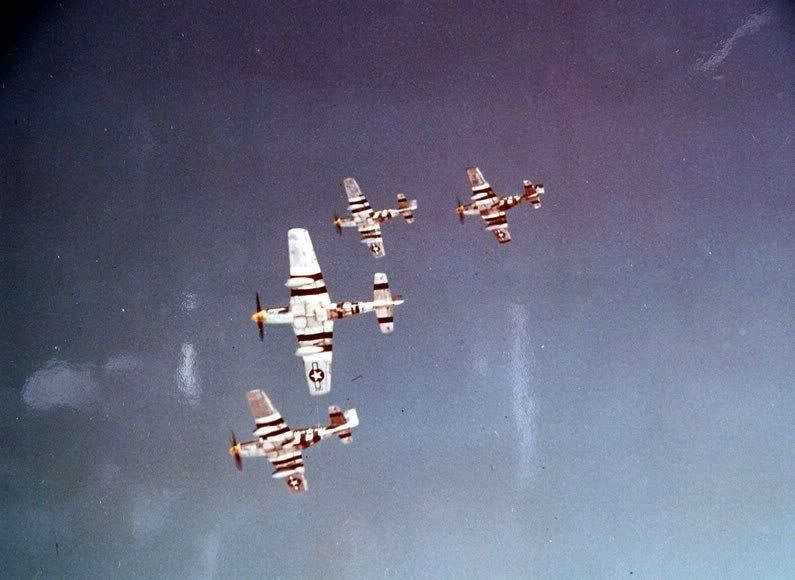
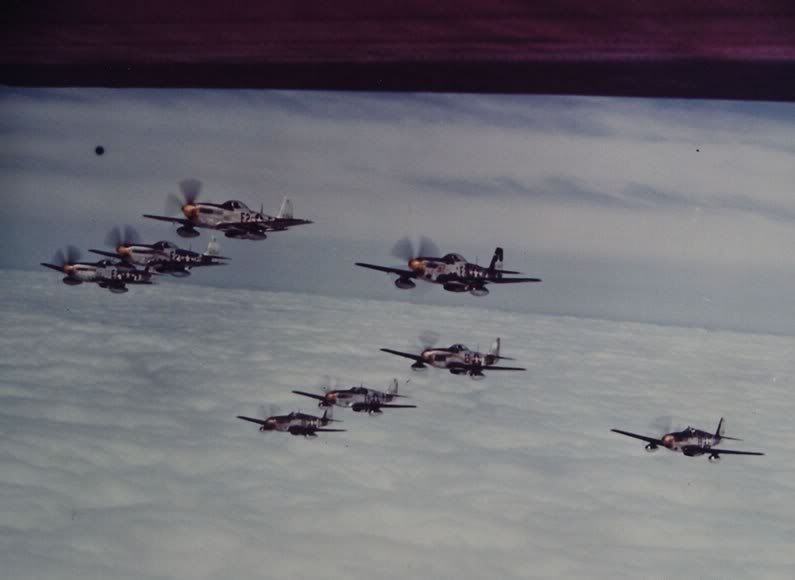
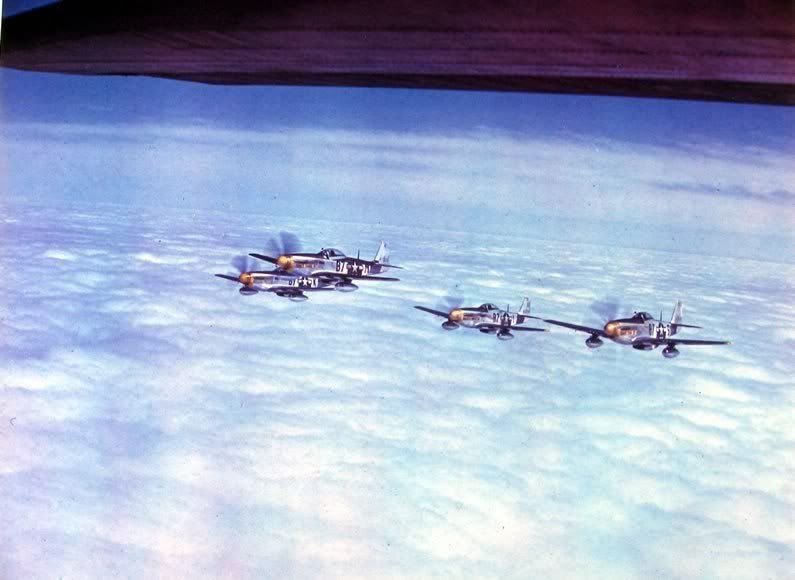


Martin
Martin
Thu May 15, 2008 1:37 am
Are you sure the yellow is correct in those pics? The bright blue camouflage appears to have shifted to dark green.... 
SN
SN
Thu May 15, 2008 4:22 am
I just KNEW that someone would not be able to refrain from saying that !

Martin
Martin
Thu May 15, 2008 2:31 pm
Are you sure the yellow is correct in those pics? The bright blue camouflage appears to have shifted to dark green
Clue me in guys. You mean that model I built back in the day wasn't supposed to be yellow and blue? What happened with that picture anyway? I'm sure there must be an old thread but i don't want to hunt it
down. Appreciate the pictures Swiss Mustangs, thank you!
Thank you.
.
???
Thu May 15, 2008 4:14 pm
I knew that Navy pilots were flying mustangs!!
Re: ???
Fri May 16, 2008 1:32 am
Jack Cook wrote:I knew that Navy pilots were flying mustangs!!
true
some Navy pilots flew with the 111th TRS (F-6's) when this unit was based in Corsica and later France
From floatplanes to Mustangs
A Navy pilot’s exciting transition to the P-51
By Robert Snowden
In 1944, an Army Air Corps Unit based in Corsica, Italy, briefly had a small group of Navy pilots who flew P-51Cs, and I was one of them. What was most surprising during this hectic, exciting time was how the Mustang afforded me an unexpected insight that would come to define what was, and still is for me, the true joy of flight.
Earlier that year, I had completed Navy flight training in Corpus Christi, Texas, and had qualified in the then new OS2U—a single-float seaplane. I was disappointed I wasn’t flying fighters but was happy to be a Navy pilot, helping in the war effort. My first assignment was on the USS Philadelphia, a cruiser in the European theater. I was one of seven pilots flying SOC-3s; they were antiquated biplanes that we flew to patrol for targets and relay coordinates to the gunnery of naval ships. These planes were catapulted from the cruiser and landed astern on a steel net towed by the ship. The outmoded aircraft were not only disappointing to fly but also dangerous, as they were easy targets for the marauding Messerschmitts.
Fortunately, I received orders to return to Atlantic City, New Jersey, to join the VC-8 group and train in high-performance aircraft. I started in the F4F Wildcat, proceeded to the F4U Corsairs and, ultimately, to the F6F Hellcats. Flying these glamorous planes in training missions made me believe I was headed for fast-paced, nerve-racking deployments. On D-Day, I was in Norfolk, Virginia, for carrier qualification. Disappointed to have missed the big event, I was further dismayed when I received orders to return to the USS Philadelphia. At the very least, I assumed they had at least transitioned to OS2Us, but I soon found myself again at the rudder of an old SOC-3. I was thrilled to receive new orders to go to Corsica to join a to-be-formed recon unit in the 111th Tactical Reconnaissance Squadron. Some of the other Navy pilots had received the same training I had, and others were trained in England in Spitfires. None of us had flown P-51s.
I was issued a pilot’s handbook and went for a test flight; it was almost my last. The P-51C has an oil-cooler door that opens automatically at takeoff and closes during ascent to provide plenty of cool air to the radiator during that critical time. Unfortunately, the door’s automatic function failed, and the door didn’t close, so the engine immediately overheated and started pouring thick, black smoke. I landed as quickly as possible and told the mechanic that I was afraid the engine was about to die on me. He informed me that black smoke means the engine is still burning oil and that the engine cuts out only after you see white smoke. That wasn’t in the handbook, so I was grateful that he shared it with me.
On my second flight, I noticed the P-51C was smaller and lighter than the Corsair and had an impressive climb rate. It didn’t carry much fuel, so the missions we flew over the next few months required the addition of two cumbersome belly tanks. We were also advised not to drop the tanks unless we were fired upon because they cost $1,000 each! With the tanks, the P-51C’s performance was seriously impaired, but it was still so much more exhilarating to fly than the sluggish SOC-3.
Our next task was to name our planes and add the characteristic WW II nose art. Pilots with artistic talents did the actual painting in their spare time. The Deacon was named for the pilot who looked like one; Sweetie Pants was named for a pilot’s wife, and Mild Max was the ironic nickname of a pilot’s hot-tempered father (a man who vehemently defended his son after he buzzed the country club where Max was a member). My Val Gal II was named for my wife. Val had worked as a secretary at the Chance Vought plant in Stratford, Connecticut and posed as a riveter for one of their ads that supported the war effort. Among the more risqué names was Weenie Merchant in honor of its pilot’s interest and success in dating. That name was put on the plane while the "Merchant" himself was on liberty, and when he returned, he appreciated the joke as much as we did.
After missing out on D-Day, I was excited to learn that we were assigned to support the invasion of southern France. We spotted targets for bombardment and flew through heavy flak, but I stayed over the area as long as possible. As a result, I accidentally became the first Allied pilot to land in the south of France after the invasion. I was very low on fuel, and I knew civil engineers for the Navy were still constructing an emergency landing area out of Marston matting; it is made of interlocking steel panels that make a hell of a racket when you land on them. The workers were surprised to see me coming in, and once I landed, they immediately asked, "What’s the matter with you? This runway isn’t finished!" I told them that, under the circumstances, I couldn’t wait for the ribbon-cutting ceremony. I soon saw how my training in carrier landings helped me make the most of such a short landing area, as an Army Air Corp pilot landed a little later and promptly ran off the end of the runway into a vineyard. All of the Navy pilots on this temporary assignment to the 111th received the Distinguished Flying Cross for our involvement in the invasion.
After the invasion, we flew reconnaissance missions in Europe for several months and then flew bomber-escort missions into Germany. A few months later, we were disbanded and sent back to our previous assignments. I returned to the USS Philadelphia, but fortunately, by then, they had transitioned to OS2Us. After experiencing the thrills of flying fighters, I expected flying seaplanes again to be a letdown, but in reality, I didn’t realize how much fun the OS2Us were until after the War. Although my Navy career gave me the opportunity to fly supercharged F4U-5 Corsairs and many other exciting aircraft, I came to see that flying the OS2U wasn’t "white-knuckle," and it offered a beautiful flying experience with the freedom to land almost anywhere. But if I hadn’t experienced those few tense minutes in which I contemplated the logistics of landing on that tiny patch of Marston matting, I might not have ever learned that.
Martin
??
Fri May 16, 2008 7:08 am
Where there's blue too 


Formation pics
Fri May 16, 2008 8:26 am
Those formation pics are AWESOME!
So beautiful and deadly at the same time.
So beautiful and deadly at the same time.
Ok but what are the CORRECT colors?
Fri May 16, 2008 8:46 am
I've wondered for years:
E2-S - were the topsides green? Or blue?
E2-S - were the topsides green? Or blue?
???
Fri May 16, 2008 10:04 am
Anyone-anyone????
Bueller, Ferris Bueller??
Bueller, Ferris Bueller??
Fri May 16, 2008 11:34 am
I've wondered for years:
E2-S - were the topsides green? Or blue?
They were green. According to Urban Drew (the pilot of "Detroit Miss"), who I talked to many years ago...