First French jet - SNCASO SO.6000 Triton
Mon Dec 03, 2007 8:00 am
For an early jet, it has some unique claims to fame. The project was started in secret, while still under German occupation. It was one of the few types to have used both British and German first generation jet engines. - Intended originally to use the Rateau-Anxionnaz GTS-65 engine, but a German Junkers Jumo 004 was fitted instead, to the first prototype. Nos 3, 4 and 5 used license-built Rolls-Royce Nene jet engines.
No.3 survives, and while each looks similar the intake geometry varied significantly.

The third SO.6000 Triton as seen on display at the Musée de l'Air et de l'Espace at Le Bourget, Paris.
No.3 survives, and while each looks similar the intake geometry varied significantly.
The third SO.6000 Triton as seen on display at the Musée de l'Air et de l'Espace at Le Bourget, Paris.
Mon Dec 03, 2007 3:52 pm
Who says you can't polish a turd? 
Regards,
Regards,
Mon Dec 03, 2007 11:09 pm
MERDE !
Mon Dec 03, 2007 11:18 pm
I think that's a little harsh, gentlemen. It has a quirky appeal all of its own I think, and without making cheap anti-French jokes, I think it's a remarkable achievement to even be considering a jet-powered aircraft while under occupation.
The question I'm left with is: were the French engineers developing their original engine independent of von Ohan and Whittle? Remember, there was a war on, and they' weren't sharing.
The XP-59 couldn't have taken a axial flow engine as an alternative, either.
It's not the shape of the body that's bothersome, it's the teeny wings...
The question I'm left with is: were the French engineers developing their original engine independent of von Ohan and Whittle? Remember, there was a war on, and they' weren't sharing.
The XP-59 couldn't have taken a axial flow engine as an alternative, either.
It's not the shape of the body that's bothersome, it's the teeny wings...
Tue Dec 04, 2007 12:48 am
Why is that? Not that the US really had a flight worthy one at that time.JDK wrote:The XP-59 couldn't have taken a axial flow engine as an alternative, either.
Tue Dec 04, 2007 1:03 am
bdk wrote:Why is that? Not that the US really had a flight worthy one at that time.JDK wrote:The XP-59 couldn't have taken a axial flow engine as an alternative, either.
Well, I mean that the configuration was unsuitable. But actually, now you mention it, it could have taken two, perhaps, just, and not been such a slug?
As you say, the point was 'at the time'. Just about everyone's first jet was a bit inadequate as a fighter or was intended as a testbed only. Once the game was on, everyone caught up pretty quickly, but there's no good reason the US couldn't have developed its own jet in the 30s or early 40s, except they didn't. Given how good US innovation was elsewhere, it's a kind of gap. (That's an unfair criticism, but leaving aside national feelings, it does seem a little remarkable - there were enough ideas floating around, and even the Italians and Spaniards were trying, even though they were dead ends.)
Incidentally, what's the connection with the GAF Jindavik, the Triton and the XP-59?
Tue Dec 04, 2007 1:09 am
Here's a look from another angle:
http://www.eads.net/xml/content/OF00000 ... 623390.jpg
Now, where have I seen this design before? Oh yeah:
http://www.aerofiles.com/curt-at9a.jpg
http://www.eads.net/xml/content/OF00000 ... 623390.jpg

Now, where have I seen this design before? Oh yeah:
http://www.aerofiles.com/curt-at9a.jpg
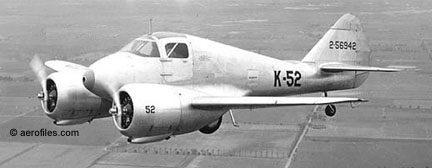
Tue Dec 04, 2007 1:20 am
Members of the suppository school of streamlining.
Footage of the beast in action here:
http://www.youtube.com/watch?v=hdg2xpyz07g
With a Spanish voiceover. This is one of the others, note the just visible nose intake.
Footage of the beast in action here:
http://www.youtube.com/watch?v=hdg2xpyz07g
With a Spanish voiceover.
This is one of the others, note the just visible nose intake.
Tue Dec 04, 2007 3:24 pm
I think the isolationists were putting their heads in the sand militarily and people in general were not looking for dramatically faster air travel as the US was pretty hard hit by the depression. GE was chosen to develop the I-16 for the P-59 due to their expertise with turbochargers. That probably explains why many engines of the era had a centrifugal flow compressor as those were more familiar to them and had many fewer parts.JDK wrote:Once the game was on, everyone caught up pretty quickly, but there's no good reason the US couldn't have developed its own jet in the 30s or early 40s, except they didn't. Given how good US innovation was elsewhere, it's a kind of gap.
Incidentally, what's the connection with the GAF Jindavik, the Triton and the XP-59?
The connection between the three? All were cosmetically challenged!
 At one time flew with British turbojets?
Tue Dec 04, 2007 5:16 pm
bdk wrote:I think the isolationists were putting their heads in the sand militarily and people in general were not looking for dramatically faster air travel as the US was pretty hard hit by the depression. GE was chosen to develop the I-16 for the P-59 due to their expertise with turbochargers. That probably explains why many engines of the era had a centrifugal flow compressor as those were more familiar to them and had many fewer parts.
All good points, bdk. I'm no jet expert, but IIRC, Ohan's first was a centrifugal flow, and all the early British research was on centrifugal - not sure if turbos were a driver, but it was Whittle's preferred parth. IIRC, there was one early British axial, but the Germans went for Axial asap, as they were more efficient, Ja?
As to the 'what iffery', someone not inventing something's a silly point to make in a way, yet it still seems odd to me despite your valid points. Jet research wasn't about speed, originally, it was because people invent things whatever, because they were more efficient that the trend with pistons, and thus could be argued as attractive if the money's short - longer down the road. Britain was a wasteland of technical innovation of this level when Whittle started, and the Nazis were only interested in short term Blitzkrieg tools; without private enterprise funding by Heinkel...
Another 'What if'. What if Britain hadn't shared it's jet experience with the US in W.W.II. When would the first American jet have flown?
bdk wrote:JDK wrote:Incidentally, what's the connection with the GAF Jindavik, the Triton and the XP-59?
The connection between the three? All were cosmetically challenged!
They all look beautiful, bdk.
As to the British jets , yes, but I was asking for a much more important point. Add the Fokker S-14, and TS-11 Iskra. Got it yet?
Tue Dec 04, 2007 5:40 pm
Aerodynamic shape was very logical- secure!! Idea was to test engine and in this was every engineer need safe aerodynamics platfrom. Also I have get info during the conversation with one French researchers that German actually were captured drawings from which was later developed Jumo turbo jet. As well I could not give his name in public there you take this info with reserve.
Main diference among the axial and radial engine is several. Axial need more pressure in fornt the intake while the radial need fast air flow in front of intake. Radial engine was of simpler design then axial but in other way addiabatic curve was better with axial. Other penalty with radial is its larger diameter. Germans have a problem with turbine blades and in later stage they are introduce blade made from pressed tubes and they give better durability and as i could remember air flow throught it cooled them in work. I have detailed evolution material made in USA about Jumo 004... but I am lazy to prepare detailed article for web site
I think I have more images of this airplane, from museum but also archive. If I get time I will upload it for sure.
Main diference among the axial and radial engine is several. Axial need more pressure in fornt the intake while the radial need fast air flow in front of intake. Radial engine was of simpler design then axial but in other way addiabatic curve was better with axial. Other penalty with radial is its larger diameter. Germans have a problem with turbine blades and in later stage they are introduce blade made from pressed tubes and they give better durability and as i could remember air flow throught it cooled them in work. I have detailed evolution material made in USA about Jumo 004... but I am lazy to prepare detailed article for web site
I think I have more images of this airplane, from museum but also archive. If I get time I will upload it for sure.
Tue Dec 04, 2007 7:44 pm
Mgawa
When you say radial engine do you mean centrifugal engine (centrifugal flow Jet compressor)? A radial engine in the U.S. is reciprocating pistons.
Steve
When you say radial engine do you mean centrifugal engine (centrifugal flow Jet compressor)? A radial engine in the U.S. is reciprocating pistons.
Steve
Tue Dec 04, 2007 7:56 pm
I think this is a language detail. A centrifugal compressor causes the air to flow radially out of it.planeoldsteve wrote:When you say radial engine do you mean centrifugal engine (centrifugal flow Jet compressor)? A radial engine in the U.S. is reciprocating pistons.
Tue Dec 04, 2007 10:34 pm
First jet aircraft to fly for each of those countries?JDK wrote:As to the British jets , yes, but I was asking for a much more important point. Add the Fokker S-14, and TS-11 Iskra. Got it yet?
Tue Dec 04, 2007 10:40 pm
bdk wrote:First jet aircraft to fly for each of those countries?JDK wrote:As to the British jets , yes, but I was asking for a much more important point. Add the Fokker S-14, and TS-11 Iskra. Got it yet?
