Wanted A-26 cockpit info
Sat Dec 01, 2007 6:13 pm
Looking for a detail cockpit layout for the A-26 out of the pilots manuel.
Sat Dec 01, 2007 7:56 pm
Looks like an early one
Sat Dec 01, 2007 8:48 pm
Nice pic. [Mine has dual controls..] 
I'm looking to see if anyone has done a stencil kit for the A-26. We are about to repaint mine and would like to put all of the original stencils/markings on correctly.
Any help appreciated..
I'm looking to see if anyone has done a stencil kit for the A-26. We are about to repaint mine and would like to put all of the original stencils/markings on correctly.
Any help appreciated..
Sat Dec 01, 2007 9:03 pm
Oscar Duck wrote:Nice pic. [Mine has dual controls..]
I'm looking to see if anyone has done a stencil kit for the A-26. We are about to repaint mine and would like to put all of the original stencils/markings on correctly.
Any help appreciated..
If NASM has the A-26 blueprints on Microfilm they would probably have stencil info and sizes.
The P-51 prints have that info.
Rich
Sat Dec 01, 2007 9:32 pm
Here are two from the Douglas archives that were used in Douglas A-26 and B-26 Invader:

and

Both single control also, but they may help a bit.
and
Both single control also, but they may help a bit.
Sat Dec 01, 2007 9:43 pm
I like the center cap logo on the last pic, any still flying around with that still in place?
Sat Dec 01, 2007 10:29 pm
1st pic of Aerovin's is a B model with the hardnose. 2nd is a C with the glass nose. You can tell by the tunnel in the 2nd picture.
Sat Dec 01, 2007 11:02 pm
Here's the A-26C at March ARB for comparison:

Sun Dec 02, 2007 1:40 am
Hey Scott,
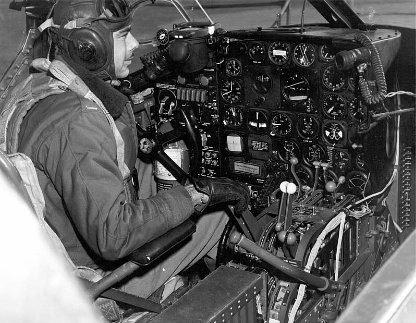
I wonder about the instrument panel added to the right side in the tunnel access area in your first cockpit shot. It looks like instrumentation for a turbine. I think I can even make out the word jet by one switch. Maybe it was a test ship? If so, it sure is strange that it would be bone stock elsewhere. Any more detail on this photo from Boeing?
Here is a shot I took of the K model cockpit. Just a wee bit different!
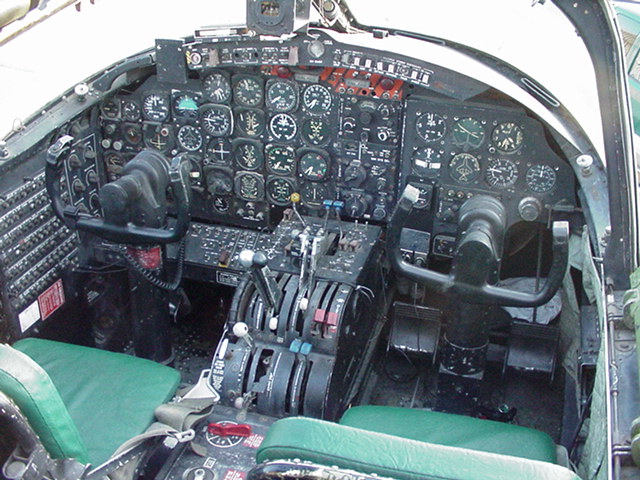
I wonder about the instrument panel added to the right side in the tunnel access area in your first cockpit shot. It looks like instrumentation for a turbine. I think I can even make out the word jet by one switch. Maybe it was a test ship? If so, it sure is strange that it would be bone stock elsewhere. Any more detail on this photo from Boeing?
Here is a shot I took of the K model cockpit. Just a wee bit different!
Sun Dec 02, 2007 2:25 am
I just noticed something else. I wonder what the tachometer is for on the top of the panel in Scott's photo. Just under the 100 does that say TURBO-METER? I have seen tachometers for the GE turbos in some installations but as far as I know this was not the set up for the R-2800 in the A-26. Anyone know what is going on here?
Sun Dec 02, 2007 8:50 am
Taigh
The manifold pressure gauge is next to this one.
Could that be a Torque meter or read Torqumeter?
One other thin on the A-26k or TA-26's can you get to the nose, behind the panel in flight and can you split the columns like an AT-11?
Steve
The manifold pressure gauge is next to this one.
Could that be a Torque meter or read Torqumeter?
One other thin on the A-26k or TA-26's can you get to the nose, behind the panel in flight and can you split the columns like an AT-11?
Steve
Sun Dec 02, 2007 9:54 am
Taigh,
You are right in that the first one has a second panel for a turbojet engine. I looked before I leapt and that is the cockpit of the the XA-26F, the one equipped with the GE I-16 turbojet engine installed in the rear fuselage and with the R-2800-83 piston engines and four bladed props. That -83 engine installation might explain the torquemeter.
Serial for the XA-26F was 44-34586. Sorry for any confusion I might have added.

You are right in that the first one has a second panel for a turbojet engine. I looked before I leapt and that is the cockpit of the the XA-26F, the one equipped with the GE I-16 turbojet engine installed in the rear fuselage and with the R-2800-83 piston engines and four bladed props. That -83 engine installation might explain the torquemeter.
Serial for the XA-26F was 44-34586. Sorry for any confusion I might have added.
Last edited by aerovin on Sun Dec 02, 2007 10:14 am, edited 1 time in total.
Sun Dec 02, 2007 10:07 am
And for those curious ones, here are two blow-ups of the details that raised some questions on the XA-26F panel:
The torquemeter:

And the panel for the jet engine:

For doubter and conspiracy theorists out there, another enlargement:

I love digital photography.
The torquemeter:
And the panel for the jet engine:
For doubter and conspiracy theorists out there, another enlargement:
I love digital photography.
Sun Dec 02, 2007 12:48 pm
Too cool Scott. I never would have thought of torquemeter. I have seen torque measured as brake mean effective pressure or BMEP but not as straight torque. How interesting. Thanks for the additional close ups.
It looks like they have installed two different tachometers as well. These were an early WWII style individual unit that are a lot easier to read accurately. The needle will do a full sweep around the dial for 1000 RPM (as opposed to 1000 RPM per 50 degrees of arc in the standard instrument) and has a small counter for thousands of RPM. This is very similar to the turbine tach. It makes sense that they would use this type of tach for accuracy while testing engines.
These instruments had integral mounting nuts on the back of the flange so it could only be mounted behind the panel unlike the rest of the instruments. It also looks like all of the special instruments have markings on the face of the glass. I wonder if there is any significance to the B-29 marking on the torquemeter or is that an 8-29. Maybe it's a date?
As for the K model; I am under the impression that they didn't use the glass noses in combat. The column on the copilots side would not break away like it could in the AT-11. Although it had the full instrument panel and rudder pedals with complete with brakes I believe the panel on the copilots side was hinged toward the center. I would certainly think that this panel and column configuration would make it real hard to get into the nose in flight. Anyone else have any real experience with this?
I have an A-26 glass nose and the guy I got it from said it was used in testing for the K. All I have was his word and no documentation to back it up but it did still have Viet Nam camouflage on it.
Happiness is a warm high resolution scanner!
We are such Geeks!
It looks like they have installed two different tachometers as well. These were an early WWII style individual unit that are a lot easier to read accurately. The needle will do a full sweep around the dial for 1000 RPM (as opposed to 1000 RPM per 50 degrees of arc in the standard instrument) and has a small counter for thousands of RPM. This is very similar to the turbine tach. It makes sense that they would use this type of tach for accuracy while testing engines.
These instruments had integral mounting nuts on the back of the flange so it could only be mounted behind the panel unlike the rest of the instruments. It also looks like all of the special instruments have markings on the face of the glass. I wonder if there is any significance to the B-29 marking on the torquemeter or is that an 8-29. Maybe it's a date?
As for the K model; I am under the impression that they didn't use the glass noses in combat. The column on the copilots side would not break away like it could in the AT-11. Although it had the full instrument panel and rudder pedals with complete with brakes I believe the panel on the copilots side was hinged toward the center. I would certainly think that this panel and column configuration would make it real hard to get into the nose in flight. Anyone else have any real experience with this?
I have an A-26 glass nose and the guy I got it from said it was used in testing for the K. All I have was his word and no documentation to back it up but it did still have Viet Nam camouflage on it.
I love digital photography.
Happiness is a warm high resolution scanner!
We are such Geeks!
Wanted A-26 cockpit info
Sat Dec 08, 2007 3:18 pm
Spookyboss,as per your PM,I've tried to find pictures showing the bombing panel on the left forward section of the cockpit.Here's what I have from a Korean War vintage B-26B/C manual:
[img][img]http://i171.photobucket.com/albums/u303/tkr62/DouglasB-26CockpitPictures001.jpg[/img]
[/img]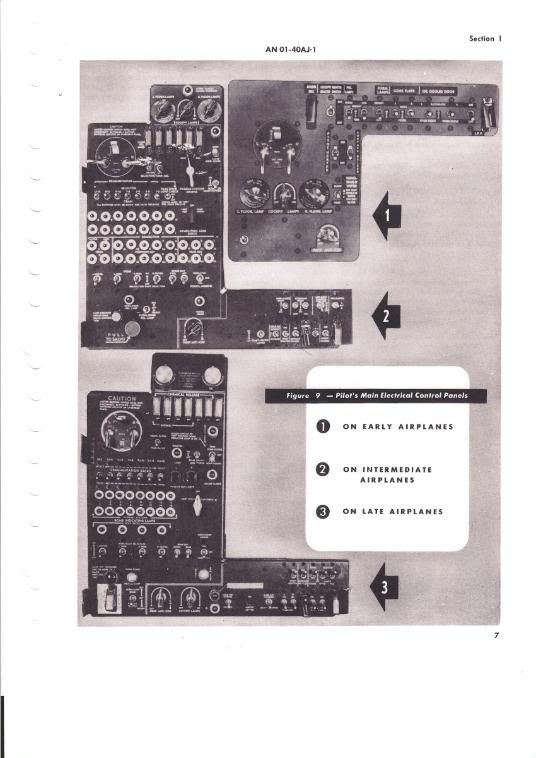
[img][img]http://i171.photobucket.com/albums/u303/tkr62/DouglasB-26CockpitPictures003.jpg[/img][/img]
[img][img]http://i171.photobucket.com/albums/u303/tkr62/DouglasB-26CockpitPictures004.jpg[/img][/img]
[img][img]http://i171.photobucket.com/albums/u303/tkr62/DouglasB-26CockpitPictures005.jpg[/img][/img]
[img][img]http://i171.photobucket.com/albums/u303/tkr62/DouglasB-26CockpitPictures001.jpg[/img]
[/img]
[img][img]http://i171.photobucket.com/albums/u303/tkr62/DouglasB-26CockpitPictures003.jpg[/img][/img]
[img][img]http://i171.photobucket.com/albums/u303/tkr62/DouglasB-26CockpitPictures004.jpg[/img][/img]
[img][img]http://i171.photobucket.com/albums/u303/tkr62/DouglasB-26CockpitPictures005.jpg[/img][/img]