|
John Dupre asked a question about Spitfire oil changes and I thought it might be of general enough interest to be its own topic.
The rule of thumb for Merlins, has been 25 hours for oil change intervals, and that pretty well was accepted whether it was a Rolls in a Spitfire, or a Packard in a Mustang. If any Allison guys or reading this, what was/is their norm?
The Merlin comes from the factory with 3 oil filters( or is it 4?). The are two in the sump that are wire mesh, not too fine, you could stick a needle through the holes. Then there is a fine mesh one on that filters the oil going into the prop. Might be another, I can't be sure as I have not change it myself in a long time. I don't think Rolls does, but at least some Packards in 51s have a Cuno (brand name?) filter also, which is I think is a stack of fine mesh metal disks.
Originally all ran on straight mineral oil, there was not an AD or ashless dispersant. Some in England still use this. You know the Brits, "Hey if it was good enough for Capt. Cook, it's good enough for me". Just teasing, guys? Do you know why the Brits put long range tanks on a Spit? So they could fly over to France and get a decent meal. They do make some beautiful airplanes and cars, and some fine pilots, and they know how to do a tennis tournament or a play. Not to mention Liz Hurley and Sir Winston, when it comes to style.
Some things are new. There is now A D oil, which resists forming ash which is a by product of combustion. The stuff more stays in suspension to be drained off at oil change or filtered out. Some old timers inaccurately refer to "detergent" oil and mineral oil. This is not correct, there has not been any detergent in aviation oil in many years. There is AD and mineral, none of it is detergent, unlike auto engines. Both types now come in single weight usually 100( 50) or 120 (60), as well as various multigrades, 20-50, 20-60, which tries to act like a 20 weight when cold and a 60 when hot. One thing is well known, if you start a Merlin that has been sitting for days, it will take some time for oil to flow up the the top to the cams and followers ( rocker arms or fingers) and wear may occur. This is bad if it is cold, at say 40degrees 120w is like honey. So if you can you preheat the plane in a nice warm hangar, or some owners like me have added a simple glue-on 120 v electric heater to the sump and oil tank, as well as a pre oil pump. I use Phillips 20w-60 oil, at home and when I can get it on the road. You can add any other type and weight ok if you need to top up enroute.
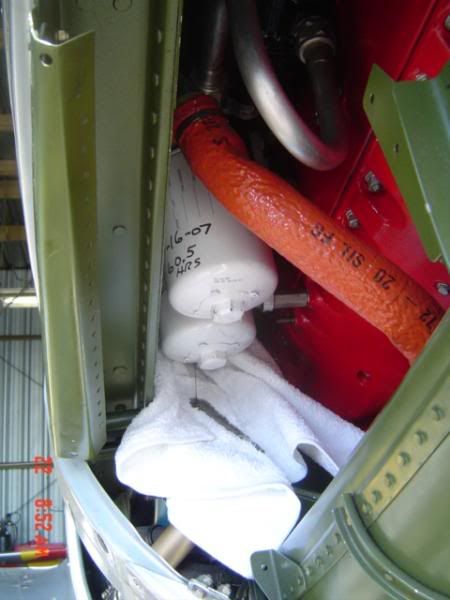
Next and of vital importance is the kit that Jack Hovey machined that adds Champion paper cartridge filters to the oil system.The Merlin pumps so much oil that you need two flters. These are very fine and really filter down to microns. Cost used to be about $2500 per kit an d worth every penny. So now there are 2 fliters to replace and 3 to clean.
So as original, 25 hours was normal to change oil and clean the screens. With the better paper filters we normally do it about 35 hours. It is important to cut open the filter to see how much and what kind of debris may be caught. A trace of iron, aluminum is normal piston and cylinder wear, BUT you do not want to see the copper alloy stuff from main bearings, and not much steel from the crankshaft, etc. That's called "making metal" and may mean an overhaul if it gets worse, or if you are Strega it might mean that "Fat Bear" is going to win that day. I also send an oil sample out to be analyzed as to amount and type of metal and dirt ( silicon) found, but often the filter inspection is more telling.
To change the oil on my plane requires removing 4 cowlings, the side ones are easy with the Brit type qiuck release fasteners. Then the air fliter box on the bottom of the engine . We change this filter at annual , and we use a Bracket oil wetted foam, they supply it cut right to size, it is cheap, and more affective than the original factory mesh type. I have never understood why an otherwise seemingly rational Mustang owner would operate an expensive plane with a rare and expensive engne without an air filter and suck dirt right into the engine, but many do. Some will tell you the only fly off paved surfaces,but there is plenty of dust in the air at Oskosh, not to even mention Madera or Leward Air Ranch or Genenseo. The Spit air fliter system is different than the 51 type, but when we didn't have a good seal in the door that closes the direct air path and puts the filter in use, I saw more silicon (dirt) in the oil analysis.
My plane holds about 12 gallons of oil, I get a chuckle when the line guy at FBO s bring out a single quart to top up.
As part of the oil change, Ray checks the top end, he removes the cam covers and looks for cam wear. The Merln Fingers with the carbide wear surface are an imrovement over the factory followers. Just goes to show that those Canucks are pretty smart when sober, even when not on hockey skates. He also checks head torque. We have never found any problem there, the bolts always seem to stay as set. I have heard 51 mechanincs say they find loose bolts and sometimes a broken one. I do not know why my engine should be better in this regard than the Packards. Is there some design difference, or is it because normal Spifire takeoff power is 44 in vs perhaps 55 to 61 inches in the P-51? Or do all those 51 wheel landings shake the bolts loose? Who knows, it just seems to be?
So there is a fair amount of work in normal oil change and inspection on a Merlin. It may be one guy for 2 or 3 days or 2 guys for a day or 2. Perhaps $2000 and relative piece of mind for another perhaps 6 months. remember in combat the ground crews use to take a look at the engne between each mission, even if not an oil change. Some might think that this level of service is too much trouble for the priviledge to getting to fly behind a Merlin. For these folks, there are lot's of ordinary airplanes that don't ask for as much.
_________________
Bill Greenwood
Spitfire N308WK
Last edited by Bill Greenwood on Thu Nov 26, 2009 2:59 pm, edited 3 times in total.
|



 Login
Login Register
 FAQ
FAQ Search