Quote:
From Melissa Gray
CNN
(CNN) -- A team of scientists will use a World War II-era plane to explore one of the last uncharted regions of Earth, in hopes of learning more about climate change.
The four-year effort, which kicks off in December, aims to unveil what lies beneath the thick Antarctic ice sheet known as the Aurora and Wilkes Subglacial Basins -- an area about half the size of the United States.
Martin Siegert of Edinburgh University in Scotland says the basins are home to mountains, valleys and lakes covered in ice that is rapidly melting into the ocean.
"The satellite observations tell us the ice is losing mass at this moment, and we really do need to understand that," Siegert said. "We need to comprehend why the ice sheet is responding in this way."
Siegert will be joined on the expedition by colleagues from the University of Texas at Austin and the Australian Antarctic Division.
According to the University of Texas, Antarctic ice cores have revealed aspects of the Earth's climate dating back 800,000 years.
About 1 million years ago, research shows, the Earth's climate changed in a way that caused ice ages to come and go more rapidly than before. Scientists have long wondered what caused the shift.
The Australian researchers plan to search for sites to drill new ice cores to reveal data older than 1 million years. The chemistry of the ice may help the researchers understand the climate.
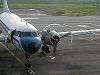
The researchers will take three sets of flights out of Australia's Casey Station in an upgraded Douglas DC-3 aircraft.
Though Casey Station belongs to Australia, it is on the Windmill Islands and is "perched on the edge of the massive Antarctic ice cap," according to the Australian Antarctic Division. Casey is 2,410 miles (3,880 kilometers) due south of Perth, southwest Australia.
The team chose the DC-3 because it offers greater fuel efficiency than heavy cargo planes and better range than lighter planes.
The DC-3 first hit the skies in 1935 and is credited with making passenger airlines profitable. Its military version, the C-47, also proved useful in transporting troops and cargo during World War II, according to Boeing, which merged with McDonnell Douglas in 1997.
"We're getting much more science done with less oil using this old airframe with modern engines," said Don Blankenship, a research scientist at the University of Texas' Institute for Geophysics.
Added Siegert, "This is quite a robust aircraft. It's been used in Antarctica quite often."
Previous attempts to research the area covered only about 40 percent of the ice sheet. Those efforts stopped in the 1970s, Siegert said.
"I guess everyone thought we'd return one day," he said. "I don't think anybody realized it would take us 30 years."
The research can resume now, he said, because the Australians built an airstrip near Casey that they can use for the project, he said.
As they fly over the area, the researchers will use high-resolution radar and other instruments to measure the thickness of the ice and the composition, density and texture of the rocks beneath it.
In addition to helping researchers analyze past climate change, the project will also help them forecast sea level changes.
"The data that we collect should provide a lot more detail of what caused past climate shifts, why there appears to be more ice loss from glaciers at present, and give us real clues to what may happen in the coming decades," Siegert said.
It will take three Antarctic summers to chart the areas, beginning in December with the eastern section. The eastern area is believed to have the thickest ice on the continent -- perhaps up to 3 miles thick.
The next flights will be in 2009-2010 and in 2010-2011.
Funding for the project comes from Britain's Natural Environmental Research Council, the U.S. National Science Foundation, the Australian Antarctic Division and UT-Austin.
Found it here:
http://edition.cnn.com/2008/TECH/scienc ... ca.basins/


 Login
Login Register
 FAQ
FAQ Search