All
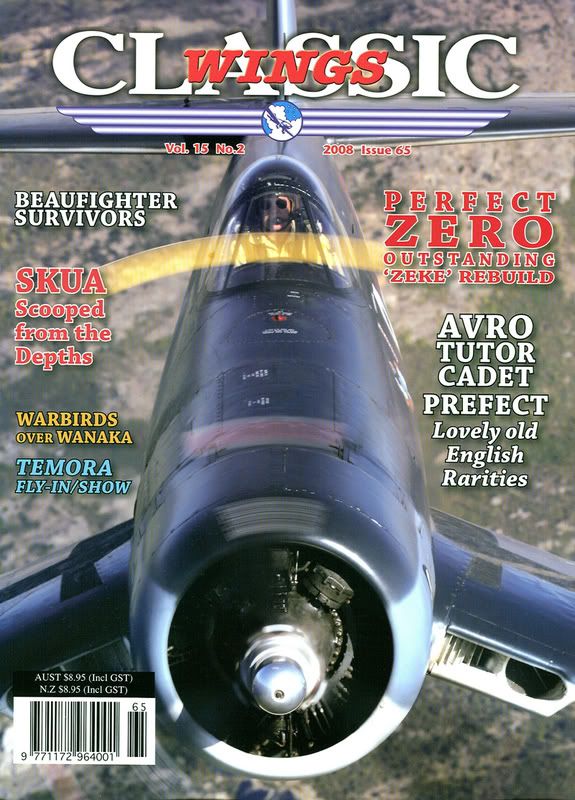
Latest magazine is out, features as follows:
A PERFECT ZERO!
When anyone is asked to name a Japanese fighter aircraft you can almost guarantee that ‘Zero’ will be the answer, and for many that is as far as their knowledge extends on the subject. Japanese types have tended to take a backseat, particularly when compared to their Allied and German counterparts, and this apathy seems to have extended as far back as the post-war years, which saw relatively few examples put aside for preservation. With only one genuine Zero flying today collectors have had to settle with totally rebuilt aircraft powered by American engines to full the void. Most have started with recovered remains which are good for patterns, and totally rebuilt the aircraft, having to remanufacture thousands of parts, costing vast amounts of time and money.
One of the most exquisite machines to be reborn in this way is Zero ‘1498’ currently owned by Warren Pietsch of Minot, North Dakota - the story of this aircraft’s completion and colours is the subject of this article.
OPERATION SKUA
The ungainly Skua achieved a degree of fame when, on 10th April 1940, twenty aircraft attacked and sank the German cruiser ‘Königsberg’ at Bergen. This was the first time a major warship had been sunk by aircraft. However this success was soon tempered when squadrons suffered heavy losses in an attack on the capital ships ‘Scharnhorst’ and ‘Admiral Hipper’ at Trondheim on 13th June, in what would become known as ‘Black Thursday.’ Eight out of fifteen aircraft were lost in the attack including both squadron commanders, whose aircraft ditched at Geitastand, nearby Trondheim. It is this machine that was the focus of a recovery effort by the Norwegians, it being one of two aircraft shot down and sought by the Bodø museum in order that a complete example might be rebuilt for display. This article describes that effort and the results that will eventually see at least one of these unsung types grace a museum floor.
BEAUFIGHTER SURVIVORS
The subject of our ‘Mystery Aircraft’ in Issue 60 we are now able to present a comprehensive survivor listing following the input of Rob Greinert who sorts out some of the ongoing confusion regarding the machines of Australian origin. The list is complimented by some wonderful 'then and now' photographs. Few of these powerful machines survive, although as has been shown in previous news items others have been discovered relatively intact in the waters off Greece and Norway, so there is at least the possibility that we maybe able to add to the list sometime in the future!
AVRO CADET-RARE AS HEN'S TEETH!
Well almost! The Avro Tudor / Cadet family was never built in large numbers so it isn't surprising that relatively few survive. One of the first types we focused on after launching Classic Wings back in 1994, the editor was keen to explore just how many machines, be they derelicts in barns, crash wreckage or accumulated parts, had the likelihood of being resurrected. As a result we are thrilled to be able to generate the first 'survivors list' of this series showing that there are 17 aircraft remaining, five of which have returned to the skies. With these and other changes to the disposition of the remaining machines, we decided to revisit the story, which is complimented by period photos and lovely air to airs.
AIR SHOWS
WARBIRDS OVER WANAKA
TEMORA FLY-IN



 Login
Login Register
 FAQ
FAQ Search